Xbee Controlled, Granite-wrapped Clock Travels Into Future

From the looks of it this clock is a couple of months ahead of its time. [Oscar] built the clock (translated) taking time to add a lot of goodies into the mix. First up, the parts you see include six large 7-segment displays for hours, minutes, and seconds as well as an LED marquee which can scroll messages. Inside there’s a temperature and humidity sensor for environmental feedback, and an Xbee module which allows for wireless computer control. Time is kept by a DS1307 real-time clock, which is read by an Arduino Uno, then pushed to the display by the pair of I2C addressable SAA1064 drivers. The whole thing was enclosed in four sheets of granite for the box, and a pane of glass for the front. We sure hope it’s well anchored to that wall. You can see it ticking away after the break.

Continue reading “Xbee Controlled, Granite-wrapped Clock Travels Into Future”
Embedding An Accelerometer And XBee In A Guitar

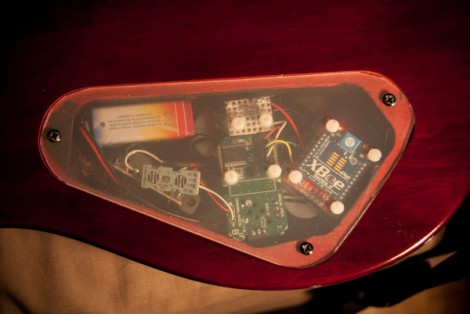
[JP Carrascal] hacked his guitar by adding motion control while removing the need for wires. He’s using a dual-Arduino system with an Mini Pro inside the guitar and a Duemilanova for the receiver connected to a computer. Wireless is provided by the XBee module seen above and a gutted Wii remote accelerometer is in there for motion sensing. Check out the artfully blurry demonstration of the motion effects after the break.

While he added some potentiometer-based controls there is also an automatic power-down feature. [JP] replaced the mono pickup with a stereo one and used the extra conductor as a switch to activate the additional electronics. We wonder if he also winds his own pickups or builds his own effects pedals.

Continue reading “Embedding An Accelerometer And XBee In A Guitar”

Wearable XBee Morse Code Keyer

xbeeglove

NYC Resistor hosted a wearable wireless workshop today. It was taught by [Rob Faludi] and [Kate Hartman]. They brought along their recently released LilyPad XBee breakout boards. The goal of the class was to use the digital radios to build wireless communication gloves. Above, you can see the conductive thread sewn into the fingertips to key the device. The signal is transmitted to the other glove, which flashes an indicator LED so you can communicate using Morse code.

This Week In Security: No More CVEs, 4chan, And Recall Returns

The sky is falling. Or more specifically, it was about to fall, according to the security community this week. The MITRE Corporation came within a hair’s breadth of running out of its contract to maintain the CVE database. And admittedly, it would be a bad thing if we suddenly lost updates to the central CVE database. What’s particularly interesting is how we knew about this possibility at all. An April 15 letter sent to the CVE board warned that the specific contract that funds MITRE’s CVE and CWE work was due to expire on the 16th. This was not an official release, and it’s not clear exactly how this document was leaked.

Many people made political hay out of the apparent imminent carnage. And while there’s always an element of political maneuvering when it comes to contract renewal, it’s worth noting that it’s not unheard of for MITRE’s CVE funding to go down to the wire like this. We don’t know how many times we’ve been in this position in years past. Regardless, MITRE has spun out another non-profit, The CVE Foundation, specifically to see to the continuation of the CVE database. And at the last possible moment, CISA has announced that it has invoked an option in the existing contract, funding MITRE’s CVE work for another 11 months.

Continue reading “This Week In Security: No More CVEs, 4chan, And Recall Returns”

Pulling Apart An Old Satellite Truck Tracker

Sometimes there’s nothing more rewarding than pulling apart an old piece of hardware of mysterious origin. [saveitforparts] does just that, and recently came across a curious satellite system from a surplus store. What else could he do, other than tear it down and try to get it humming? 

The device appeared to be satellite communication device for a tracking unit of some sort, complete with a long, thick proprietary cable. That led to a junction box with a serial port and an RJ45 port, along with some other interfaces. Disassembly of the unit revealed it contained a great deal of smarts onboard, including some kind of single-board computer. Comms-wise, it featured a cellular GPRS interface as well as an Orbcomm satellite modem. It also packed in GPS, WiFi, Xbee, Ethernet, and serial interfaces. It ultimately turned out to be a Digi ConnectPort X5 device, used as a satellite tracking system for commercial trucks.

What’s cool is that the video doesn’t just cover pulling it apart. It also dives into communicating with the unit. [saveitforparts] was able to power it up and, using the manufacturer’s software, actually talk to the device. He even found the web interface and tested the satellite modem.

Ultimately, this is the kind of obscure industry hardware that most of us would never come into contact with during our regular lives. It’s neat when these things show up on the secondary market so hackers can pull them apart and see what makes them tick. Video after the break.

Continue reading “Pulling Apart An Old Satellite Truck Tracker”

Linux Fu: Kernel Modules Have Privileges

I did something recently I haven’t done in a long time: I recompiled the Linux kernel. There was a time when this was a common occurrence. You might want a feature that the default kernel didn’t support, or you might have an odd piece of hardware. But these days, in almost all the cases where you need something like this, you’ll use loadable kernel modules (LKM) instead. These are modules that the kernel can load and unload at run time, which means you can add that new device or strange file system without having to rebuild or even restart the kernel.

Normally, when you write programs for Linux, they don’t have any special permissions. You typically can’t do direct port I/O, for example, or arbitrarily access memory. The kernel, however, including modules, has no such restriction. That can make debugging modules tricky because you can easily bring the system to its knees. If possible, you might think about developing on a virtual machine until you have what you want. That way, an errant module just brings down your virtual machine. Continue reading “Linux Fu: Kernel Modules Have Privileges”

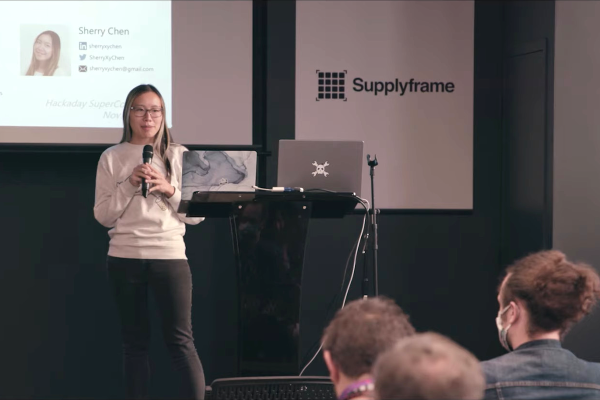
Supercon 2022: All Aboard The SS MAPR With Sherry Chen

How do you figure out what is in a moving body of water over a mile wide? For those in charge of assessing the water quality of the Delaware river, this is a real problem. Collecting the data required to evaluate the water quality was expensive and time-consuming, taking over six years. Even then, the data was relatively sparse, with just a few water quality stations and only one surface sample for every six miles of river.

Sherry Chen, Quinn Wu, Vanessa Howell, Eunice Lee, Mia Mansour, and Frank Fan teamed up to create a solution, and the SS MAPR was the result. At Hackaday Supercon 2022, Sherry outlined the mission, why it was necessary, and their journey toward an autonomous robot boat. What follows is a fantastic guide and story of a massive project coming together. There are plans, evaluations, and tests for each component.

Sherry and the team first started by defining what was needed. It needed to be cheap, easy to use, and able to sample from various depths in a well-confined bounding box. It needed to run for four hours, be operated by a single person, and take ten samples across a 1-mile (2 km) section of the river. Some of the commercial solutions were evaluated, but they found none of them met the requirements, even ignoring their high costs. They selected a multi-hull style boat with off-the-shelf pontoons for stability and cost reasons.
Continue reading “Supercon 2022: All Aboard The SS MAPR With Sherry Chen”