An optical keyboard that works using IR LEDs and phototransistors.

Take A Look At This Optical Keyboard

Making keyboards is easy, right? Just wire up a bunch of switches matrix-style to a microcontroller, slap some QMK and a set of keycaps on there and you’re good to go. Well, yeah, that might work for cushier environments like home offices and Hackaday dungeons, but what if you need to give input under water, in a volatile area, or anywhere else you’d have to forego the clacking for something hermetically sealed? Mechanical switches can only take you so far — at some point, you have to go optical.

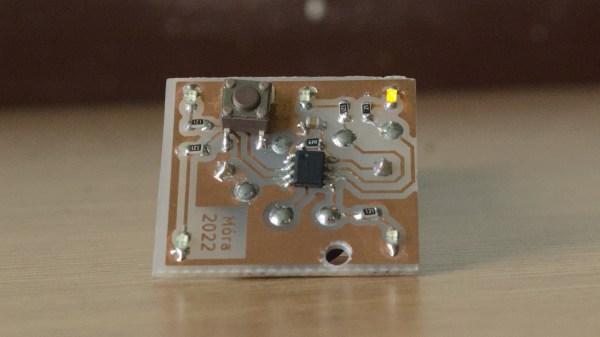
the layers of an optical keyboardThis gorgeous keyboard works with reflected IR beams to determine when a finger is occupying a given key site (because what else are you going to call them?). Each key site has an IR LED and a phototransistor and it works via break-beam.

[BenKoning] wanted a solution that would be easy for others to build, with a low-cost BOM and minimal software processing cost. It just so happens to be extremely good-looking, as well.

The reason you can’t see the guts is that black layer — it passes infrared light, but is black to the eye. The frosted layer diffuses the beams until a finger is close enough to register. Check it out in action after the break, and then feed your optical key switch cravings with our own [Bob Baddeley]’s in-depth exploration of them.

Continue reading “Take A Look At This Optical Keyboard”

3D Printed Scooter Zips Around

Tooling around downtown on a personal electric vehicle is a lot of fun, but it is even better when you do like [James Dietz] and ride on your own 3D-printed electric scooter. As one of the entries for the Hackaday Prize, RepRaTS (Replicable Rapid prototyper Transportation System) has a goal of doing for scooters what the original RepRap project did for 3D printing: provide a user-friendly design base that you can extend, modify, and maintain. It doesn’t even require power tools to build, other than, of course, your 3D printer.

The design uses threaded rods and special plastic spacers made to hold a large load. The prototype is deliberately oversized with large hub motors, with the understanding that most builds will probably be smaller. As you can see in the video below, the scooter seems to go pretty fast and handles well.

Continue reading “3D Printed Scooter Zips Around”

a variety of enclosure options

The Many Ways To Solve Your Enclosure Problems

Most projects around here involve some sort of electronics, and some sort of box to put them in. The same is true of pretty much all commercially available electronic products as well.

Despite that, selecting an enclosure is far from a solved problem. For simple electronics it’s entirely possible to spend more time getting the case just right than working on the circuit itself. But most of the time we need to avoid getting bogged down in what exactly will house our hardware.

The array of options available for your housing is vast, and while many people default to a 3D printer, there are frequently better choices. I’ve been around the block on this issue countless times and wanted to share the options as I see them, and help you decide which is right for you. Let’s talk about enclosures!

Continue reading “The Many Ways To Solve Your Enclosure Problems”

Samsung tablet with custom side loaded hack software

Smart Home Hack Breaks Down Walls Figuratively And Literally

Are you ready for a tale of poorly supported hardware, clueless contractors, and bad coding? Look no further than [Neighborino]’s excellent write-up where he details his pursuit of smart home pwnership.

[Neighborino]’s smart home system controls the windows, blinds, outlets, and HVAC. But by the time the high-rise apartment was ready for occupancy in 2015, the smart home controllers were already showing their age. You see, the contractor had installed an app to run the home’s programmable logic controllers (PLCs) on stock Galaxy Tab 3 hardware. Yes, that’s a tablet originally released in 2013. They then built the tablets into the wall of each apartment, dooming the homeowner to rely on the vendor forevermore.

It was not long before [Neighborino] and their fellow residents were dealing with stability problems. Bloatware from both Samsung and Google was causing major slowdowns, and the PLC system’s unpublished WiFi password prevented replacement of the controllers.

Being an Android developer by trade, [Neighborino] set siege to the walled garden before him. The writeup details the quest to execute what would be a straightforward hack on anything but the x86 hardware that was being targeted.

de-bloating app strips all non-essential software.
A debloating app strips all non-essential software.

The first fruit of [Neighborino]’s efforts was a hack for the aged tablets that would display the WiFi password, allowing owners to connect their own controllers to their smart homes. Of course, this is Hackaday, so you know that [Neighborino] didn’t stop there.

Despite having to deal with two different versions of Android and tablets that were built into the wall of the apartments of non-hacker neighbors, [Neighborino] succeeded in sideloading an APK. This freed them from the shackles of the company that installed the original system and gets longer life out of their Snowden-era Samsungs. A de-bloating tool frees up memory and restores the systems to a nearly performant status. A reboot scheduler keeps the x86 tablets running without user intervention, and of course the WiFi password revealer makes yard waste out of the previously walled garden.

If Smart Home hacks are your thing, we recently covered a Voice Controlled Smart Home setup, and less recently another that combined a Smart Home with a Dumb Terminal. Be sure to share your own smart home hacks with us via the Tip Line!

Angry antibodies

Monoclonal Antibodies: The Guided Missiles Of Medicine

Whenever anyone mentions the word “antibodies” these days, it’s sure to grab your attention. Thoughts generally flow to the human immune system and the role it plays in the ongoing COVID-19 pandemic, and to how our bodies fight off disease in general. The immune system is complex in the extreme, but pretty much everyone knows that antibodies are part of it and that they’re vital to the ability of the body to recognize and neutralize invaders like bacteria and viruses.

But as important as antibodies are to long-term immunity and the avoidance of disease, that’s far from all they’re good for. The incredible specificity of antibodies to their target antigens makes them powerful tools for biological research and clinical diagnostics, like rapid COVID-19 testing. The specificity of antibodies has also opened up therapeutic modalities that were once the stuff of science-fiction, where custom-built antibodies act like a guided missile to directly attack not only a specific protein in the body, but sometimes even a specific part of a protein.

Making these therapies work, though, requires special antibodies: monoclonal antibodies. These are very much in the news recently, not only as a possible treatment for COVID-19 but also to treat everything from rheumatoid arthritis to the very worst forms of cancer. But what exactly are monoclonal antibodies, how are they made, and how do they work?

Continue reading “Monoclonal Antibodies: The Guided Missiles Of Medicine”

Bringing A Ruined Game Boy Cart Back To Life With Tons Of Soldering

Retro consoles and handhelds are full of nostalgia and happy memories for many. However, keeping these machines and their media going can be a difficult job at times. [Taylor] was challenged to rescue a copy of Kirby’s Dream Land for the original Game Boy, and set about the task.

The cartridge was badly corroded, with many of the traces eaten through, rendering the game inoperable. First, all the components were removed, and the board was cleaned. This allowed easy access to the traces across the whole board. Then, the job was to delicately remove some solder mask from the parts of the traces still remaining, and bridge the gaps with fine copper wire. Even worse, several vias were damaged, which [Taylor] tackled by feeding jumper wires through the board and executing a repair on each side.

It’s a simple enough repair for the experienced hand, but virtually magic to a retro gaming fan that doesn’t know how to solder. [Taylor] has given us a great example of how to deal with corroded carts properly, with enough detail to be quite educational to the beginner.

We’ve seen other great work in this vein too, like an Amiga 2000 brought back from a horrible creeping green death. If you’ve done your own retro rescue, be sure to drop us a line!

Continue reading “Bringing A Ruined Game Boy Cart Back To Life With Tons Of Soldering”

German Experiment Shows Horses Beating Local Internet Connections

These days, we’re blessed with wired and wireless networks that can carry huge amounts of data in the blink of an eye. However, some areas are underprovisioned with bandwidth, such as Schmallenberg-Oberkirchen in Germany. There, reporters ran a test last December to see which would be faster: the Internet, or a horse?

The long and the short of it is that Germany faces issues with disparate Internet speeds across the country. Some areas are well-served by high-speed fiber services. However, others deemed less important by the free market struggle on with ancient copper phone lines and subsequently, experience lower speeds.

Thus, the experiment kicked off from the house of photographer [Klaus-Peter Kappest], who started an Internet transfer of 4.5GB of photos over the Internet. At the same time, a DVD was handed to messengers riding on horseback to the destination 10 kilometers away. The horses won the day, making the journey in about an hour, while the transfer over [Kappest’s] copper connection was still crawling along, only 61% complete.

Obviously, it’s a test that can be gamed quite easily. The Internet connection would have easily won over a greater distance, of course. Similarly, we’ve all heard the quote from [Andrew Tanenbaum]: “Never underestimate the bandwidth of a station wagon full of tapes hurtling down the highway.”

Notably, [Kappest’s] home actually had a fiber line sitting in the basement, but bureaucracy had stymied any attempts of his to get it connected. The stunt thus also served as a great way to draw attention to his plight, and that of others in Germany suffering with similar issues in this digital age.

Top speeds for data transfer continue to rise; an Australian research team set a record last year of 44.2 terabits per second. Naturally, the hard part is getting that technology rolled out across a country. Sound off below with the problems you’ve faced getting a solid connection to your home or office.