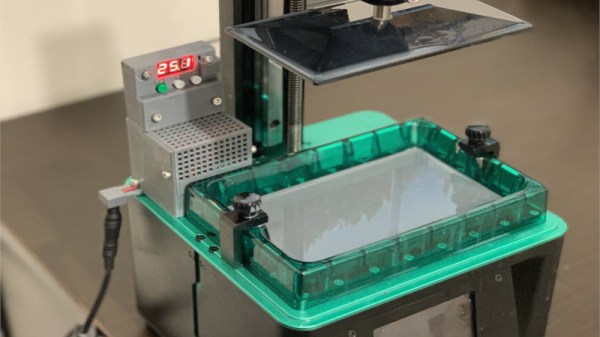
Resin printers can offer excellent surface finish and higher detail than other 3D printing technologies, but they come with their own set of drawbacks. One is that they’re quite sensitive to temperature, generally requiring the resin chamber to be heated to 25-30 degrees Celsius for good performance. To help maintain a stable temperature without a lot of mucking around, [Grant] put together a simple chamber heater for his printer at home.
Rather than go for a custom build from scratch with a microcontroller, [Grant] was well aware that off-the-shelf solutions could easily do the job. Thus, a W1209 temperature control board was selected, available for under $5 online. Hooked up to a thermocouple, it can switch heating elements via its onboard relay to maintain the set temperature desired. In this case, [Grant] chose a set of positive-temperature coefficient heating elements to do the job, installing them around the resin chamber for efficiency.
The heater can preheat the chamber in under fifteen minutes, much quicker than other solutions using space heaters or heat mats. The time savings will be much appreciated by [Grant], we’re sure, along with the attendant increase in print quality. If you’re still not sure if resin printing is for you, have a read of our primer. And, if you’ve got your own workflow improvements for resin printing, drop us a line!
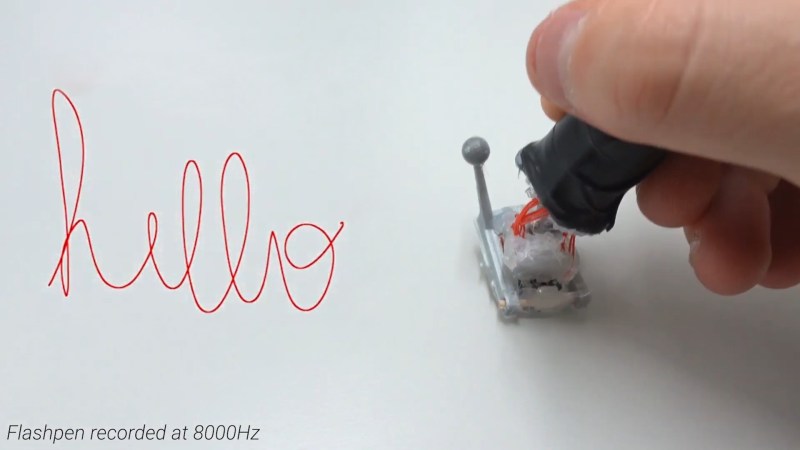
 The fundamental technology behind the pen is simple, with the device using an optical flow sensor harvested from a high-end gaming mouse. This is a device that uses an image sensor to detect the motion of the sensor itself across a surface. Working at an update rate of 8 KHz, it eclipses other devices in the market from manufacturers such as Wacom that typically operate at rates closer to 200Hz. The optical sensor is mounted to a plastic joint that allows the user to hold the pen at a natural angle while keeping the sensor parallel to the writing surface. There’s also a reflective sensor on the pen tip which allows cameras to track its position in space, for use in combination with VR technology.