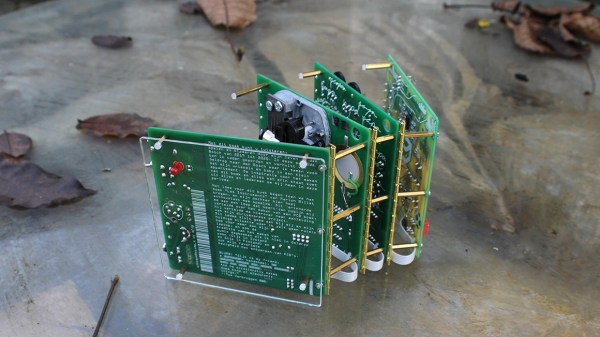
A PCB Diary

[Gijs Gieskes] has made another eye-catching PCB wonder, this time a diary built from several circuit boards which are assembled into a book, not unlike a PC/104 system. But with [Gijs]’s system you can easily open the stack-up to access single boards without disassembling the whole thing. We don’t see brass piano hinges on PCB assemblies very often, but [Gijs]’s PCB designs are anything but conventional. Hint: if you wanted to recreate this technique using more ordinary hardware, you can find hinged PCB standoffs from various suppliers.
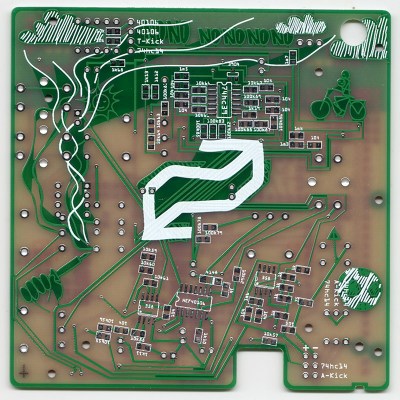
Bicycle, soccer ball, smoke on the “No no no no no…” PCB

Apparently it’s more than a passive piece of art.  Each board has several circuits, some of which (all?) are functioning is ways not clearly described, which seems to be intentional. According to his build log, different things happen when you mix and match the inter-board ribbon cables in various ways. We are told in the instructions “to just try and see what happens”. No schematics are posted, but there is a partial description of the circuits in the manual and parts on the two-layer boards are well-labeled. Although after spot checking a few circuits board photos, we’d guess that no small number of traces, and perhaps some parts, are wild goose chases.

The project claims to be a diary for the years 2018 and 2019, but we will leave it as an exercise for the reader to interpret the messages that [Gijs] has embedded into this fascinating piece. We have written about several of his projects over the years, such as this crazy bent Casio SK-1 from all the way back in 2005. And before dismissing this “book” style of circuit board stack-up as only for artists, check out this teardown of a Soyuz clock we covered back in January.
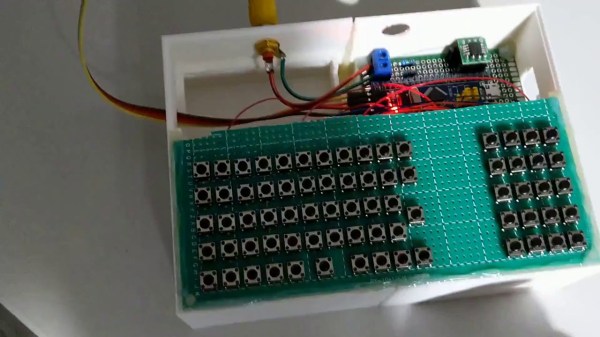
PET 2001 Emulator On $2 Of Hardware

Since the late 60s, Moore’s law has predicted with precision that the number of semiconductors that will fit on a chip about doubles every two years. While this means more and more powerful computers, every year, it also means that old computers can be built on smaller and cheaper hardware. This project from [Bjoern] shows just how small, too, as he squeezes a PET 2001 onto the STM32 Blue Pill.

While the PET 2001 was an interesting computer built by Commodore this project wasn’t meant to be a faithful recreation, but rather to test the video output of the Blue Pill, with the PET emulation a secondary goal. It outputs a composite video signal which takes up a good bit of processing power, but the PET emulation still works, although it is slightly slow and isn’t optimized perfectly. [Bjoern] also wired up a working keyboard matrix as well although missed a few wire placements and made up for it in the software.

With his own home-brew software running on the $2 board, he has something interesting to display over his composite video output. While we can’t say we’d emulate an entire PC just to get experience with composite video, we’re happy to see someone did. If you’d like to see a more faithful recreation of this quirky piece of computing history, we’ve got that covered as well.

Continue reading “PET 2001 Emulator On $2 Of Hardware”

CentOS Is Dead, Long Live CentOS

On Tuesday, December 8th, Red Hat and CentOS announced the end of CentOS 8. To be specific, CentOS 8 will reach end of life at the end of 2021, 8 years ahead of schedule. To really understand what that means, and how we got here, it’s worth taking a trip down memory lane, and looking at how the history of Red Hat Enterprise Linux (RHEL), CentOS, and IBM are intertwined.

Continue reading “CentOS Is Dead, Long Live CentOS”

Who Says Solder Paste Stencils Have To Be CNC Cut?

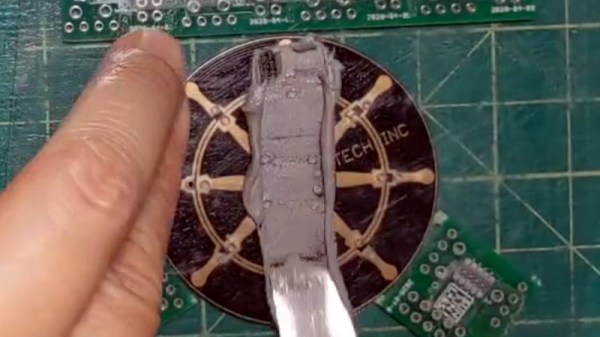
Imagine having a surface mount kit that you’d like to stencil with solder paste and reflow solder, but which doesn’t come with a solder stencil. That was what faced [Honghong Lu], and she rose to the challenge by taking a piece of PET sheet cut from discarded packaging and hand-cutting her own stencil. It’s not a huge kit, the Technologia Incognita 2020 kit, but her home-made stencil still does an effective job.

So how does one create a solder stencil from household waste? In the video we’ve put below the break, she starts with her packaging, and cuts from it a square of PET sheet. It’s 0.24mm thick, which is ideal for the purpose. She then lays it over the PCB and marks all the pads with a marker pen, before cutting or drilling the holes for the pads. The underside is then sanded to remove protruding swarf, and the stencil can then be used in the normal way. She proves it by stenciling the solder paste, hand placing the parts, and reflowing the solder on a hotplate.

It’s clear that this is best suited to smaller numbers of larger components, and we’ll never use it to replace a laser-cut stencil for a thousand tiny 0201 discretes. But that’s not the point here, it’s an interesting technique for those less complex boards, and it’s something that can be tried by anyone who is curious to give stenciling and reflowing a go and who doesn’t have a project with a ready-cut stencil. And for that we like it.

Making your own stencils doesn’t have to include this rather basic method. They can be etched, or even 3D printed.

Continue reading “Who Says Solder Paste Stencils Have To Be CNC Cut?”

Hyperloop: Fast, But At What Cost?

When it comes to travelling long distances, Americans tend to rely on planes, while the Chinese and Europeans love their high speed rail. However, a new technology promises greater speed with lower fares, with fancy pods travelling in large tubes held at near-vacuum pressures. It goes by the name of Hyperloop.

Virgin Hyperloop recently ran the first-ever passenger test of a Hyperloop vehicle, reaching 100 mph on a short test track.

Spawned from an “alpha paper” put together by Elon Musk in 2013, the technology is similar to other vactrain systems proposed in the past. Claiming potential top speeds of up to 760 mph, Hyperloop has been touted as a new high-speed solution for inter city travel, beating planes and high speed rail for travel time. Various groups have sprung up around the world to propose potential routes and develop the technology. Virgin Hyperloop are one of the companies at the forefront, being the first to run a pod on their test track with live human passengers, reaching speeds of 100 mph over a short 500 meter run.

It’s an exciting technology with a futuristic bent, but to hit the big time, it needs to beat out all comers on price and practicality. Let’s take a look at how it breaks down.

Continue reading “Hyperloop: Fast, But At What Cost?”

Mind-Controlled Beer Pong Gets Easier As You Drink

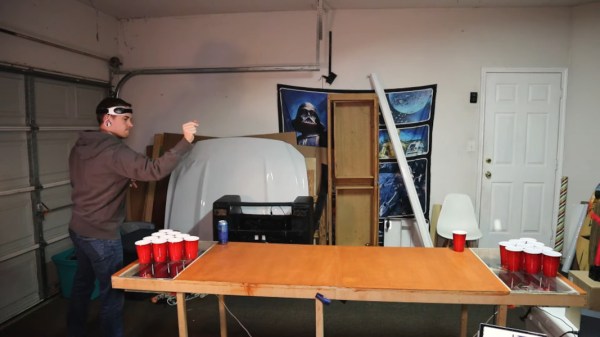
Wouldn’t it be nice if beer pong could somehow get easier the more you drink? You know, so you can drink more? [Ty Palowski] has made it so with automated, mind-controlled beer pong.

[Ty] started by making a beer pong table that moves the cups back and forth at both ends. An Arduino Nano controls a stepper that controls a slider, and the cups move with the slider through the magic of magnets. The mind control part came cheaper than you might think. Back in 2009, Mattel released a game called Mind Flex that involves an EEG headset and using brain waves to guide a foam ball on a stream of air through a little obstacle course. These headsets are available for about $12 on ebay, or at least they were before this post went up.

[Ty] cracked open the headset added an HC-06 Bluetooth module to talk to the Arduino. It’s using a program called Brainwave OSC to get the raw data from the headset and break it into levels of concentration and relaxation. The Arduino program monitors the attention levels, and when a certain threshold of focus is reached, it moves the cups back and forth at a predetermined speed ranging from 1 to an impossible-looking 10. Check out the two videos after the break. The first one covers the making of the the automatic beer pong part, and the second is where [Ty] adds mind control.

We’ve seen a different headset — the hacker-friendly NeuroSky Mindwave — pop up a few times. Here’s one that’s been hacked to induce lucid dreaming.

Continue reading “Mind-Controlled Beer Pong Gets Easier As You Drink”

North American Field Guide To Rail Cars

Trains are one of the oldest and most reliable ways we have of transporting things and people over long distances. But how often do you think about trains? Where I live, they can clearly be heard every hour or so. I should be used to the sound of them by now, but I like it enough to stop what I’m doing and listen to the whistles almost every time. In the early morning quiet, I can even hear the dull roar as it rumbles down the track.

I recently got a front row seat at a railroad crossing, and as the train chugged through the intersection, I found myself wondering for the hundredth time what all the cars had in them. And then, as I have for the last twenty or thirty years, I wondered why I never see a caboose anymore. I figured it was high time to answer both questions.


Image via GBX

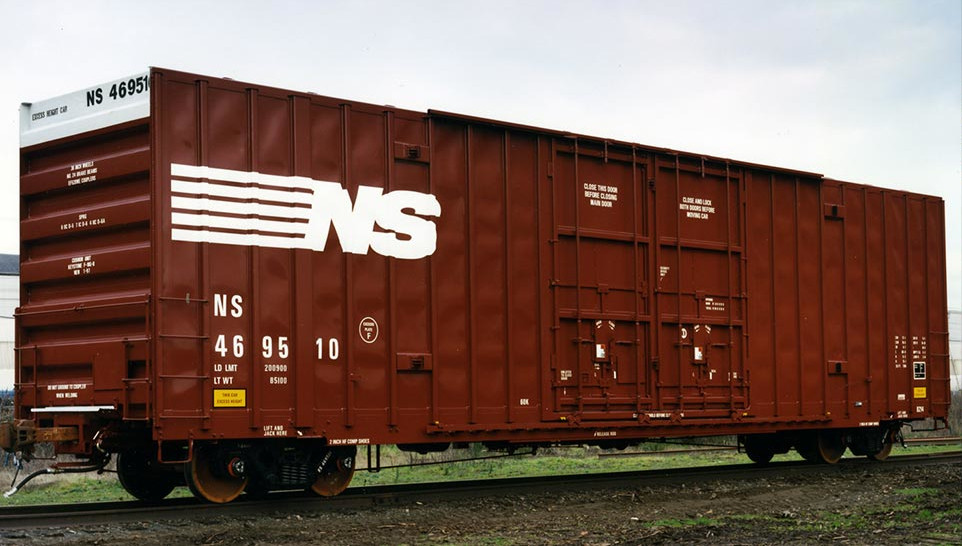
Boxcar

Boxcars are probably the most easily identifiable after the engine and the caboose.

Boxcars carry crated and palletized freight like paper, lumber, packaged goods, and even boxes. Refrigerated box cars carry everything from produce to frozen foods.

Boxcars (and barns for that matter) are traditionally a rusty red color because there were few paint options in the late 1800s, and iron-rich dirt-based paint was dirt cheap.


Flat car with bulkheads. Image via YouTube

Flat Car

Standard, no-frills flat cars are the oldest types of rail cars. These are just big, flat platform cars that can carry anything from pipe, rail, and steel beams to tractors and military vehicles.

Flat cars come in different lengths and are also made with and without bulkheads that help keep the cargo in place. Some flat cars have a depression in the middle for really tall or heavy loads, like electrical transformers.


Image via Ship Cars Now

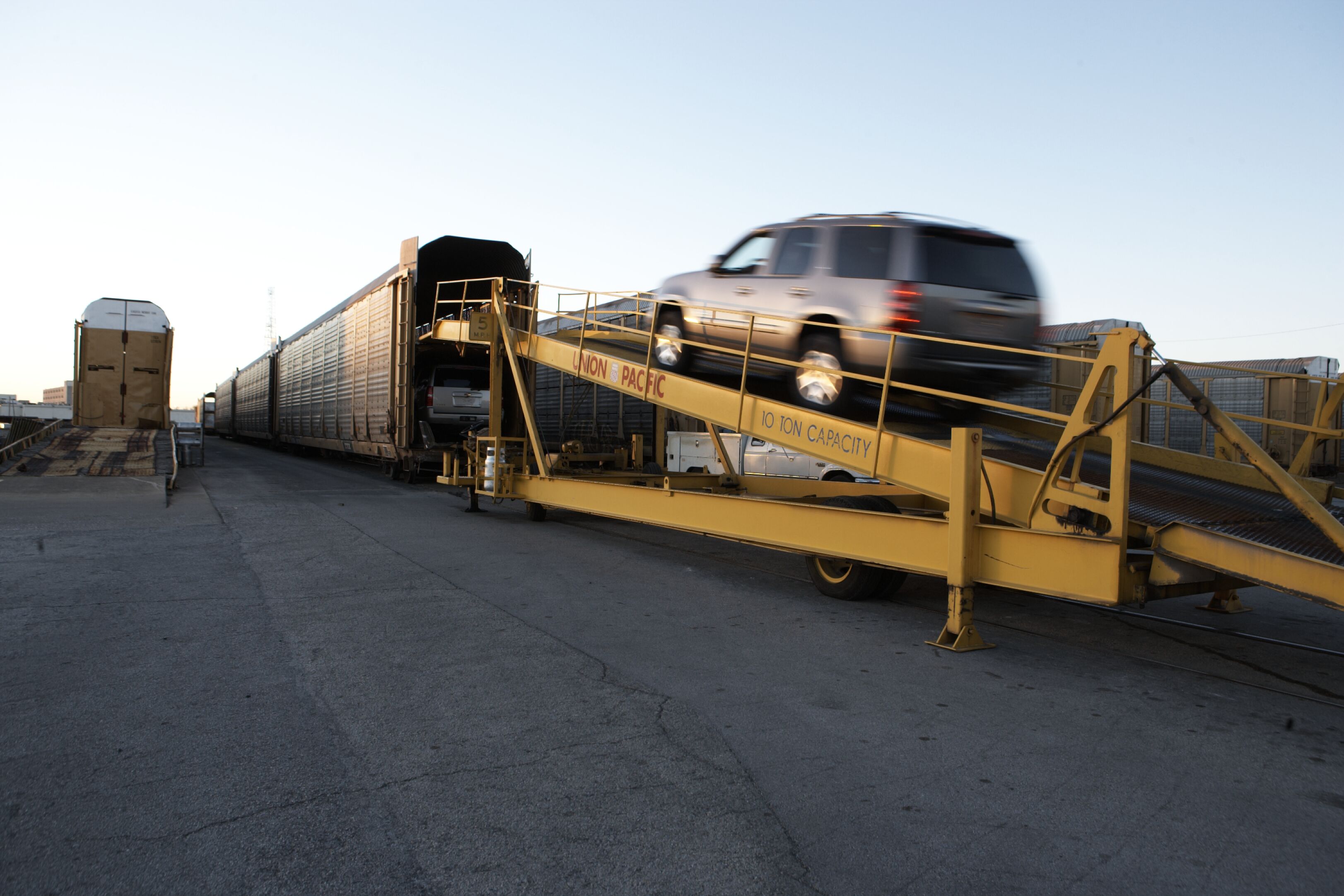
Auto Rack

As the name implies, auto racks carry passenger cars, trucks, and SUV from factories to distributors. They come in two- and three-level models, although there have been specialized auto racks over the years.

Perhaps the strangest auto rack of them all was the Vert-a-Pac. When Chevrolet came up with the Vega in the gas-conscious 1970s, they wanted to be able to move them as cheaply as possible, so they shipped the cars on end. If you’re wondering about all the fluids in the car when they were upended, a special baffle kept oil from leaking out, the batteries were capped, and the windshield washer fluid bottle was positioned at an angle.

Continue reading “North American Field Guide To Rail Cars”