You’ve built a brand new project, and it’s a wonderful little thing that’s out and about in the world. The only problem is, you need to know its location to a decent degree of accuracy. Thankfully, GPS is a thing! With an off-the-shelf module, it’s possible to get all the location data you could possibly need. But how do you go about it, and what parts are the right ones for your application? For the answers to these questions, read on! Continue reading “How To Choose The Right GPS Module For Your Project”
Hackaday Podcast 080: Trucks On A Wire, Seeing Sounds, Flightless Drone, And TEA Laser Strike
Hackaday editors Elliot Williams and Mike Szczys flip through the index of great hacks. This week we learn of a co-existence attack on WiFi and Bluetooth radios called Spectra. The craftsmanship in a pneumatic drone is so awesome we don’t care that it doesn’t fly. Building a powerful TEA laser is partly a lesson in capacitor design. And join us in geeking out at the prospect of big rigs getting their juice from miles of overhead wires.
Take a look at the links below if you want to follow along, and as always, tell us what you think about this episode in the comments!
Direct download (60 MB or so.)
$5 Lets Your Documents Go Virtual
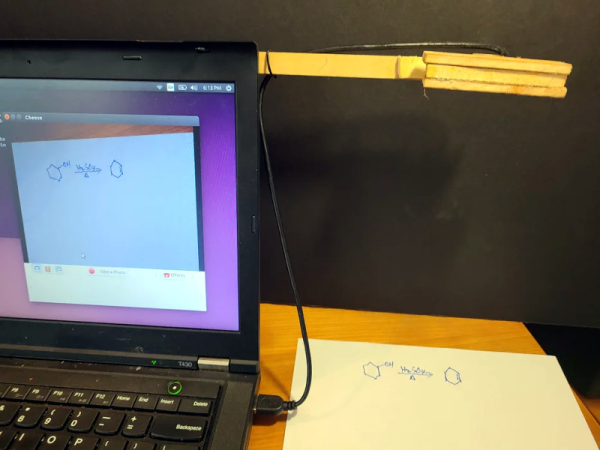
Video conferencing is nothing new, but the recent world events have made it much more mainstream than it has been in the past. Luckily, web camera technology is nothing new and most software can also show your screen. But what about your paper documents? Turns out that [John Nelson] can show you how to spend $5 for an old laptop camera module and put your documents center stage on your next Zoom, Skype or other video conferences.
This is especially good for things that would be hard to draw in real time during a conference like a quick sketch, a schematic, or as you can see in the post and the video demo below, chemical molecule diagrams.
This Week In Security: DEF CON, Intel Leaks, Snapdragon, And A Robot Possessed
Last weekend, DEF CON held their “SAFE MODE” conference: instead of meeting at a physical venue, the entire conference was held online. All the presentations are available on the official DEF CON YouTube channel. We’ll cover a few of the presentations here, and watch out for other articles on HaD with details on the other talks that we found interesting.
Continue reading “This Week In Security: DEF CON, Intel Leaks, Snapdragon, And A Robot Possessed”
Robotic Arm Sports Industrial Design, 3D-Printed Cycloidal Gears
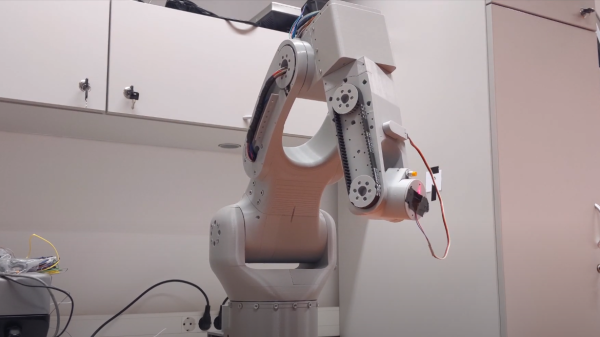
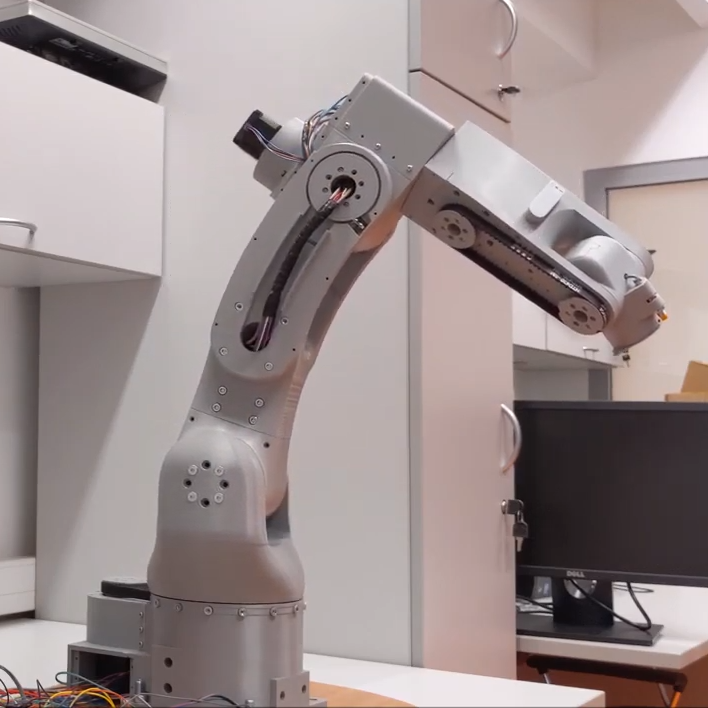
[Petar Crnjak]’s Faze4 is a open source robotic arm with 3D printable parts, inspired in part by the design of industrial robot arms. In particular, [Petar] aimed to hide wiring and cables inside the arm as much as possible, and the results look great! Just watch it move in the video below.
Cycloidal gearboxes have been showing up in robotic arm projects more and more, and Faze4 makes good use of them. Why cycloidal gears? They are readily 3D printed and offer low backlash, which makes them attractive for robotic applications. There’s no need to design cycloidal gears from scratch, either. [Petar] found this cycloidal gear generator in OnShape extremely useful when designing Faze4.
The project’s GitHub repository has all the design files, as well as some video demonstrations and a link to assembly documentation for anyone who would like to make their own. Watch Faze4 go through some test movements in the video embedded below.
Continue reading “Robotic Arm Sports Industrial Design, 3D-Printed Cycloidal Gears”
Moving Fridge Magnets Make For Unique Clock
We see a ton of clock projects around these parts, and being hackers, we love to feature them all. But every once in a while we stumble upon a great new way to display the time that really gets our attention and requires a closer look, such as this moving fridge magnet clock.
The fridge magnets [Craig Colvin] built this unique clock around are the colorful plastic kinds that have adorned the lower regions of refrigerators in toddler-filled households for ages. Instead of residing on a fridge, [Craig] laminated a sheet of white acrylic to a thin sheet of steel, to give the magnets something to hold onto. Moving the numbers is the job of a CoreXY-style mechanism. The belt-driven Cartesian movement maneuvers a head to to the right location to pick up a number; a servo in the head moves two powerful magnets into position under the number. The head then moves the number to the right spot, releases its magnets, and the number stays put on the board. You can see it in action in the video after the break.
While we love this as it is, it brings to mind some great mods. One can imagine the addition of letters to make a legit word clock, or to just add a calendar display. We’d also love to see these magnets in their natural habitat by building this into the door of a working fridge.
Continue reading “Moving Fridge Magnets Make For Unique Clock”
PIC32 DMA Is A Weird Machine
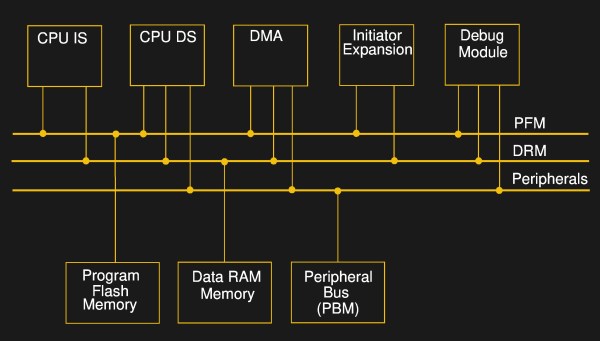
Direct memory access (DMA) systems in computers are more powerful than you might think, and [Bruce Land] and [Joseph Primmer] have done some clever hacking to take full advantage of this on the PIC32 microcontrollers. This is a cool proof-of-concept hack — you can do general computing in the DMA subsystem without using the CPU at all if you don’t mind taking your time — but they also include two useful examples: a direct digital synthesis machine and a random number generator. Both of these run using exactly 0% CPU time.
How do they do it? DMA is a mechanism for shuttling data around in memory or between hardware peripherals without involving the CPU. Say you want to take a large block of memory containing music, and spit it out slowly to an I2S audio converter. A DMA subsystem could be configured to take an interrupt from the sound chip, pass it a chunk of data, increment the data pointer, and wait for the next interrupt.
The gimmick, which goes back at least to [Rushanan] and [Checkoway]’s “Run DMA” paper, is that you can modify the memory source and destination addresses of one DMA service from another DMA service, and that some registers automatically perform mathematical operations on whatever data is put into them. Combine these together, and you’ve got transport-triggered programming.
(An awesome side-note: our own [Al Williams] developed a one-instruction transport-triggered CPU way back in the day: the One Instruction Wonder.)
What is this good for? Writing simple helper applications that run independent of the CPU on a PIC32 microcontroller. [Land] and [Primmer]’s direct-digital synthesis example is a great one. But there are a lot of cases where you simply want to take in some new data and pre-process it a little bit before it enters the main program flow. While creating weird machines in the DMA engine might be a slower way to get it done, it keeps the CPU free for doing other stuff. We’re sure you’ll come up with something.