A USB-C Bench Power Supply

A bench power supply is one of those things that every hacker needs, and as the name implies, it’s intended to occupy a place of honor on your workbench. But with the addition of USB-C support to his DPH5005 bench supply, [Dennis Schneider] is ready to take his on the road should the need ever arise.

The build started with one of the common DPH5005 bench power supply kits, which [Dennis] says he was fairly happy with aside from a few issues which he details in the post on his blog. Even if you aren’t looking to modify your own kit with the latest and greatest in the world of Universal Serial Bus technology, it’s interesting to read his thoughts on the power supply kit if you’ve been considering picking one up yourself.

Under normal circumstances you are supposed to give the DPH5005 DC power via the terminals on the back panel of the supply, which in turn is regulated and adjusted via the front panel controls. To add support for USB-C, all [Dennis] had to do was install a USB-PD trigger module configured to negotiate 20 VDC in the back of the case and connect it to the DC input. To hold it in place while isolating it from the metal case, he used a piece of scrap PCB carefully cut and wrapped in Kapton tape.

This actually isn’t the first portable bench power supply we’ve seen. Last year we saw one that got its input power from Makita portable tool batteries, but we think all things considered, the USB-C option is probably a bit more convenient.

Axiom, A 100+kW Motor Controller For Making Big Motors Move

We’ve seen a lot of motor driver boards for robots and the odd electric skateboard. What we haven’t see a lot of is one big enough to drop into an electric vehicle. 

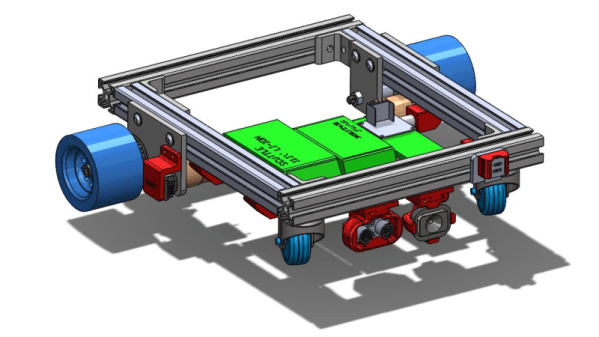
The Axiom motor controller was a winner of the bootstrap contest and is a Finalist in the 2019 Hackaday Prize. The driver aims to deliver 300A continuous at 400V all day long. Which is a very impressive amount of power from a board that appears to be quite compact.

The brains of the device is an ice40 FPGA from Lattice running software based on the VESC Project. Its open source roots will certainly allow for some interesting hacks and an increasingly stable platform over time. Not to mention the existing software tools will aid in the sometimes cumbersome motor-driver tuning process.

The board designs are available, but we agree with the team that the complexity of assembly is likely going to be high (along with the price). The amount of research and skill going into this complicated kit is a bit mind-boggling, but we hope it will really enable some cool hacks, from cars, to ATVs, and maybe even an electric flyer.

Gigantic FPGA In A Game Boy Form Factor, 2019 Supercon Badge Is A Hardware Siren Song

Look upon this conference badge and kiss your free time goodbye. The 2019 Hackaday Superconference badge is an ECP5 FPGA running a RISC-V core in a Game Boy form factor complete with cartridge slot that is more open than anything we’ve ever seen before: multiple open-source CPU designs were embedded in an open system, developed using the cutting-edge in open-source FPGA tools, and running (naturally) open-source software on top. It’s a 3,000-in-one activity kit for hardware people, software people, and everyone in between.

The brainchild of Jeroen Domburg (aka Sprite_TM), this design has been in the works since the beginning of this year. For more than 500 people headed to Supercon next week, this is a source of both geeky entertainment and learning for three action-packed days and well beyond. Let’s take a look at what’s on the badge, what you need to know to hack it, and how the design serves as a powerful development tool long after the badge hacking ceremonies have wrapped up.

Continue reading “Gigantic FPGA In A Game Boy Form Factor, 2019 Supercon Badge Is A Hardware Siren Song”

Circuit Sculpture Hack Chat

Join us on Wednesday, November 6 at noon Pacific for the Circuit Sculpture Hack Chat with Mohit Bhoite!

For all the effort engineers put into electronic design, very few people ever get to appreciate it. All the hard work that goes into laying out a good PCB and carefully selecting just the right components is hidden the moment the board is slipped into an enclosure, only to be interacted with again through a user interface that gets all the credit for the look and feel of the product.

And yet there are some who design circuits purely as works of art. They may do something interesting or useful, but function is generally secondary to form for these circuit sculptors. Often consisting of skeletons of brass wire bent at precise angles to form intricate structures, circuit sculptures are the zen garden of electronic design: they’re where the designer turns to quiet the madness of making deadlines and meeting specs by focusing on the beauty of components themselves and putting them on display for all to enjoy.

By day, our host Mohit designs and builds hardware at Particle. By night, however, the wires and pliers come out, and he makes circuit sculptures that come alive. Check out his portfolio; you won’t be disappointed. This Hack Chat will be your chance to find out everything that goes into making these sculptures. Find out where Mohit gets his inspiration, learn his secrets for such precise, satisfyingly crisp wire-bending, and see what it takes to turn silicon into art.

join-hack-chat

Our Hack Chats are live community events in the Hackaday.io Hack Chat group messaging. This week we’ll be sitting down on Wednesday, November 6 at 12:00 PM Pacific time. If time zones have got you down, we have a handy time zone converter.

Click that speech bubble to the right, and you’ll be taken directly to the Hack Chat group on Hackaday.io. You don’t have to wait until Wednesday; join whenever you want and you can see what the community is talking about. Continue reading “Circuit Sculpture Hack Chat”

Improbably Cheap Pocket Welder Gets An ESP32 Makeover

If you move in certain shady circles, you may have noticed the crop of improbably cheap “pocket welders” popping up on the market these days. They’re all variations on a theme, most with wildly optimistic specs minimal accessories of the lowest possible quality. But their tiny size and matching price make them irresistible to the would-be welder, as well as attractive to hardware hackers.

With a 220-V outlet in the garage waiting to be filled and well-knowing the risks, [Mr. RC-Cam] purchased one of these diminutive welding machines. Its shortcomings were immediately apparent, and a complete rework of the welder was undertaken. After addressing safety issues like the lack of a ground connection, [Mr. RC-Cam] added a color-matched 3D-printed hood to house a fancy new LCD touchscreen display. Backing that up is an ESP32 with Bluetooth, which supports remote control via a key fob. He also added a current sense board that uses the welder’s current shunt to measure welding current. Expediently calibrated using a waffle iron and a milli-ohmmeter, the sensor showed that the 200A max advertised for the welder was more like 100A. He tried adding some big electrolytics to fix the current issues, but no dice. With a decent stinger and ground clamp, the modified welder is good enough for his needs, and much was learned in the process. We call that a hacking win.

As an aside, [This Old Tony] recently did a review on a similar welder if you want more details on the internals. We also covered the conversion of a buzz-box to a TIG welder recently, should that be more your style.

Continue reading “Improbably Cheap Pocket Welder Gets An ESP32 Makeover”

How Smart Are AI Chips, Really?

The best part about the term “Artificial Intelligence” is that nobody can really tell you what it exactly means. The main reason for this stems from the term “intelligence”, with definitions ranging from the ability to practice logical reasoning to the ability to perform cognitive tasks or dream up symphonies. When it comes to human intelligence, properties such as self-awareness, complex cognitive feats, and the ability to plan and motivate oneself are generally considered to be defining features. But frankly, what is and isn’t “intelligence” is open to debate.

What isn’t open to debate is that AI is a marketing goldmine. The vagueness has allowed for marketing departments around the world to go all AI-happy, declaring that their product is AI-enabled and insisting that their speech assistant responds ‘intelligently’ to one’s queries. One might begin to believe that we’re on the cusp of a fantastic future inhabited by androids and strong AIs attending to our every whim.

In this article we’ll be looking at the reality behind these claims and ponder humanity’s progress towards becoming a Type I civilization. But this is Hackaday, so we’re also going to dig into the guts of some AI chips, including the Kendryte K210 and see how the hardware of today fits into our Glorious Future. Continue reading “How Smart Are AI Chips, Really?”

ESP32 Makes Great MPPT Controller In Low-Cost Solar Installation

Solar power projects have become, in general, a matter of selecting components like panels and batteries, hooking them together with industry-standard connectors, and sitting back to watch the free electricity flow. As such, solar projects have become a bit boring, so it’s not often we see one that attracts our attention the way this dirt-cheap open-source solar project does.

The backstory on [Tim O’Brien]’s DIY off-grid PV system starts with his desire to charge his eWheel, which amounts to a battery-powered standing unicycle. They look like a fun option for getting around an urban environment if you have the requisite degree of coordination, which we clearly lack. But charging something like that or an eBike is a great use case for solar, especially since [Tim] happened upon a 450W PV panel on the cheap. Sadly, the panel was a commercial unit, and compatible off-the-shelf MPPT, or maximum power-point tracking, controllers are expensive.

His solution was to build his own controller using a cheap DC-DC converter that just so happens to have serial remote control. An ESP32 monitors the panel voltage and controls the buck converter to run whatever he wants. When he’s not charging his eWheel, the system runs his laptop and router. As a bonus, the ESP32 talks to IoT services like Adafruit.io and Thingspeak, allowing him to track MPPT data without shipping it off to parts unknown.

While we appreciate a DIY MPPT controller and like [Tim]’s build, we feel like the documentation needs a bit of fleshing out. With solar installations, the devil is in the details, and not addressing seemingly mundane issues like cable routing and connector installation can lead to disaster.