A CNC Hacked Together In Pajamas

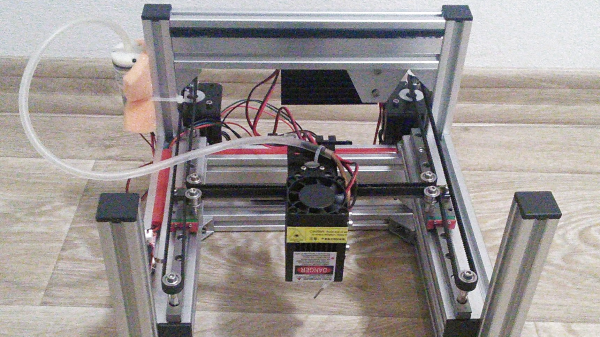
Sometimes you just gotta sit down and hack something together. Forget the CAD and the cool software toys; just hammer away until you have something working. That’s how [bobricus] ended up with this cute little laser engraver anyway.

For under $300 US of parts and a few nights working in his pajamas, the aptly named, pajama micro laser engraver is a pretty nice little machine for its class. Not having the space for a full size machine and not necessarily needing its capabilities he aimed to produce something compact.

The frame is aluminium extrusion, the movement is core-XY an H-bot on linear rails, and it appears to just be a grbl board with a Chinese laser module on it. He took a bit of care to make the frame a cube which allows him to easily vent the fumes from the little unit. There’s even a small air pump to blow the off-gas from the cutting away from the laser.

All in all a nice little hack useful for all sorts of things from solder masks to cutting wood veneers. You can see it zipping around in the video after the break.



Continue reading “A CNC Hacked Together In Pajamas”

Josephine Peary, First Lady Of The Arctic

In the late nineteenth century, there was only one Earthly frontier left to discover: the North Pole. Many men had died or gone insane trying to reach 90°N, which, unlike the solidly continental South Pole, hides within a shifting polar sea.

One of history’s most driven Pole-seekers, Robert Peary, shocked the world when he announced that his wife Josephine would accompany him on his expedition to Greenland. The world responded, saying that she, a Washington socialite with no specialized training, had absolutely no business going there. But if it weren’t for Jo’s contributions, Robert would probably have never made it to the Pole, or even out of Greenland. Sewing and cooking skills may not seem like much, but they are vital for surviving in the Arctic climate. She also hunted, and managed the group’s Inuit employees.

Josephine Peary was more than just the woman behind the man. An Arctic explorer in her own right, she spent three winters and eight summers on the harsh and unforgiving frontier. Back at home, her Arctic accounts painted a picture of a frozen and far-off world that most could only wonder about. Jo’s writing career brought in expedition money for her husband, which sometimes turned into bailout money.

Josephine Peary, DC debutante. Image via Bowdoin College

Woman About Washington

Josephine Cecilia Diebitsch was born May 22nd, 1863 to German immigrant parents who encouraged her to explore the world. Her father, Hermann, was a linguist at the Smithsonian Institute. Because of his position, the Diebitsch family rubbed elbows with much of high society. Though Jo was raised to be a Victorian lady and upheld those values, she had progressive ideas about what women could do with themselves in addition to being wives and mothers.
Continue reading “Josephine Peary, First Lady Of The Arctic”

Peep These Ultra-Real 3D-Printed Eyeballs

For humans, life is in the eyes. Same deal with automatons. The more realistic the eyes, the more lifelike (and potentially disturbing) the automaton is. [lkkalebob] knows this. [lkkalebob] is so dedicated to ocular realism in his ultra-real eyeballs that he’s perfected a way to make the minuscule veins from a whisper of cotton thread.

First he prints an eyeball blank out of ABS. Why ABS, you ask? It has a semi-translucence that makes it look that much more real. Also, it’s easier to sand than PLA. After vigorous sanding, it’s time to paint the iris and the apply the veins. [lkkalebob] shaves strands of lint from red cotton thread and applies it with tweezers to smears of super glue.

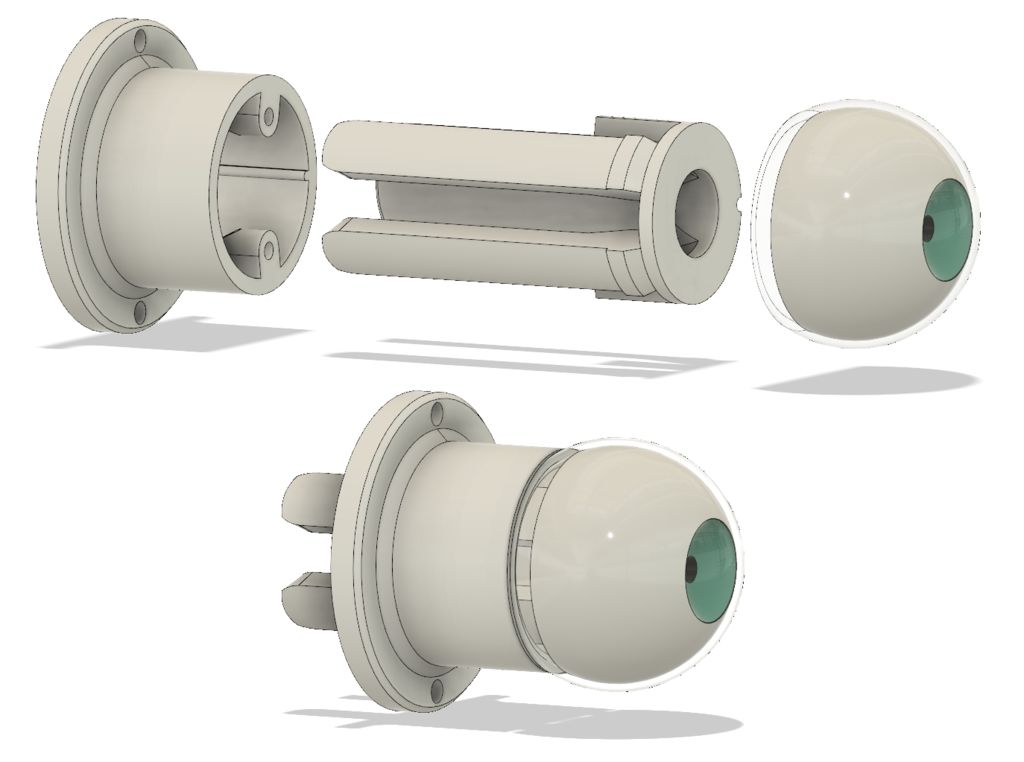
Here comes our favorite part. To make the whole process easier, [lkkalebob] designed a jig system that takes the eyeballs all the way through the stages of fabrication and into the sockets of the automaton. The hollow eye cups pressure fit on to prongs that hold it in place. This also gives the eyeball a shaft that can be chucked into a drill for easy airbrushing. In the build video after the break, he uses the eye-jig to cast a silicone mold, which he then uses to seal the eyes in resin.

Don’t have a printer or any desire to make human automata? It doesn’t take much to make mesmerizing mechanisms.

Continue reading “Peep These Ultra-Real 3D-Printed Eyeballs”

The Basics Of Persistence Of Vision Projects

Persistence of Vision (POV) is a curious part of the human visual system. It’s the effect by which the perception of an image lingers after light has stopped entering the eye. It’s why a spinning propeller appears as a disc, and why a burning sparkler appears to leave a trail in the air. It’s also commonly used as a display technology, where a series of flashing LEDs can be used to create messages that appear to float in the air. POV displays are a popular microcontroller project, and today, we’ll explore the basic techniques and skills required in such builds.

Continue reading “The Basics Of Persistence Of Vision Projects”

Planting 20 Million Trees, Using Drones, Cannons, And More Unconventional Ways

When YouTuber MrBeast hit 20 million subscribers, it kicked off the promise to plant 20 million new trees by 2020. While seeming rather mad for a single person to attempt such a feat, the channel has begun an organized effort under the banner of ‘Team Trees‘. With many famous and less famous YouTubers and other online personalities pitching in, along with a number of companies and organizations, it seems like it’s not as far-fetched of an idea as it first seemed.

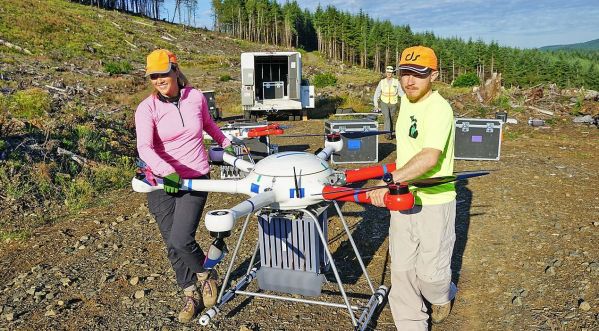
We’ve embedded MrBeast’s video after the break where you’ll also find a video by Mark Rober, who teamed up a company called DroneSeed, who use large flying drones to distribute seeds contained in nutrition pods over large areas. Their focus is on reforestation after large wildfires and other events that leave the land devoid of trees. Of course, this being seeds, it will take quite a while for results to become visible.

The impatient Canadians over at Linus Media Group figured that they’d rather plant tree seedlings at a breakneck pace, cobbling together a nitrogen cannon that fires a nutrition pellet into the soil, creating the hole for the seedling, or alternately firing the pellet and seedling into the soil in one go from the breach-loading cannon. Obviously the results from the latter method are decidedly more questionable, taking a bit chunk out of the about 300 seedlings they were planning to add to the local nature.

Regardless of the method chosen, any significant reforestation around the world could be a crucial part of reducing the global increase of atmospheric CO2, and the climate challenges this creates.  With sources putting the total number of trees in the world today at about 3 trillion, 20 million more doesn’t seem like a lot, yet techniques we’re learning today to speed up the process of reforestation might play a major role in the near future.

Continue reading “Planting 20 Million Trees, Using Drones, Cannons, And More Unconventional Ways”

Unix Tell All Book From Kernighan Hits The Shelves

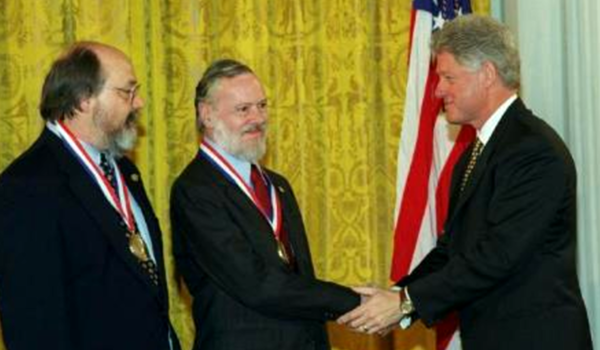
When you think of the Unix and C revolution that grew out of Bell Labs, there are a few famous names. Dennis Ritchie, Ken Thompson, and Brian Kernighan come to mind. After all, the K in both K&R C and in AWK stand for Kernighan. While Kernighan is no stranger to book authorship — he’s written several classics including “the white book” for C and Unix — he has a new book out that is part historical record and part memoir about the birth of Unix.

Usually, when a famous person writes a retrospective like this, it is full of salacious details, but we don’t expect much of that here. The book talks about Bell Labs and Multics, of course. There’s serious coverage of the first, sixth, and seventh editions with biographies of people integral to those releases.

Continue reading “Unix Tell All Book From Kernighan Hits The Shelves”

Simple Seismic Sensor Makes Earthquake Detection Personal

When an earthquake strikes, it’s usually hard to miss. At least that’s the case with the big ones; the dozens or hundreds of little quakes that go largely unnoticed every day are interesting too, and make sense to track. That’s usually left to the professionals, with racks of sensitive equipment and a far-flung network of seismic sensors. That doesn’t mean you can’t keep track of doings below your feet yourself, with something like this DIY seismograph.

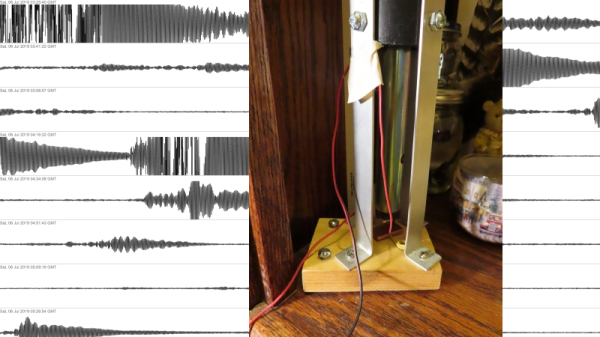
Technically, what [Alex] built is better called a “seismic detector” since it’s not calibrated in any way. It’s just a simple sensor for detecting ground vibrations, whether they be due to passing trucks or The Big One. [Alex] lives in California, wedged between the Hayward, Calaveras, and San Andreas faults in San Jose, so there is plenty of opportunity for testing his device. The business end is a simple pendulum sensor, with a heavy metal bob hanging from a long wire inside a length of plastic pipe. Positioned close to the bob is a copper plate; the bob and the plate form an air-dielectric variable capacitor that controls the frequency of a simple 555 oscillator. The frequency is measured by a PIC microcontroller and sent to a Raspberry Pi, which displays the data on a graph. You can check in on real-time seismic activity in San Jose using the link above, or check out historical quakes, like the 7.1 magnitude Ridgecrest quake in July. [Alex]’s sensor is sensitive enough to pick up recent quakes in Peru, Fiji, and Nevada, and he even has some examples of visualizing the Earth’s core using data from the sensor. How cool is that?

We’ve seen other seismic detectors before, like this piezo-based device, or even one made from toilet parts. We like the simplicity of the capacitive sensor [Alex] used, though.