New Contest: Flexible PCBs

The now-humble PCB was revolutionary when it came along, and the whole ecosystem that evolved around it has been a game changer in electronic design. But the PCB is just so… flat. Planar. Two-dimensional. As useful as it is, it gets a little dull sometimes.

Here’s your chance to break out of Flatland and explore the third dimension of circuit design with our brand new Flexible PCB Contest.

We’ve teamed up with Digi-Key for this contest. Digi-Key’s generous sponsorship means 60 contest winners will receive free fabrication of three copies of their flexible PCB design, manufactured through the expertise of OSH Park. So now you can get your flex on with wearables, sensors, or whatever else you can think of that needs a flexible PCB.

Continue reading “New Contest: Flexible PCBs”

Door Springs And Neopixels Demonstrate Quantum Computing Principles

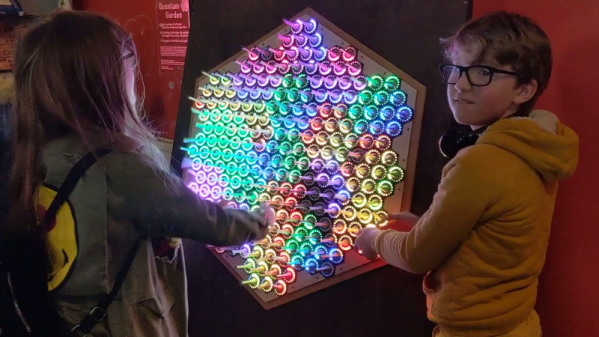
They may be out of style now, and something of a choking hazard for toddlers, but there’s no denying that spring doorstops make a great sound when they’re “plucked” by a foot as you walk by. Sure, maybe not on a 2:00 AM bathroom break when the rest of the house is sleeping, but certainly when used as sensors in this interactive light show.

The idea behind [Robin Baumgarten]’s “Quantum Garden” is clear from the first video below: engaging people through touch, sound, and light. Each of the 228 springs, surrounded by a Neopixel ring, is connected to one of the 12 inputs on an MPR121 capacitive touch sensor. The touch sensors and an accelerometer in the base detect which spring is sproinging and send that information to a pair of Teensies. A PC then runs the simulations that determine how the lights will react. The display is actually capable of some pretty complex responses, including full-on games. But the most interesting modes demonstrate principles of quantum computing, specifically stimulated Raman adiabatic passage (STIRAP), which describes transfers between quantum states. While the kids in the first video were a great stress test, the second video shows the display under less stimulation and gives a better idea of how it works.

We like this because it uses a simple mechanism of springs to demonstrate difficult quantum concepts in an engaging way. If you need more background on quantum computing, [Al Williams] has been covering the field for a while. Need the basics? Check out [Will Sweatman]’s primer.

Continue reading “Door Springs And Neopixels Demonstrate Quantum Computing Principles”

1 Trillion USD Refund! (PDF Enclosed)

Security researchers have found that it is possible to alter a digitally signed PDF without invalidating its signatures. To demonstrate it, they produced a fake document “refund order” of $1,000,000,000,000 dollars, with a valid signature from Amazon. This sparked my attention, since I was quite sure that they didn’t use some sort of quantum device to break the cryptography involved in the signing process. So what exactly is going on?

The researchers claim to found at least three different ways to, in their words:

… use an existing signed document (e.g., amazon.de invoice) and change the content of the document arbitrarily without invalidating the signatures. Thus, we can forge a document signed by invoicing@amazon.de to refund us one trillion dollars.

That’s not good news if you take into account that the main purpose of digitally signing a document is, well, prevent unauthorized changes in that document. The good news is that you can update your software to fix this flaws because of this research; the main PDF readers companies were given time to fix the issues. The bad news is that if you rely on the signature verification for any sensitive process, you likely want to go back and see if you were using vulnerable software previously and check that documents were correctly validated. I’m thinking about government institutions, banks, insurance companies and so on.

The implications are yet to be seen and probably won’t even be fully known.

There are three classes of attacks that work on different software. I’ll try to go into each one from what I could tell from reading the research.

Continue reading “1 Trillion USD Refund! (PDF Enclosed)”

Hacking The IPod Nano Display: Beautiful!

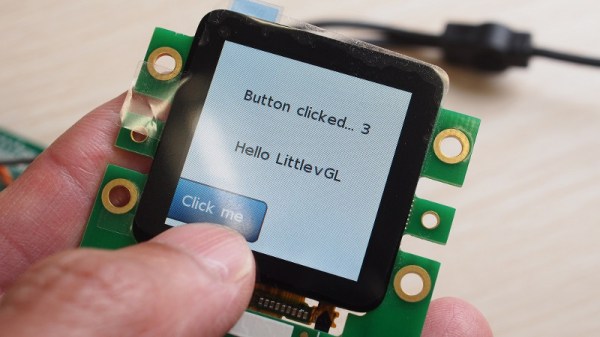
The 6th Generation iPod Nano was something of a revelation on launch. Packing a color screen, audio hardware, and a rechargable battery into a package no bigger than a large postage stamp remains impressive to this day. They’re now being used in various maker projects for their displays, but if you’re doing so, you might want to think about how you’re going to build a graphical interface. Not to worry – just grab an ESP32 and the right GUI library, and you’re on your way.

The Nano screen uses a MIPI DSI interface, which isn’t the easiest thing to use directly with the ESP32. Instead, a SSD2805 interface chip converts parallel input data to MIPI DSI signals to drive the display. Driving the display is only part of the game, however – you need something to display on it. Combining the LittlevGL GUI library with the screen’s touchpad makes creating a full graphical interface easy.

Hacked screens are something we don’t see as much these days, with the proliferation of display products aimed directly at the maker market. However, it’s always awesome to see a successful hack pulled off well. We’ve seen the display reverse engineered, too – and it certainly wasn’t easy.


The Strangest Gameboy Emulator We’ve Seen Yet

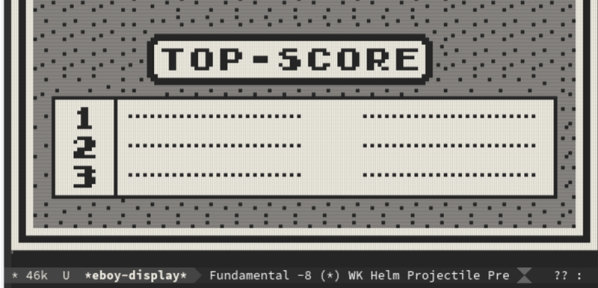
In the secret Hackaday bunker, we have some emacs users, some vi users, and some people who don’t really care. However, even the staunchest of our emacs supporters had to do a double take at [Vreeze’s] project that creates a GameBoy emulator using the venerable text editor. You can see [Alexei Nunez’s] reaction to the emulator in the video below.

The Eboy uses unicode characters to output the graphics. You can use emacs commands to load ROM images and use your keyboard to control the game.

Continue reading “The Strangest Gameboy Emulator We’ve Seen Yet”

3D Printing Photos Is Slow But Awesome

Historically speaking, lithophanes are images made in porcelain with an etching or moulding process, in which an image is visible when backlit due to the varying thickness of the material. Porcelain isn’t the easiest thing to work with, but thankfully for those of us in the present, 3D printers are here to make everything better. [RCLifeOn] has been experimenting with printing lithophanes with great results.

The trick to printing a good lithophane is all in the preparation. It’s important to pick an image that looks good in greyscale, as this is not a process that reproduces color in any way. [RCLifeOn] then discusses the finer points of printer setup to get a nice looking print. Layer heights should be as small as possible to avoid visible vertical bands, and the lithophane should be printed in a vertical orientation, to avoid the print sagging due to a lack of support.  Infill is best set to 100%. Most importantly, the printer should avoid crossing the outline of the print to avoid any stringy plastic artifacts spoiling the final product.

It’s a great guide that should help even a 3D printing novice create a great print with the minimum of fuss. A lithophane can make a wonderful gift and is also a good test of a printer’s capabilities, due to the fine detail required. We’ve seen them produced before too, in a wonderful lightbox configuration. Video after the break.

Continue reading “3D Printing Photos Is Slow But Awesome”

Tech Imitates Life: Fireflies Make Better Light Bulbs

While we often think we are clever designers, living things often meet or beat the best human designs. It is easy to forget that nature even has living lightbulbs, among them the firefly. Researchers from Penn State decided to compare how fireflies create light and found that they deal with a problem similar to LEDs. The insight may lead to an increase in efficiency for LEDs, which is currently about 50%.

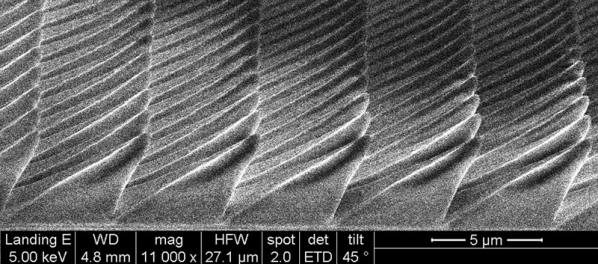
The problem is that some light generated never gets out of the LED (or the firefly’s body). Some light inevitably reflects back into the device. One known mitigation for this is creating a tiny texture pattern on the LED surface which allows more light to escape. These are typically a V-shaped structure etched into the surface. This isn’t news to the firefly, however, which has similar structures on their lanterns as do some other light-generating animals (apparently glowing cockroaches are a thing). However, the organic structures differ from LED textures in an important way.

Continue reading “Tech Imitates Life: Fireflies Make Better Light Bulbs”