Firework Shows, The Vintage Atari Way

In the summer of 1987, the Atari magazine ST-Log caried a piece entitled “Atari Sets Off Fireworks!”, a profile of the use of Atari computers in professional firework displays by Astro Pyrotechnics, a now-defunct California company. Antic podcast host [Kevin Savetz] tracked down the fireworks expert interviewed in 1987, [Robert Veline], and secured not only an interview, but a priceless trove of photographs and software. These he has put online, allowing us a fascinating glimpse into the formative years of computerized pyrotechnics.

The system uses not one, but two Ataris. An ST has all the display data and scheduling set up in the Zoomracks card file software, this is then exported to an 800XL which does the work of running the display. We’re told the code for the 800XL is loaded on a ROM cartridge for reliability. The 800XL is mounted in an aluminium briefcase with a small CRT monitor and battery, and a custom interface board stuffed with TO220 power transistors to fire the pyrotechnics themselves.

It’s unlikely that you’ll be breaking out a vintage Atari yourselves to fun a firework show three decades later, but the opportunity to examine in detail a real-world contemporary commercial use of a now-vintage computer doesn’t come along too often. You can read the original article on the Internet Archive, and listen to the [Veline] interview on the podcast episode.

This is the first Atari firework controller we’ve brought you, but we’ve shown you plenty of others like this beautifuly-executed Arduino build. And if you wonder how to trigger the fireworks themselves, how about destroying a resistor?

Building A Better Baby Bottle Boiler

[Sebastian Foerster] hasn’t been at his blog in a while. He and his wife just had twins, so he’s been busy standing waiting for formula or milk to warm up. Being a technical kind of guy, he took a look at the tools currently on the market to do this, analyzed them, and decided instead to do it himself.

[Sebastian] looked to his Nespresso Aeroccino – a milk frother designed to give you hot or cold frothy milk for the top of whatever beverage you decide to put it on top of. It made the milk a bit too hot, 60°C, but once it got to the temperature, it would shut off, so if [Sebastian] could get it to shut off at a lower temperature, he had found the solution!

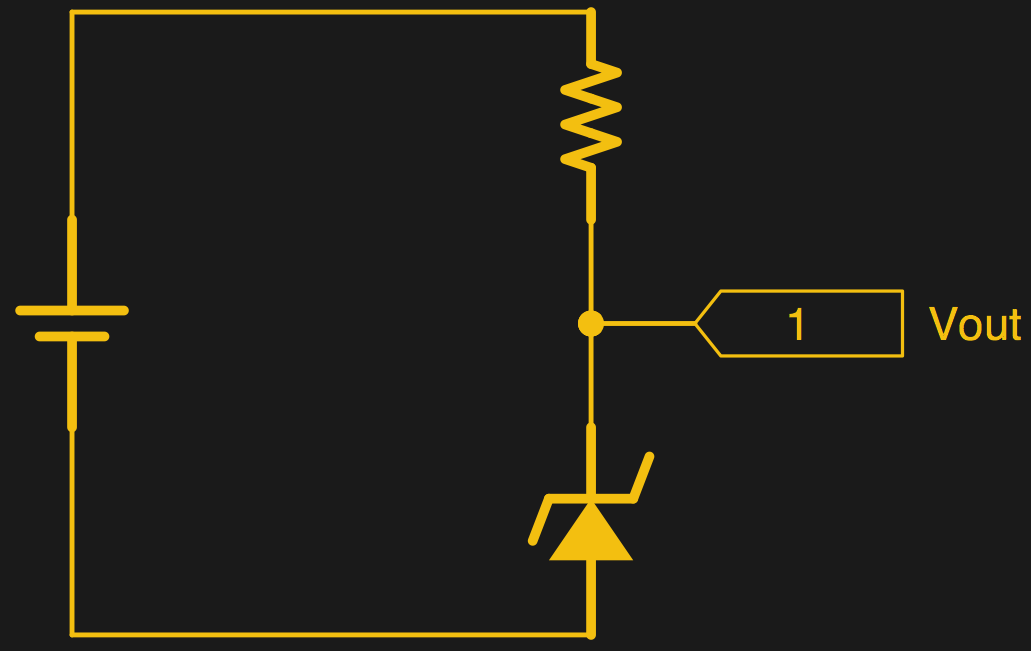
After taking the Aeroccino apart and going over the circuit, it seemed like a simple design relying on a resistor and NTC (negative temperature coefficient) thermistor connected to an ATTiny44 microcontroller. [Sebastian] didn’t want to have to reprogram the ATTiny, so he looked at the resistor and NTC. The resistor and thermistor create a voltage divider and that voltage is read in by the microcontroller through an analog pin. After looking up some info on the thermistor and replacing the resistor with a potentiometer, [Sebastian] could adjust the shut-off temperature while measuring with a thermometer. When he got the temperature he liked, he reads the value of the potentiometer and then replaces it with a couple of resistors in series.

Now [Sebastian] gets the babies’ bottles ready from fridge to temperature in about 25 seconds. He doesn’t have to worry about keeping an eye on the bottles as they heat up. We’re sure that getting two bottles ready in under a minute is much better on the nerves of new parents than waiting around for ten minutes. For more fun with thermistors, check out our article on resistors controlled by the environment or check out this bluetooth bbq thermometer!

Tweet The Power Of Lightning!

How quickly would you say yes to being granted the power to control lightning? Ok, since that has hitherto been impossible, what about the lesser power of detecting and tweeting any nearby lightning strikes?

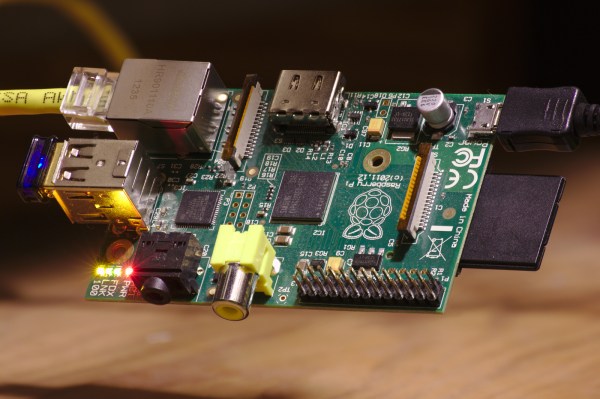
Tingling at the possibility of connecting with lightning’s awesome power in one shape or another, [Hexalyse] combined AMS’s lightning sensor chip with a Raspberry Pi and a whipped up a spot of Python code to tweet the approach of a potential storm. Trusting the chip to correctly calculate strike data, [Hexalyse]’s detector only tweets at five minute intervals — because nobody likes a spambot — but waits for at least five strikes in a given time frame before announcing that a storm’s-a-brewing. Each tweet announces lightning strike energy, distance from the chip, and number of strikes since the last update. If there haven’t been any nearby lightning strikes for an hour, the twitter feed announces the storm has passed.

It just so happened that as [Hexalyse] finished up their project, a thunderstorm bore down on their town of Toulouse, France putting their project to the test — to positive success. Check out the detector’s tweets (in French).

We recently featured another type of lightning detector that auto-deploys a lightning rod once a storm arrives!

6502 Retrocomputing Goes To The Cloud

In what may be the strangest retrocomputing project we’ve seen lately, you can now access a virtual 6502 via Amazon’s Lambda computing service. We don’t mean there’s a web page with a simulated CPU on it. That’s old hat. This is a web service that takes a block of memory, executes 6502 code that it finds in it, and then returns a block of memory after a BRK opcode or a time out.

You format your request as a JSON-formatted POST request, so anything that can do an HTTP post can probably access it. If you aren’t feeling like writing your own client, the main page has a form you can fill out with some sample values. Just be aware that the memory going in and out is base 64 encoded, so you aren’t going to see instantly gratifying results.

Continue reading “6502 Retrocomputing Goes To The Cloud”

Best Product Entry: Open Source Internet Of Dosimeter

[Radu Motisan] Has entered a cool project into the Best Product portion of this year’s Hackaday Prize. It’s called an Open Source IoT Dosimeter. It has a Geiger tube for detecting radiation levels along with Internet connectivity and a host of other goodies.

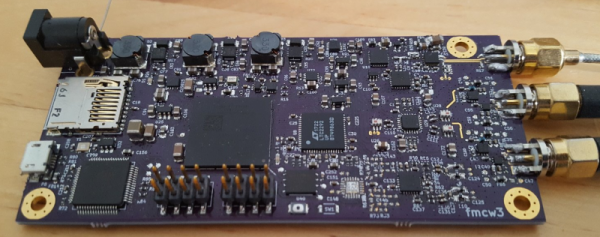
Dubbed the KIT1, this IoT dosimeter can be used as a portable radiation detector with its Nokia 5110 LCD as an output or a monitoring station with Ethernet. With its inbuilt speaker, it alerts users to areas with excessive radiation. KIT1 is a fully functioning system with no need for a computer to get readouts, making it very handy and easy to use. It also has room for expansion for extra sensors allowing a fully customized system. The project includes all the Gerbers and a BOM so you can send it off to a PCB fab lab of your choice, solder on a few components, and have a fully functioning IoT Dosimeter. you don’t even need the LCD or the Ethernet; you can choose which output you prefer from the two and just use that allowing for some penny-pinching.

This is a great project and who doesn’t need an IOT Dosimeter these days?

Old Chart Recorder Becomes Single-Pixel Scanner

With so many ways to capture images from paper, do we really need another one? Especially one that takes 15 minutes to capture a 128×128 pixel image? Probably not, but building a single-pixel RGB scanner is pretty instructive, and good clean fun to boot.

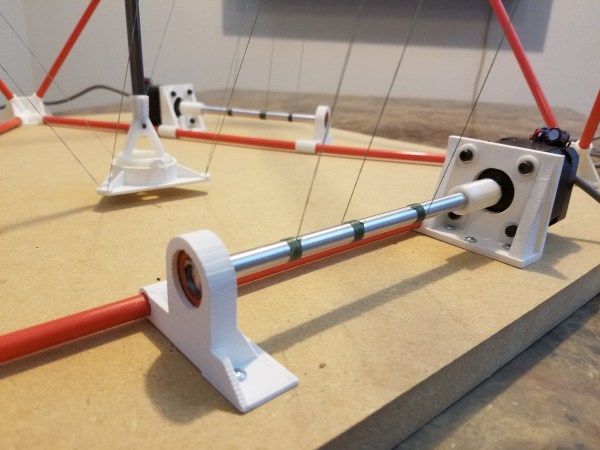
We have to admit that when [Kerry Wong] scored an ancient Hewlett-Packard X-Y chart recorder a while back, we wondered if it would lead to anything useful. One may quibble with the claim that the Lorenz attractor plotter he built with it is useful, and this single pixel scanner is equally suspect, but we like the idea. Using an Arduino to drive the X- and X-axis of the recorder through a raster pattern over the bed and replacing the pen with an RGB sensor board, [Kerry] was able to collect the color data for each pixel and reconstruct the image. It wouldn’t be too hard to replicate this if you don’t have an analog X-Y recorder, which just goes to show that not everything needs to be steppers and digital to get something useful done. Or at least semi-useful.

As for the RGB sensor used, they’ve made appearances here many times before, mostly in M&M sorters but with the occasional synesthesia simulator.

Continue reading “Old Chart Recorder Becomes Single-Pixel Scanner”

Dropping Zip Bombs On Vulnerability Scanners

If you’ve ever looked at the server logs of a computer that lives full-time on the Internet, you know it’s a rough world out there. You’ll see hundreds of attempts per day to break in to your one random little box. Are you going to take that sitting down? Christian Haschek didn’t.

Instead of simply banning IPs or closing off services, [Christian] decided to hit ’em where it hurts: in the RAM. Now, whenever a bot hits his server looking for a poorly configured WordPress install, he serves them 10 GB of zeroes, compressed down into 10 MB by gzip:

dd if=/dev/zero bs=1M count=10240 | gzip > 10G.gzip

The classic trick uses zip multiple times on itself, which lets you compress arbitrarily large files into just a few kB. [Christian] tried this with gzip, and discovered that it didn’t automatically recurse, so he’s taking a small bandwidth hit for the team. If you know how to get more data packed smaller using gzip, leave a note in the comments.

Nobody really knows if this works on the bad guys’ servers, but [Christian] said that they stopped hitting him after downloading a couple payloads. If you want to test out what it does to your system, click this link. If you don’t run a server, but phishing e-mails get you hot under the collar, check out [Robbie Gallagher]’s talk on phishing the phishers from last year’s Schmoocon for cathartic tales of revenge.