These Twenty Assistive Technologies Projects Won $1000 In The Hackaday Prize

Today, we’re excited to announce the winners of the Assistive Technologies portion of The Hackaday Prize. In this round, we’re looking for projects that will help ensure a better quality of life for the disabled. Whether this is something that enhances learning, working, or daily living. These are the projects that turn ‘disability’ into ‘this ability’.

Hackaday is currently hosting the greatest hardware competition on Earth. We’re giving away hundreds of thousands of dollars to hardware creators to build the next great thing. Last week, we wrapped up the fourth of five challenges. It was all about showing a design to Build Something That Matters. Hundreds entered and began their quest to build a device to change the world.

There’s still one entry challenge remaining in The Hackaday Prize. Anything Goes is on right now and open to every idea imaginable. If you’re building a computer made of sand, awesome. Quadcopter hammock? Neat. This is the portion of the Hackaday Prize that’s open to the best ideas out there. It’s up to you to explain how your creation makes the world a little bit better place.

The winners of the Assistive Technologies challenge are, in no particular order:

Assistive Technologies Hackaday Prize Finalists:

Continue reading “These Twenty Assistive Technologies Projects Won $1000 In The Hackaday Prize”

Hack Space Debris At Your Peril

Who has dibs on space debris? If getting to it were a solved problem, it sure would be fun to use dead orbital hardware as something of a hacker’s junk bin. Turns out there is some precedent for this, and regulations already in place in the international community.

To get you into the right frame of mind: it’s once again 2100 AD and hackers are living in mile-long space habitats in the Earth-Moon system. But from where do those hackers get their raw material, their hardware? The system abounds with space debris, defunct satellites from a century of technological progress. According to Earth maritime law, if space is to be treated like international waters then the right of salvage would permit them to take parts from any derelict. But is space like international waters? Or would hacking space debris result in doing hard time in the ice mines of Ceres?

Continue reading “Hack Space Debris At Your Peril”

If You’re Going To Make A Model Engine, You Might As Well Make It A Merlin

It has been remarked before in more than one Hackaday post, that here are many communities like our own that exist in isolation and contain within them an astonishing level of hardware and engineering ability. We simply don’t see all the work done by the more engineering-driven and less accessory-driven end of the car modification scene, for example, because by and large we do not move in the same circles as them.

One such community in which projects displaying incredible levels of skill are the norm is the model making world. We may all have glued together a plastic kit of a Spitfire or a Mustang in our youth, but at the opposite end of the dial when it comes to models you will find craftsmanship that goes well beyond that you’d find in many high-end machine shops.

A project that demonstrates this in spades is [mayhugh1]’s quarter-scale model of a vintage Rolls-Royce Merlin V12 piston aero engine. This was the power plant that you would have found in many iconic Allied aircraft of the WW2 era, including the real-life Spitfires and all but the earliest of those Mustangs. And what makes the quarter-scale Merlin just that little bit more special, is that it runs. Just add fuel.

The build took place over a few years and many pages of a forum thread, and includes multiple blow-by-blow accounts, photos, and videos. It started with a set of commercial castings for the engine block, but their finishing and the manufacture of all other engine parts is done in the shop. In the final page or so we see the video we’ve placed below the break, of the finished engine in a test frame being run up on the bench, with a somewhat frightening unguarded airscrew attached to its front and waiting to decapitate an unwary cameraman. Sit down with a cup of your favourite beverage, and read the build from start to finish. We don’t think you’ll be disappointed.

Continue reading “If You’re Going To Make A Model Engine, You Might As Well Make It A Merlin”

Hackaday UK Unconference Art

Hackaday London Meet-up This Friday

Hackaday takes over London at the end of this week. Join us on Friday night as we host a meetup at the Marquis Cornwallis, a pub in Bloomsbury.

This is a Bring-a-Hack style meetup, so grab something you’ve been working on to get the conversation flowing as you enjoy food and drink with members of the Hackaday community from the area. Also on hand from the Hackaday Crew will be [Mike Szczys], [Elliot Williams], [Jenny List], [Pedro Umbelino], and [Adil Malik]. We’re consistently delighted by the many and varied projects that show up — we want to meet you and hear about your project no matter how trivial, or involved. We do suggest you bring something handheld though, as tabletop space will be limited.

DesignSpark LogoWe’ve rented the upper floor of the pub and ordered food and fine beverages for all who attend. This is possible thanks to the support of DesignSpark, the exclusive sponsor of the Hackaday UK Unconference.

Tickets for that event have been sold out for ages now, so we’re glad to host a meetup to involve more of the UK Hackaday community. There are still a few left for this Friday Meetup so claim your free ticket now!

Doppler Module Teardown Reveals The Weird World Of Microwave Electronics

Oscillators with components that aren’t electrically connected to anything? PCB traces that function as passive components based solely on their shape? Slots and holes in the board with specific functions? Welcome to the weird and wonderful world of microwave electronics, brought to you through this teardown and analysis of a Doppler microwave transceiver module.

We’ve always been fascinated by the way conventional electronic rules break down as frequency increases. The Doppler module that [Kerry Wong] chose to pop open, a Microsemi X-band transceiver that goes for about $10 on eBay right now, has vanishingly few components inside. One transistor for the local oscillator, one for the mixer, and about three other passives are the whole BOM. That the LO is tuned by a barium titanate slug that acts as a dielectric resonator is just fascinating, as is the fact that PB traces can form a complete filter network just by virtue of their size and shape. Antennas that are coupled to the transceiver through an air gap via slots in the board are a neat trick too.

[Kerry] analyzes all this in the video below and shows how the module can be used as a sensor. If you need a little more detail on putting these modules to work, we’ve got some basic circuits you can check out.

Continue reading “Doppler Module Teardown Reveals The Weird World Of Microwave Electronics”

Wall fans for circulating hot ceiling air

Winter Is Coming: Keeping Heat Where It’s Needed

If your workshop has ceilings as high as [Niklas Roy]’s 3.6 meters (11.8 feet), then you’re familiar with his problem. Hot air rises, and there it usually stays until the heat is transferred outdoors. But in the winter time we need that heat indoors and down low. One solution is to install ceiling fans that blow that hot air back down. However, [Niklas] often builds tall things that would collide with those fans. And so he had to hack together some wall hugging fans which will be both high up and out of the way.

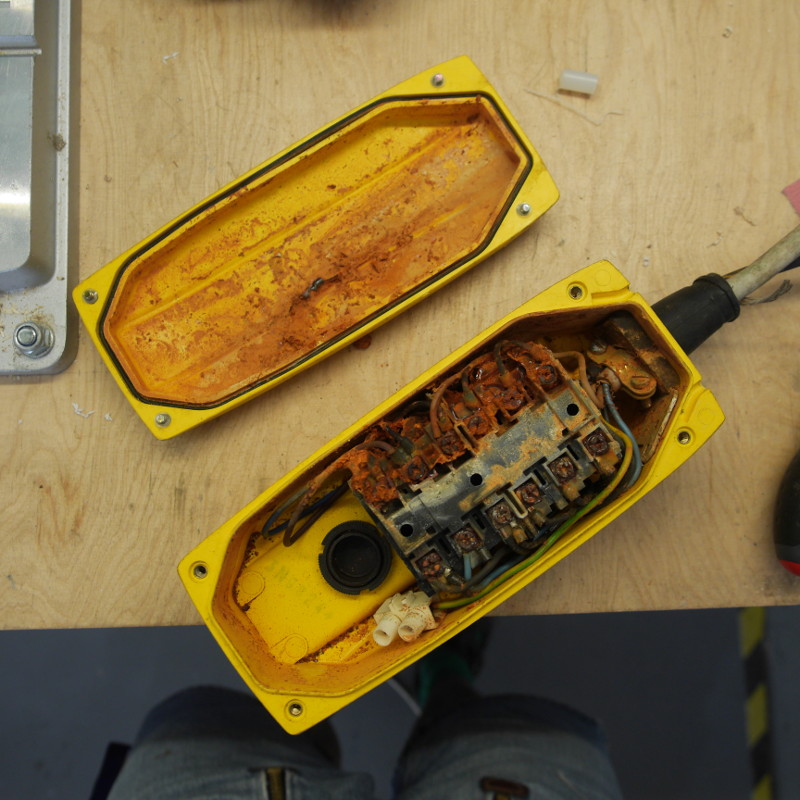
Corroded industrial controller

For the fans he’s using six of those ubiquitous standing fans, the ones that normally sit on a post a few feet off the ground and swivel back and forth. Discarding the posts, he mounted the fan bodies to a horizontal wooden frame with a wheel attached to one end, one that he’d made for another project. A rope around the wheel, and hanging down, makes it easy to tilt the fans. For controlling the fans, a friend had given him an old industrial controller, and opening it up, all he saw was corrosion. Cleaning it all out he installed an old Russian 3-position switch from his collection.

In the future he’d like to add a closed-loop control system that would not only turn the fans on and off but also adjusting their speed. For now, however, he reports that it works really well. Check out his page for build photos and more details.

Meanwhile, winter really is coming to these northern latitudes and so here are more hacks to prepare you. For automated shovelling snow, how about an RC controlled 3D printed snow blower. And while you’re snug and warm inside remotely controlling your snow blower, you can still be getting exercise using a DIY bicycle roller. But if you do venture outside, perhaps you’d want to zip around on a dogless dog sleigh.

Scribble Your Way To Quick Printed Circuit Boards

There are a variety of techniques employed by electronic constructors seeking the convenience of a printed circuit board without the inconvenience of making a printed circuit board. Dead bug style construction in which the components float on a spiders-web of soldered leads above a ground plane is one, Manhattan style construction in which pads made from small cut squares of bare copper-clad PCB are glued on top of a groundplane is another.

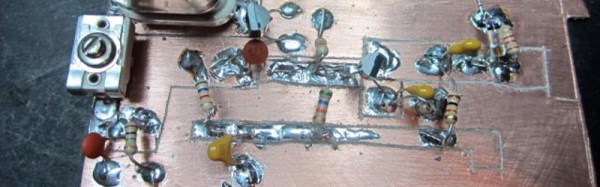
[Freestate QRP] has another take on this type of electronics, with what he calls “Scribble style” construction. He cuts away copper from bare board to create pads and rudimentary tracks, and for him the magic ingredient comes from his choice of an engineer’s scribe to do the job. This is where the “scribble” comes from, creating a pad is as simple as drawing it with the scribe.

Of course, this technique is not entirely new, constructors have been doing this type of work for years with Dremel tools, hand engraving tools, and similar. If you’ve ever tried to do it with a knife or scalpel you will know that it’s hardly an easy task with those hand tools so the prospect of another one doing a better job is rather interesting. He’s ready and able to demonstrate it in action, showing us a couple of RF circuits using the technique.

Have you tried this technique, or one like it? How did you get on, tell us in the comments. Meanwhile, you might like to read our own [Dan Maloney]’s look at dead bug and Manhattan construction.