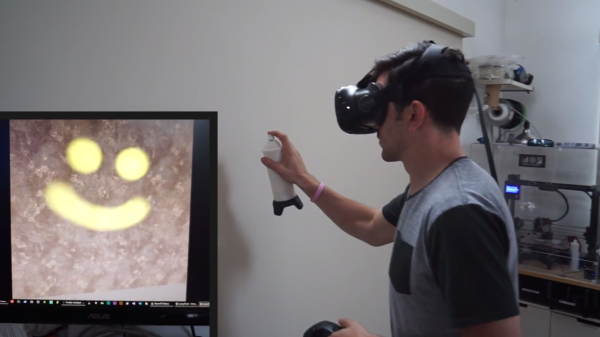
Here is a virtual spray painting project with a new and DIY twist to it. [Adam Amaral]’s project is an experiment in using the Vive Tracker, which was released earlier this year. [Adam] demonstrates how to interface some simple hardware and 3D printed parts to the Tracker’s GPIO pins, using it as a custom peripheral that is fully tracked and interactive in the Vive’s VR environment. He details not only the custom spray can controller, but also how to handle the device on the software side in the Unreal engine. The 3D printed “spray can controller” even rattles when shaken!
There’s one more trick. Since the Vive Tracker is wireless and completely self-contained, the completed rattlecan operates independently from the VR headset. This means it’s possible to ditch the goggles and hook up a projector, then use the 3D printed spray can to paint a nearby wall with virtual paint; you can see that part in action in the video embedded below.
Continue reading “Spray Paint Goes DIY Virtual With A Vive Tracker”
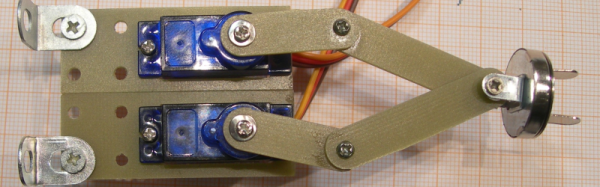
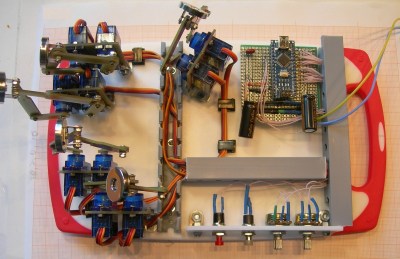 He’s using ten hobby micro servos connected to an Arduino Nano, all mounted on a kitchen chopping board, with a few other bits thrown in to round out the build. There’s one pair of servos for each finger. A five bar linkage converts the servo rotations to two-dimensional motion. The end of the linkage has a swiveling metallic disk. Patient fingers are attached to these discs via magnetic metal pads that are attached to the end of the fingers using adhesive plaster tape. Two push buttons cycle through a large number of exercise modes and two potentiometer’s help adjust the speed and smoothness (the number of points calculated for the desired motion). Two 7-segment LED display modules connected to the Arduino provides a visual interface showing program modes, speed, number of cycles and other relevant information. Replicating the project ought to be very straightforward since the device uses off-the-shelf parts which are easy to put together using the detailed build instructions, photos and code posted on [Sergei]’s project page. Check out the videos below to see the rehab helper in action.