Decapsulation Reveals Fake Chips

A while back, [heypete] needed to get a GPS timing receiver talking to a Raspberry Pi. The receiver only spoke RS-232, and the Pi is TTL level serial. [Pete] picked up a few RS-232 to TTL conversion boards from an online vendor in China. These boards were supposedly based on the Max3232, a wonderchip that converts the TTL serial to the positive and negative voltages of RS-232 serial. The converters worked fine for a few weeks, before failing, passing a bunch of current, and overheating.

On Mouser and Digikey, the Max3232 costs about $1.80 in quantity one, and shipping is extra. You can pick up a ‘Max3232 converter board’ from the usual online marketplaces for seventy five cents with free shipping. Of course the Chinese version is fake. [Pete] had some nitric acid, and decided to compare the die of the real and fake Max3232s.

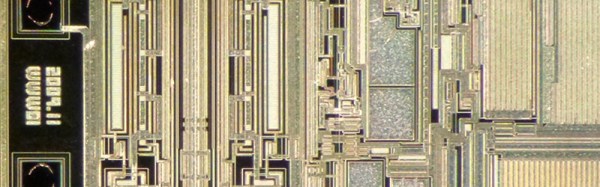
After desoldering two fake chips from their respective converter boards, and acquiring a legitimate chip straight from Maxim, [Pete] took a look at the chips under the microscope. The laser markings on the fakes are inconsistent, but there was something interesting to be found in the date code markings. It took two to four weeks for the fake chips to be etched with a date code, assembled into a converter board, shipped across the planet, put into [Pete]’s project, run for a little bit, and fail spectacularly. That’s an astonishing display of manufacturing, logistics, and shipping times. Update: The date codes on the fakes had 2013 laser etched on the plastic package, and 2009 on the die. The real chips had a date code just a few weeks before [Pete] decapped them — a remarkably short life but they gave in to a good cause.

Following the Zeptobars and CCC (PDF) guides to dropping acid, [Pete] turned his problem into solution and took a look at the dies under a microscope. The legitimate die was significantly larger, and the fake dies were identical. The official die used gold bond wires, but the fake ones didn’t.

Unfortunately, [Pete] isn’t an expert in VLSI, chip design, failure analysis, or making semiconductors out of sand. Anything that should be obvious to the layman is not, and [Pete] has no idea why these chips would work for a week, then overheat and fail. If anyone has an idea, hit [Pete] up and drop a note in the comments.
Take Your PCBs From Good To Great: Toner Transfer

dscf8697
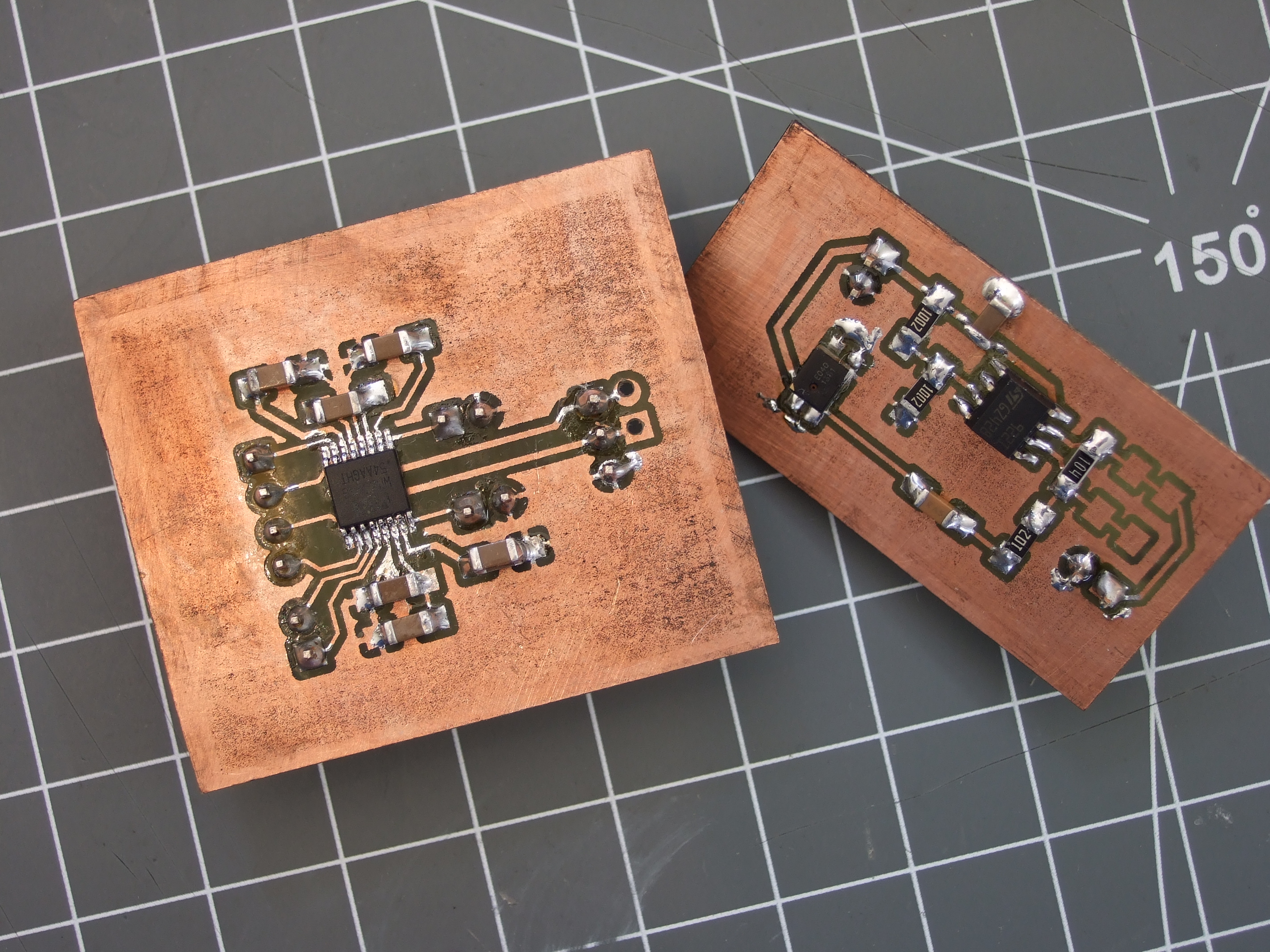
One-offs that I never would have gotten professionally made, but that were infinitely handy during development

A lot of us make circuit boards at home. I find it a useful skill to have in my bag of tricks for intermediate steps along the way to a finished project, even if the finished version is going to be sent out to a PCB fab. When I need a breakout board that meshes with other development tools, for instance, there’s nothing like being able to whip something up that plugs right in. Doing it quickly, and getting on with the rest of the project instead of placing an order and waiting for delivery, helps keep me in the flow.

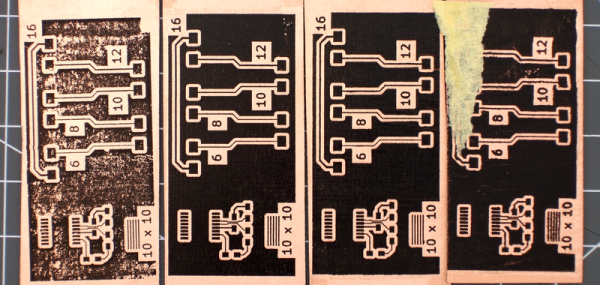
Toner transfer is by far the fastest way to make a circuit board at home — simply print the circuit out on a laser printer, iron it onto the copper, and etch. When it works, it’s awesome. When it doesn’t, it can be a hair-pulling exercise in figuring out which of myriad factors are misaligned.

For a long time now, I’ve been using a method that’s very reliable and repeatable. Recently, I’ve been tweaking a bit on the performance of the system, and I thought I’d share what I’ve got. At the moment, I’m able to very reliably produce boards with 6 mil (0.15 mm) traces and 8 mil (0.20 mm) spacing. With a little care in post-production, 4 mil / 6 mil is entirely plausible.

Continue reading “Take Your PCBs From Good To Great: Toner Transfer”

Get Your Ticket To SuperCon, The Greatest Hardware Creation Con

The world’s most excellent conference on hardware creation, the Hackaday SuperConference, is back. Get your tickets now for two magical days in Pasadena this November.

This exclusive gathering of hackers, designers, and engineers is where brilliant people geek out with their peers. Talks tell the story of research, prototyping, product design, manufacturing, and getting that new hardware out into the world. Nowhere else can you get such a concentrated dose of Sistine-Chapel-like details about what is being built in businesses small and large, basements, University labs, and everywhere else.

Early tickets are $128, get your pass to the conference now! This ticket gets you in the door for talks, breakfast and lunch on both days, a conference badge, and the party on Saturday night. SuperCon also includes hands-on workshops — these have limited capacity and some have material costs, more about this next week.

Continue reading “Get Your Ticket To SuperCon, The Greatest Hardware Creation Con”

Path To Craftsmanship: The Art Of Being Wrong

Every technical person knows, unlike artists and politicians, that they can be provably wrong; at least to a degree. Math tells the truth. Coupled with this knowledge is an ego which is often entirely based on our output. If our mechanism works, we feel good because we are provably good.

A disclaimer.
It didn’t stop Scott Adams from writing four books full of it and it won’t stop me.
from Dilbert: Advice

Unfortunately, unlike the robots we build or the simple minds we spin out of code, we are still human at the end of the day. When we feel the sting of being wrong we often respond poorly. Some of us slip into depression, claiming it all and dredging up a few other mistakes from our past along for the ride. Some of us explode into prideful rages, dropping our metaphorical shorts to show that this one fault is no fault at all compared to a history of personal majesty. Others become sullen and inward. Others ignore it all together. Others yet strike out at those around them leaving unpleasant barbs. The variations are endless, but I do think there is an ideal to be reached.

Despite the risk that the nature of the things I’ve learned will reveal exactly what kind of arrogant sod I am, I’ll give it a go anyway. I’ve made many mistakes, and I have many more to make, but these are some of the things I’ve learned. I’ve learned them all in technical fields, so I’m not sure how broadly the advice applies, but luckily this is Hackaday.

Continue reading “Path To Craftsmanship: The Art Of Being Wrong”

Sewbo Robot Sews Up Automated Garment Manufacturing

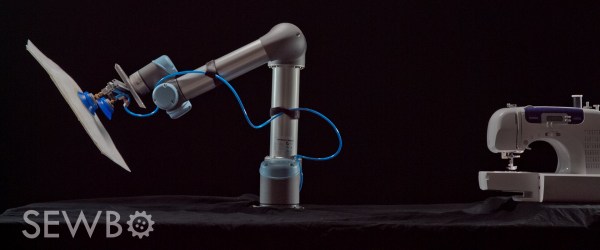
While robots enter other industries in herds, the assembly of garments has long been a tedious, human privilege. Now, for the first time, a robot has sewn an entire, wearable piece of garment. Sewbo, an industrial robot programmed to tackle the tricky task, assembles clothes and makes it look easy.

Continue reading “Sewbo Robot Sews Up Automated Garment Manufacturing”

Super-small Robotic Joints Don’t Exist? They Do Now!

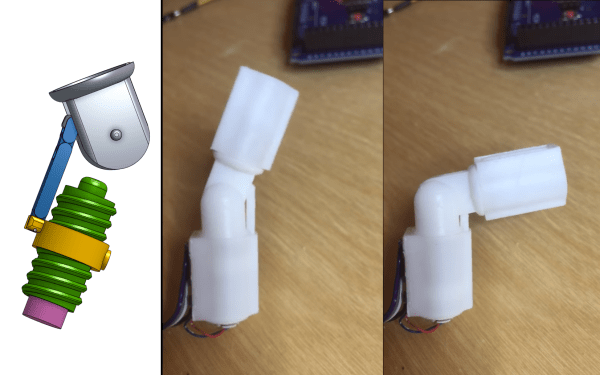
[Tim] needed very small, motorized joints for a robot. Unable to find anything to fit the bill, he designed his own tiny, robotic joints. Not only are these articulated and motorized, they are designed to be independent – each containing their own driver and microcontroller.

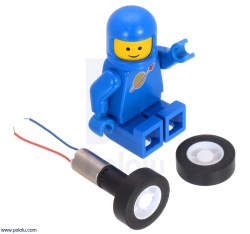
6mm geared motor next to LEGO [Source: Pololu]
None of the photos or video really give a good sense of just how small [Tim]’s design is. The motor (purple in the 3D render above, and pictured to the left) is a sub-micro planetary geared motor with a D shaped shaft. It is 6mm in diameter and 19mm long. One of these motors is almost entirely encapsulated within the screw it drives (green), forming a type of worm gear. As the motor turns the screw, a threaded ring moves up or down – which in turn moves the articulated shaft attached to the joint. A video is embedded below that shows the joint in action.

[Tim] originally tried 3D printing the pieces on his Lulzbot but it wasn’t up to the task. He’s currently using a Form 2 with white resin, which is able to make the tiny pieces just the way he needs them.

Continue reading “Super-small Robotic Joints Don’t Exist? They Do Now!”

Hackaday Prize Entry: Aesthetic As Hell

Microsoft Bob was revolutionary. Normally you’d hear a phrase like that coming from an idiot blogger, but in this case a good argument could be made. Bob threw away the ‘files’ and ‘folders’ paradigm for the very beginnings of virtual reality. The word processor was just sitting down at a desk and writing a letter. Your Rolodex was a Rolodex. All abstractions are removed, and you’re closer than ever to living in your computer. If Microsoft Bob was released today, with multiple users interacting with each other in a virtual environment, it would be too far ahead of it’s time. It would be William Gibson’s most visible heir, instead of Melinda Gates’ only failure. Imagine a cyberpunk world that isn’t a dystopia, and your mind will turn to Microsoft Bob.

Metaverse Lab is aesthetic as hell
Metaverse Lab is aesthetic as hell.

Not everyone will laugh at the above paragraph. Indeed, some people are trying to make the idea of a gigantic, virtual, 3D space populated by real people a reality. For the last few years, [alusion] has been working on Metaverse Lab as an experiment in 3D scanning, virtual web browsers, and turning interconnected 3D spaces into habitats for technonauts. The name comes from Snow Crash, and over the past twenty years, a number of projects have popped up  to replicate this convergence of the digital and physical. By integrating this idea with the latest VR headsets, Metaverse Lab is the the closest thing I’ve ever seen to the dream of awesome 80s sci-fi.

I’ve actually had the experience of using and interacting with Metaverse Lab on a few occasions. The only way to describe it is as what someone would expect the Internet would be if their only exposure to technology was viewing the 1992 film Lawnmower Man. It works, though, as a completely virtual environment where potential is apparent, and the human mind is not limited by its physical embodiment.