Arc Lighter Become Plasma Pyrography Pen

Wood burning can be quite a striking art form, but who wants to be stuck using an old-fashioned resistive heating element to char wood? You could go with laser engraving, of course, but that seems to take too much of the human touch out of it. So why not try a mini plasma pen and blow torch powered by a fancy cigarette lighter?

Arc lighters are rechargeable electronic lighters that look like a tiny stun-gun, and [NightHawkInLight] has been coming up with some interesting hacks for them. In this case, he extended the electrode leads out and mounted them to a wooden handle. The spark gap is only about 2mm, but the resulting arc is plenty hot enough to char wood with considerable precision. You’ve got to work fast, though, or the high voltage will start finding interesting paths through the char, producing Lichtenberg figures. And if a micro-scale blow torch is a tool you need, [NightHawkInLight] has got that covered too – a small brass tube with a pinched-off nozzle hooked to an aquarium pump provides the pressure for that.

Might there be other applications for this beyond pyrography? Maybe soldering or desoldering? Of non-ESD sensitive components, naturally.
Continue reading “Arc Lighter Become Plasma Pyrography Pen”

Full Color 3D Printer Upgrade Leaves Competition In The Dust

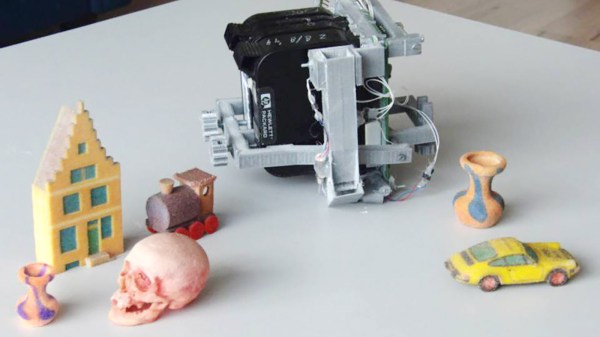
Most hobby 3D printers are based on FDM, extruding a single-color noodle of melted plastic to build up an object. Powder-based inkjet 3D printing allows you to print detailed, full-color models from a plaster-like material. The process uses ink and water droplets, dispensed from an inkjet print head to selectively fuse and color layers of a powdered binder material. When you see an offer for a 3D printed miniature version of yourself (or someone else), they are made with powder. [Aad van der Geest] wants to put this technology on your desktop with ColorPod, a kit that converts your FDM printer into a powder printer.

Continue reading “Full Color 3D Printer Upgrade Leaves Competition In The Dust”

Arduino + Software Defined Radio = Millions Of Vulnerable Volkswagens

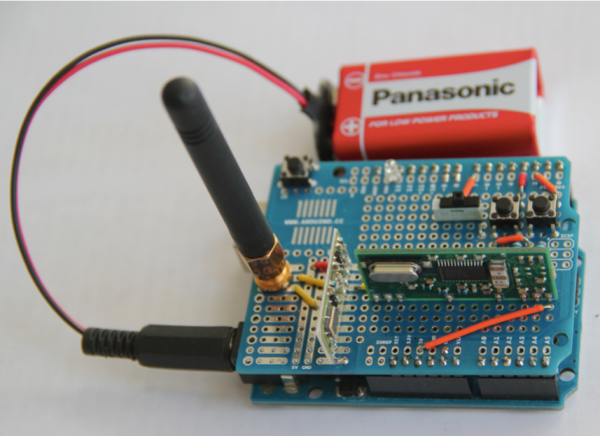
As we’ve mentioned previously, the integrity of your vehicle in an era where even your car can have a data connection could be a dubious bet at best. Speaking to these concerns, a soon-to-be published paper (PDF) out of the University of Birmingham in the UK, states that virtually every Volkswagen sold since 1995 can be hacked and unlocked by cloning the vehicle’s keyfob via an Arduino and software defined radio (SDR).

The research team, led by [Flavio Garcia], have described two main vulnerabilities: the first requires combining a cyrptographic key from the vehicle with the signal from the owner’s fob to grant access, while the second takes advantage of the virtually ancient HiTag2 security system that was implemented in the 1990s. The former affects up to 100 million vehicles across the Volkswagen line, while the latter will work on models from Citroen, Peugeot, Opel, Nissan, Alfa Romero, Fiat, Mitsubishi and Ford.

Continue reading “Arduino + Software Defined Radio = Millions Of Vulnerable Volkswagens”

Asking The Security Question Of Home Automation

“Security” is the proverbial dead horse we all like to beat when it comes to technology. This is of course not unjust — we live in a technological society built with a mindset of “security last”. There’s always one reason or another proffered for this: companies need to fail fast and will handle security once a product proves viable, end users will have a harder time with setup and use if systems are secured or encrypted, and governments/law enforcement don’t want criminals hiding behind strongly secured systems.

This is an argument I don’t want to get bogged down in. For this discussion let’s all agree on this starting point for the conversation: any system that manages something of value needs some type of security and the question becomes how much security makes sense? As the title suggests, the technology du jour is home automation. When you do manage to connect your thermostat to your door locks, lights, window shades, refrigerator, and toilet, what type of security needs to be part of the plan?

Join me after the break for an overview of a few Home Automation security concerns. This article is the third in our series — the first asked What is Home Automation and the second discussed the Software Hangups we face.

These have all been inspired by the Automation challenge round of the Hackaday Prize. Document your own Automation project by Monday morning to enter. Twenty projects will win $1000 each, becoming finalists with a chance at the grand prize of $150,000. We’re also giving away Hackaday T-shirts to people who leave comments that help carry this discussion forward, so let us know what you think below.

Continue reading “Asking The Security Question Of Home Automation”

Fractals Among Us

Think not of what you see, but what it took to produce what you see

Benoit Mandelbrot

Randomness is all around you…or so you think. Consider the various shapes of the morning clouds, the jagged points of Colorado’s Rocky Mountains, the twists and turns of England’s coastline and the forks of a lightning bolt streaking through a dark, stormy sky. Such irregularity is commonplace throughout our natural world. One can also find similar irregular structures in biology. The branch-like structures in your lungs called Bronchi, for instance, fork out in irregular patterns that eerily mirror the way rivers bifurcate into smaller streams. It turns out that these irregular structures are not as irregular and random as one might think. They’re self-similar, meaning the overall structure remains the same as you zoom in or out.

The mathematics that describes these irregular shapes and patterns would not be fully understood until the 1970s with the advent of the computer. In 1982, a renegade mathematician by the name of Benoit Mandelbrot published a book entitled “The Fractal Geometry of Nature”.  It was a revision of his previous work, “Fractals: Form, Chance and Dimension” which was published a few years before. Today, they are regarded as one of the ten most influential scientific essays of the 20th century.

Mandelbrot coined the term “Fractal,” which is derived from the Latin word fractus, which means irregular or broken. He called himself a “fractalist,” and often referred to his work as “the study of roughness.” In this article, we’re going to describe what fractals are and explore areas where fractals are used in modern technology, while saving the more technical aspects for a later article.

Continue reading “Fractals Among Us”

New 3D Printer M3D Pro Hits Kickstarter

M3D just launched their second 3D printer on Kickstarter. The M3D Pro offers more professional features than its predecessor, the M3D Micro, which is still one of cheapest 3D printers around. Despite the higher price of $499, the campaign reached its $100,000 funding goal within hours.

Continue reading “New 3D Printer M3D Pro Hits Kickstarter”

The Turing Tapes

The recent movie “The Imitation Game” gave [Alan Turing] some well-deserved fame among non-computer types (although the historical accuracy of that movie is poor, at best; there have been several comparisons between the movie and reality). However, for people in the computer industry, Turing was famous for more than just helping to crack Enigma. His theoretical work on computing led to the Turing machine, which is still an important concept for reasoning about computers in a mathematical way. He also laid the foundation for the stored program computer that we take for granted today.

What’s a Turing Machine?

A Turing machine is deceptively simple and, like many mathematical models, highly impractical. Leading off the inpracticalities, the machine includes an infinite paper tape. There is a head that can read and write any symbol to the tape at some position, and the tape can move to the left or the right. Keep in mind that the head can write a symbol over another symbol, so that’s another practical difficulty, although not an insurmountable one. The other issue is that the symbol can be anything: a letter, a number, a jolly wrencher, or a bunch of dots. Again, not impossible, but difficult to do with practical hardware implementations.

Continue reading “The Turing Tapes”