Raspberry Pi clusters are a dime a dozen these days. Well, maybe more like £250 for a five-Pi cluster. Anyway, this project is a bit different. It’s exquisitely documented.
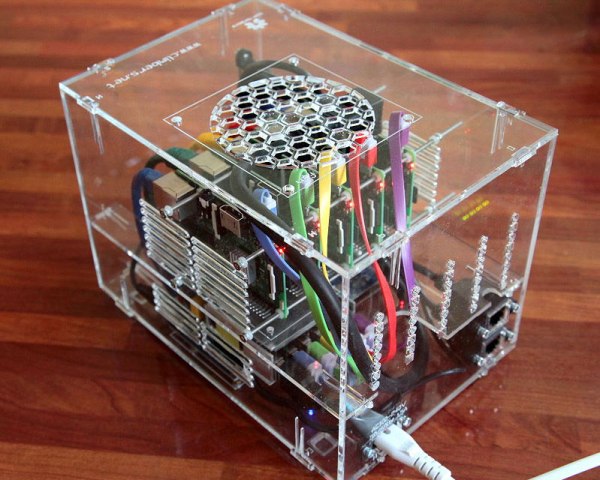
[Nick Smith] built a 5-node Pi 3 cluster from scratch, laser-cutting his own acrylic case and tearing down a small network switch to include in the design. It is, he happily admits, a solution looking for a problem. [Smith] did an excellent job of documenting how he designed the case in CAD, prototyped it in wood, and how he put the final cluster together with eye-catching clear acrylic.
Of interest is that he even built his own clips to hold the sides of the case together and offers all of the files for anyone who wants to build their own. Head over to his page for the complete bill of materials (we didn’t know Pis were something you could order in 5-packs). And please, next time you work on a project follow [Nick’s] example of how to document it well, and how to show what did (and didn’t) work.
There is a rich history surrounding the improvisation of electronic components. From cats-whisker foxhole radio detectors using razor blades through radio amateurs trying antique quartz lenses as crystal resonators and 1950s experimenters making their own point-contact transistors, whenever desirable components have been unavailable the ingenuity of hackers and makers has always sought to provide.
In an age when any component you might wish for is only a web browser and a courier package away, you might think there would be no need for such experiments. But it is in our curious nature to push the boundaries of what can be made without a factory at our disposal, so there are still plenty of ingenious home-made components under construction.
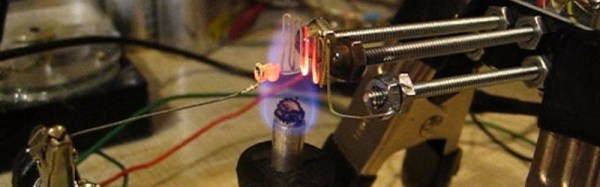
One such experiment came our way recently. It’s a few years old, but it’s a good one. [Nyle Steiner, K7NS] made a working triode without any form of vacuum, instead its medium is a flame. He’s demonstrated it as a rectifier, amplifier, and oscillator, and while it might not be the best triode ever it’s certainly one of the simplest.
In a traditional vacuum triode the current flows as electrons released from a hot cathode and are able to cross the space because there are no gas molecules for them to collide with. The flame triode has an abundance of gas, but the gasses within it and its immediate surroundings are also strongly ionized, and thus electrically conductive. Flame ionization detectors have exploited this phenomenon in scientific instruments for a very long time.
A roaring flame might not be the most practical thing to keep in your electronic equipment, but [Nyle]’s experiment is nonetheless an impressive one. He’s posted a video showing it in action, which you can see below the break.
We’ve been 3D-printing parts for self-replicating machines before, but we’ve been working on the wrong machines. Software and robotics engineer [David Sanchez Falero] is about to set it right with his Hackaday Prize entry, a 3D-printable, open source, robotic prosthetic leg for humans.
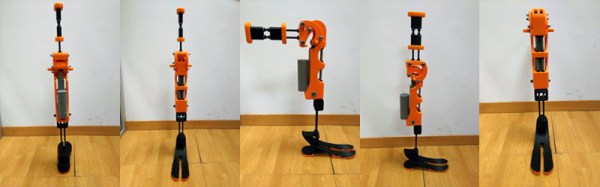
[David] could not find a suitable, 3D-printable and customizable prosthetic leg out there, and given the high price of commercial ones he started his own prosthesis project named Drakkar. The “bones” of his design are made of M8 steel threaded rods, which help to keep the cost low, but are also highly available all over the world. The knee is actively bent by a DC-motor and, according to the source code, a potentiometer reads back the position of the knee to a PID loop.
While working on his first prototype, [David] quickly found that replicating the shape and complex mechanics of a human foot would be too fragile when replicated from 3D-printed parts. Instead, he looked at how goat hooves managed to adapt to uneven terrain with only two larger toes. All results and learnings then went into a second version, which now also adapts to the user’s height. The design, which has been done entirely in FreeCAD, indeed looks promising and might one day compete with the high-priced commercial prosthesis.
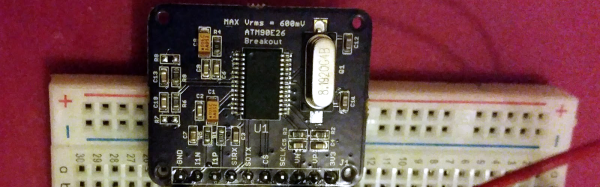
[Tisham Dhar] has been interested in monitoring AC power and previously built a breakout board for the ADE7763. He wanted to find something cheaper and more modern. The ATM90E26 fit the bill. It can communicate via a UART or SPI, and has multiple metering modes. The problem? The evaluation module from Atmel costs about $500 (and for [Dhar] $800 Australian), although the part itself can be had for under a buck in bulk. (Atmel even sent him three samples for free.)
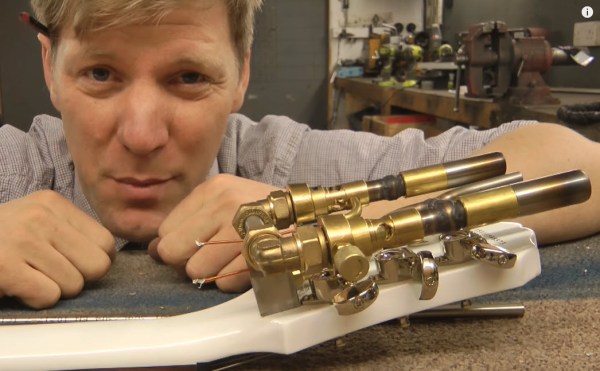
Everyone’s favorite safety-tie-wearing-eccentric-inventor, [Colin Furze], is back at it again, this time making a flamethrower guitar — sponsored by Intel!?
As an ex-plumber, [Furze] is a master fabricator, and he’s brought many amazing mechanical inventions to life. In this video, perhaps for the first time, he’s integrated an Intel Curie Arduino in it, for a bit more fine control.
He’s hacked apart a couple of propane blow-torches, milled and lathed his own fittings and manifolds, and even TIG welded together a pressure vessel for the fuel — kids, do not try this at home!
The two blowtorches act as pilot lights for a third gas supply line to make the big firing explosion — the plan for the Arduino? To blast off the fire at certain parts during the song, add timing, or even just set up some cool patterns.
Did we mention he’s also got his own custom propane fueled guitar amp to go with it??
Everyone loves learning a new programming language, right? Well, even if you don’t like it, you should do it anyway, because thinking about problems from different perspectives is great for the imagination.
Juniper is a functional reactive programming language for the Arduino platform. What that means is that you’ll be writing your code using anonymous functions, map/fold operations, recursion, and signals. It’s like taking the event-driven style that you should be programming in one step further; you write a=b+3 and when b changes, the compiler takes care of changing a automatically for you. (That’s the “reactive” part.)
If you’re used to the first-do-this-then-do-that style of Arduino (and most C/C++) programming, this is going to be mind expanding. But we do notice that a lot of microcontroller code looks for changes in the environment, and then acts (more or less asynchronously) on that data. At that level of abstraction, something like Juniper looks like a good fit.
This has got to be the ultimate name-dropping post. I’m tempted just to make a list. Or perhaps it should be like Jeopardy, I’ll list the products or companies and you guess who was there. I am of course talking about the Hackaday Bay Area Maker Faire Meetup last Saturday which started off as a steady stream of Faire-weary exhibitors and suddenly the place was packed to the gills. Luckily we have some photographic evidence of the awesome.
Peter Jansen seen on the right
If you do something three times you can start saying “always”, right? We always host a meetup on the Saturday night of Bay Area Maker Faire at O’Neill’s Irish Pub in San Mateo. It’s our kind of atmosphere: just enough room to set up hacks you tote along with you, they have Guinness, Lagunitas, and a few in-betweens on tap, you can bring in food from the various eateries that border the bar, and the staff is beyond awesome.
Despite my threat to call-out everyone by name, I’ll keep it to a minimum. It was most excellent meeting Peter Jansen who created the Open Source Science Tricorder, fourth place winner of the Hackaday Prize in 2014. I was glad to see Windell Oskay of Evil Mad Scientist Laboratories there since both Windell and Peter are Ph.D. Physicists. Of course it ended up they are able to converse with regular people too.
Eric Schlaepfer (left) and Caleb Kraft (right) with Monster 6502
Amp Hour Elite: Karl Bowers, Tony Long, Alan Yates, Jeff Keyzer
In the back Erick Schlaepfer was showing off his MOnSter6502 — check out the interview I did with him about it the day before. Astute readers will recognize who he’s showing that to: Hackaday Editor Emeritus Caleb Kraft stopped by on his way to the MAKE staff party. Somehow, although we shared a beer, neither of us thought of taking a picture together — perpetuating the mythos that Caleb is the Tyler Durden to my Tyler Durden. Incidentally, if anyone knows Chuck Palahniuk (or if he reads Hackaday which would be killer) we’d love to have him speak at SuperCon. Email me.
Also on the ‘didn’t get pictures of’ list is Anouk Wipprecht who stopped by later in the evening. I love her work and it was really great to meet her. Oops, and I’m not supposed to be dropping names. Paul Stoffregen (talking to Gerrit Coetzee and me in the bottom left corner of the image at the top of this post). Okay, enough of that.
There seemed to be a critical mass of Amp Hour elites on the scene. I grabbed this image from Chris Gammell’s Twitter. He snapped a still of Tony Long, Alan Yates, and Jeff Keyzer who have all been on the show (or hosted it). Karl Bowers, host of The Spark Gap podcast, photobombs on the left.
This barely brushes the tip of the iceberg. But I figure you get tired of hearing me prattle on. If you attended I’d love to see the photos you snapped, please link them in the comments below. And of course, if you do still want to play name-that-geek-celeb the comments are the place for it.
Thanks to Rich Hogben for taking all of these great photos and posting them up on Hackaday.io. I’d also like to thank Supplyframe for picking up everyone’s first round of drinks that night. Maker Faire has ended, but this evening will always have a special place in my heart. We look forward to seeing everyone there next year!