Chewing Gum Plus Carbon Nanotubes

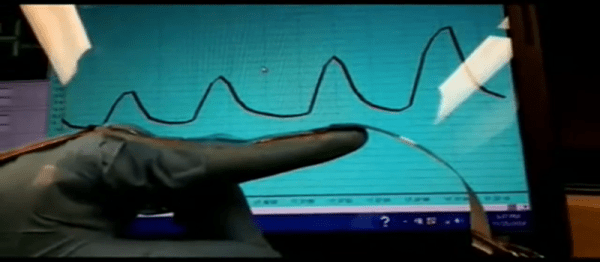
Normally, strain sensors are limited in their flexibility by the underlying substrate. This lead researchers at the University of Manitoba to an off-the-wall solution: mixing carbon nanotubes into a chewing-gum base. You can watch their demo video below the break.

The procedure, documented with good scientific rigor, is to have a graduate student chew a couple sticks of Doublemint for half an hour, and then wash the gum in ethanol and dry it out overnight. Carbon nanotubes are then added, and the gum is repeatedly stretched and folded, like you would with pizza dough, to align the ‘tubes. After that, just hook up electrodes and measure the resistance as you bend it.

The obvious advantage of a gum sensor is that it’s slightly sticky and very stretchy. The team says it works when stretched up to five times its resting length. Try that with your Power Glove.

We’ve seen a couple different DIY flex sensor solutions around these parts, one based on compressing black conductive foam and another using anti-static bags, but the high-tech, low-tech mixture of nanotubes and Wrigley’s is a new one.

Continue reading “Chewing Gum Plus Carbon Nanotubes”

Rubber Tanks And Sonic Trucks: The Ghost Army Of World War II

Winston Churchill once told Joseph Stalin “In wartime, truth is so precious that she should always be attended by a bodyguard of lies”. During World War II, the power of these bodyguards, in the form of military deception, became strikingly apparent. The German military was the most technologically advanced force ever encountered. The Germans were the first to use jet-powered aircraft on the battlefield. They created the enigma machine, which proved to be an extremely difficult system to break. How could the Allies possibly fool them? The answer was a mix of technology and some incredibly talented soldiers.

The men were the 23rd Headquarters Special Troops, better known as the Ghost Army. This unit was the first of its kind specifically created to deceive the enemy. Through multiple operations, they did exactly that. These 1100 soldiers created a diversion that drew German attention and gunfire to them, instead of the thousands of Allied troops they were impersonating.

The Ghost Army consisted of 4 distinct groups:

  • The 406th Engineer Combat Company Special were 166 “regular” soldiers – these men handled security, construction, and demolition.
  • 603rd Camouflage Engineers were the largest group at 379. As the name implies, the 603rd was created to engineer camouflage. 
  • 3132 Signal Service Company consisted of 145 men in charge of half-tracks loaded down with massive 500 watt speakers which could be heard for 15 miles. 
  • The Signal Company Special Formerly the 244th signal company, The 296 men of the Signal Company Special handled spoof radio communications.  The Germans heavily relied on captured and decoded radio messages to determine the Allies’ next move.

Continue reading “Rubber Tanks And Sonic Trucks: The Ghost Army Of World War II”

TI Releases New Edition Analog Engineer’s Pocket Reference

We aren’t sure that a PDF with 100 pages in it qualifies as a pocket reference, but TI’s Analog Engineer’s Pocket Reference is certainly a good read. You do have to register with TI (use a disposable address if you are too paranoid to do that), but the free download is well worth the effort. The document’s been around for awhile, but TI recently released a new 4th edition.

The first few pages might underwhelm you. You probably know the standard decimal prefixes and are more likely to ask Google to convert circular mils to square millimeters, for example. The second part, though, gets more into electronics. There’s standard values for resistors and quick reminders about the difference between X7R and Y5V ceramic in capacitors, for example.

Things get progressively more interesting, covering measurements and phase shifts, and then amplifiers. The little circuits are pithy but cover the bases including things like frequency response.

Continue reading “TI Releases New Edition Analog Engineer’s Pocket Reference”

RC Mini Flame Thrower Brings The Burn

It goes without saying that a radio controlled mini flame thrower can be nothing but a bad idea and you should never, ever build one. But once you watch the video below, you’ll be tempted to try. But don’t do it – you’ve been warned.

That said, the video below shows that [Make-log]’s remarkably compact build is chock full of safety interlocks and sports a thoughtful and informative user interface. It’s fueled by a small can of spray deodorant whose valve is actuated by a servo and ignited by a spark-gap igniter. Alas, this final critical component is no longer available from SparkFun, so if you choose to roll your own – which you shouldn’t – you’ll need to find a substitute.

We’ve featured an unreasonable number of flame thrower projects before, including a ton of wristmounted units. Of course if you’re a musically inclined pyromaniac, you’ll also want to check out this mini Doof Warrior setup too.

Continue reading “RC Mini Flame Thrower Brings The Burn”

Better Networking With A Macintosh Classic

While it may not be the case anymore, if you compare a Mac and a PC from 1990, the Mac comes out far ahead. PCs suffered with DOS, while the Mac enjoyed real, non-bitmapped fonts. Where a Windows PC required LANMAN to connect to a network, the Mac had networking built right into every single machine. In fact, any Mac from The Old Days can use this built-in networking to connect to the Internet, but most old Mac networking hacks have relied on PPP or other network to serial conversion. [Pierre] thought there was an incomplete understanding in getting old Macs up on the Internet and decided to connect a Mac Classic to the Internet with Apple’s built-in networking.

Since the very first Macintosh, Apple included a simple networking protocol that allowed users to share hard drives, folders, and printers over a local network. This networking setup was called LocalTalk. It wasn’t meant for internets or very large networks; the connection between computers was basically daisy chained serial cables and later RJ-11 (telephone) cables.

LocalTalk stuck around for a long time, and even now if you need to do anything with a Mac made in the last century, it’s your best bet for file transfer. Because of LocalTalk’s longevity, routers and LocalTalk to Ethernet adapters can be found fairly easily. The only problem is finding a modern device that speaks both TCP/IP and LocalTalk. You can’t use a new Mac for this; LocalTalk has been gone from OS X since Snow Leopard. You can do it with a Raspberry Pi, though.

With a little bit of futzing about with MacTCP and a few other pieces of software from 1993 or thereabouts, [Pierre] can even get his old Mac Classic online. Of course the browsers are all horribly outdated (making the Hackaday retro edition very useful), but [Pierre] was able to load up rotten.com. It takes a while with an 8MHz CPU and 4MB of RAM, but it does get the job done.

You can check out [Pierre]’s demo video below.

Continue reading “Better Networking With A Macintosh Classic”

Small-farm Automation Keeps Livestock Safe And Happy

Life down on the farm isn’t easy, and a little technology can go a long way to making things easier for the farmer. It’ll be a while before any farmer can kick back on the beach and run his place from a smartphone, but that’s clearly the direction things are heading with this small farm automation project.

1239891449500446540[Vince]’s livestock appears to consist of chickens and sheep at this point, and the fact that they share housing helped him to deploy some tech for both species. The chickens got an automated door that lets them out in the morning and shuts them in safely once they’ve returned to roost for the night – important protection against predators. The door is hoisted by a Somfy window-treatment motor, which seems a little on the overkill side to us; a thrift-store electric drill and a homebrew drum might have worked too. A Teensy with an RTC opens and closes the door according to sunrise and sunset times, and temperature and humidity sensors provide feedback on conditions inside the coop. The sheep benefit from a PTZ webcam to keep an eye on their mischief, and the whole thing is controlled by a custom web interface from [Vince]’s smartphone.

There’s just something about automating chicken coop doors that seems to inspire hackers; check out this nice self-locking design. As for [Vince]’s farm, it looks like his system has a lot of room for expansion – food and water status would be a great next step. We’re looking forward to seeing where he goes from here.

Clamps, Cauls, And The Mother Of Invention

If there’s one thing you need in a woodshop, it’s more clamps. There are bar clamps, pipe clamps, spring clamps, and trigger clamps, but for one task in the workshop, no clamp does the job just right. Gluing up panels – a few wide pieces of wood joined on edge – either requires more clamps than you have or cauls, devices that press down on the boards vertically while the clamps press the board together horizontally.

[Andrew Klein] has just invented a new type of clamp for this task, proving once again that not all problems are solved, and there’s still some places where an invention can pop out of mid-air.

The new clamps are a modification to traditional bar clamps that allow for two clamps to interlock. On each of the ‘working’ ends of the clamps, there are two adjustment handles. The first screws the clamp horizontally, just like any bar or pipe clamp. The second adjustment handle moves a bearing up and down. When this bearing meshes with a riser on the mating end of another clamp, the two clamps are pressed together vertically.

The new clamps are effectively clamps and cauls, able to push material together from side to side and top to bottom. The new clamps work, too. In the video below, you can see [Andrew] gluing up a panel. When the vertical adjustment wheel is loosened, the boards come apart vertically. When the vertical adjustment wheel is tightened, the boards are perfectly in line with each other, both edge to edge and face to face.

Continue reading “Clamps, Cauls, And The Mother Of Invention”