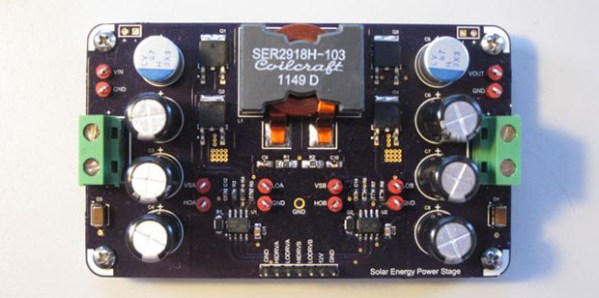
Building a solar power installation isn’t as simple as buying a few panels, wiring them up to a battery, and putting an inverter in the mix. To get the most out of your pricey panels, you’ll want to look at something called Maximum Power Point tracking. Solar panels have an IV curve, and this changes with how much sunlight they’re getting. To get the most out of a set of cells, you need make sure you’re drawing the maximum amount of power out of your cells.
[Nathaniel]’s Solar Energy Generator does just that. It can handle up to 500 Watts, sucks power down from a bank of solar cells and spits that out to a battery. That’s not everything; the project also has a microcontroller for measuring and displaying all the pertinent info, and some terminals to plug in a few DC loads.
While the Solar Energy Generator is designed for off the grid applications, this could easily augment a home installation on the cheap. If you want more than 500 Watts or so, you’ll want to look at a larger controller, but for anything under that, [Nathan] has you covered.
Videos below.
 The project featured in this post is a quarterfinalist in The Hackaday Prize.

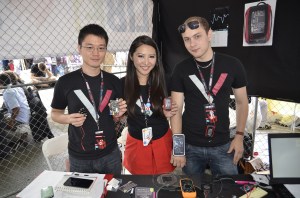 [Tom] told us that the team is currently redesigning their hardware. The next generation prototype board with more protection can be seen in the far right of the top photo. He also mentioned that they’re shooting for 5 digits of accuracy, placing them on par with many bench scopes. We’re skeptical to say the least about 5 digits, but the team is definitely putting their all into this product. We’ll wait until the Kickstarter backers start getting their final devices to see if Voltset is everything it’s cracked up to be.
 The kiln is built from slightly blemished pallet rack shelving that [Tim] cut to suit his needs. He skinned it with 1/2″ insulation boards sealed with aluminium tape and plans to add sheet metal to protect the insulation.