Valve Sells Software, So What’s With All The Hardware?

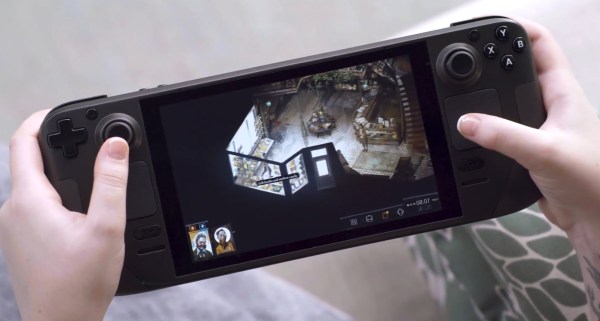
Steam branding is strong. Valve Corporation has turned their third-party marketplace into the first place millions choose to buy their PC games. The service has seen record-breaking numbers earlier this year with over 25 million concurrent users, so whatever they are doing is clearly working. Yet with all those software sales, last month Valve announced a new piece of hardware they call the Steam Deck.

Use the colloquialism you’d like, “not resting on your laurels” or “Mamba Mentality”, it’s not as if competitors in the handheld PC space are boasting ludicrous sales numbers. At their core, Valve is in the business of selling computer games. So why venture into making hardware? Continue reading “Valve Sells Software, So What’s With All The Hardware?”

Virtual Racers Battle It Out On Portable WS2812 Track

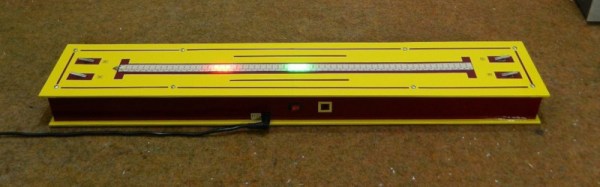
Sure modern video games are impressive, but you certainly don’t need a 4K display or high speed Internet connection to have a good time. For a perfect example, take a look at this unique one-dimensional racing game put together by [mircemk]. This variation of [Gerardo Barbarov Rostan]’s Open LED Race project has been scaled down so it can be transported easily, though at least for now, you’ll still need to plug it into an external power supply.

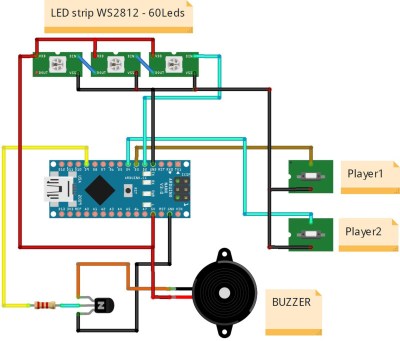
The game is pretty straightforward. By rapidly pressing their respective buttons, players race their virtual vehicles on a linear “track” made of 60 WS2812 RGB LEDs. In the most basic of terms, the faster they press their button, the faster the red or green illuminated LED that represents their car moves.
But in practice, things are made a bit more interesting with the addition of simulated gravity for the “hills” the racers will encounter. The cars also have a bit of inertia, and will coast along even when you aren’t mashing the button. There are even optional engine sounds, though as with the visual representation of the cars, a certain degree of imagination is required for the desired effect.

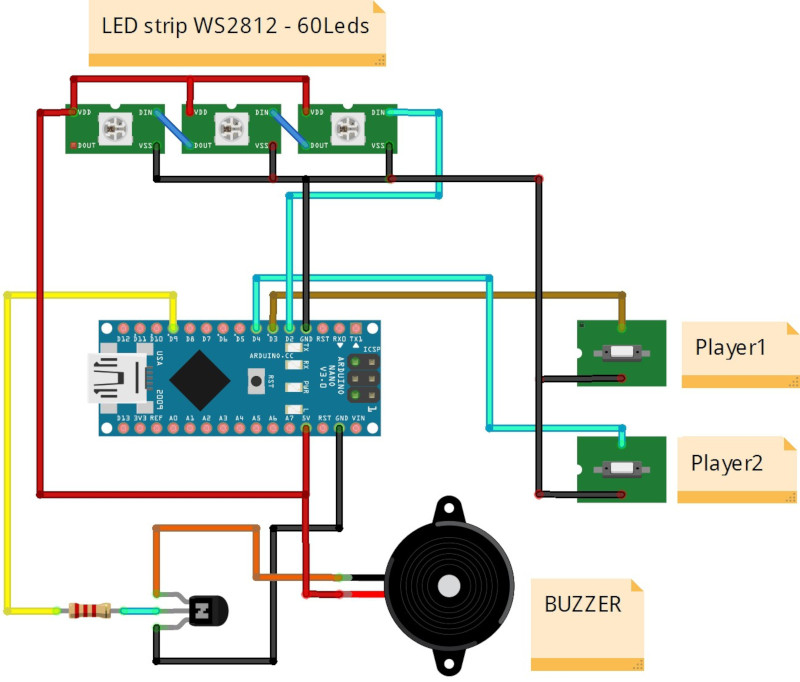
The hardware requirements for this game are minimal, and can easily be adapted to what you have in the parts bin. Beyond the strip of WS2812 LEDs, all you really need is a microcontroller and two buttons. Here [mircemk] is using an Arduino Nano, but you could press pretty much any MCU into service. To make this version as portable as possible, the buttons are built right into the PVC sheet enclosure, but putting them in some wired remotes would make for a bit more comfortable gameplay.

We’ve covered several projects that have aimed to turn the humble string of RGB LEDs into an interactive electronic game over the years. As long as you’ve got an open mind, you can find a whole world hidden inside some blinking lights.

Continue reading “Virtual Racers Battle It Out On Portable WS2812 Track”

Mega Man 4 Free of Charge ROM Hack Pexels Anete Lusina

Mega Man Hack Drops Charge Shot, Adds Classic Style

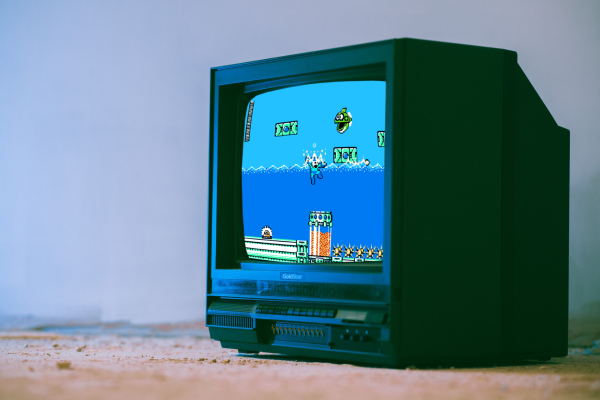
When it comes to the six original Mega Man games there is a clear dividing line between the first three and the last. Mega Man 4 introduced the charging shot mechanic that allowed players to hold down the fire button in order to power-up a single blast from Mega Man’s arm cannon. The aptly named, “Mega Man 4: Free of Charge” ROM hack by [Peter] seeks to bring cohesion with the first trilogy of Mega Man games by removing the charge shot mechanic completely. To compensate for the change, enemy health bars were also adjusted so that enemies aren’t as bullet-spongy.

The Mega Man 4: Free of Charge download comes as an IPS patch file. There are free utilities out there like Floating IPS that can apply the patch file to a clean dump of a NES cartridge. This ROM hack is playable on original Nintendo Entertainment System hardware via a flashcart device, or it can be played by any common NES emulator like FCEUX or Nestopia.

One of the most annoying parts of Mega Man 4 (minus the difficulty) was the constant whir of the charge shot drowning out the brilliant soundtrack. With a patch like [Peter]’s this is no longer a going concern, and players are able to give their thumbs a bit of a break by not needing to continually hold down fire throughout a run. All welcomed changes aside, it still won’t change the fact that the Japanese TV commercial for the game is cooler than the print ads in the US.

Continue reading “Mega Man Hack Drops Charge Shot, Adds Classic Style”

Retro League GX Homebrew on CRT

Rocket League Inspired Homebrew Reverses Onto Nintendo GameCube

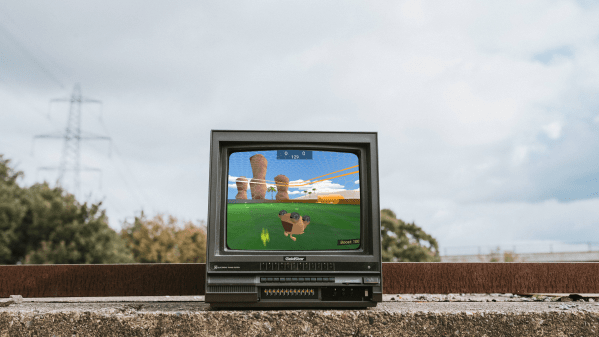
Would it have been too obvious to call a game about soccer playing RC cars, Soc-Car? Well [Martin] thought so and opted to call his Nintendo GameCube homebrew game, Retro League GX. The game clearly takes inspiration from Rocket League developed by Psyonix, as it pits teams of cars on a pitch plus comes complete with boosts to boot. There are some impressive physics on display here, and according to Krista over at GBATemp everything is playable on original hardware. Though those without a GameCube can certainly get a match in via the Dolphin emulator.

There are a number of ways to boot homebrew on a Nintendo GameCube, however, the most essential piece of software would be Swiss. Swiss is a homebrew utility that interfaces with all the myriad of ways to load code onto a GameCube these days. Common ways loading homebrew include saving files onto an SD card then using a SDGecko device that plugs into the memory card ports, or a SD2SP2 device that plugs into one of the GameCube’s expansion ports located on the bottom of the console. Those who prefer ditching the disc drive entirely can load homebrew via a optical disc emulator device like the GC Loader.

Still on the roadmap Retro League GX are ports for 3DS, PSP, Wii, and Linux. LAN and Online multiplayer are in the works as well. So at least that way GameCube broadband adapter owners may get to branch out beyond Phantasy Star Online for once. Best of all, [Martin] stated that the code for Retro League GX will be open sourced sometime next year.

Continue reading “Rocket League Inspired Homebrew Reverses Onto Nintendo GameCube”

Build That Catan Board You Designed

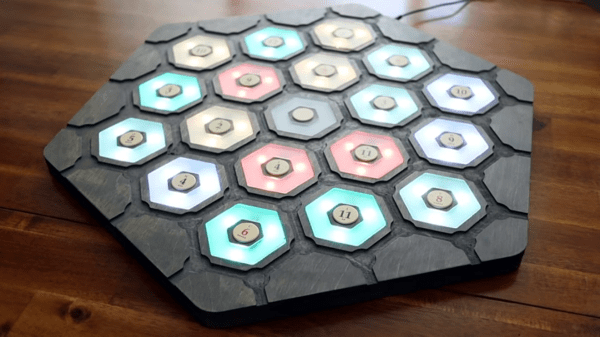
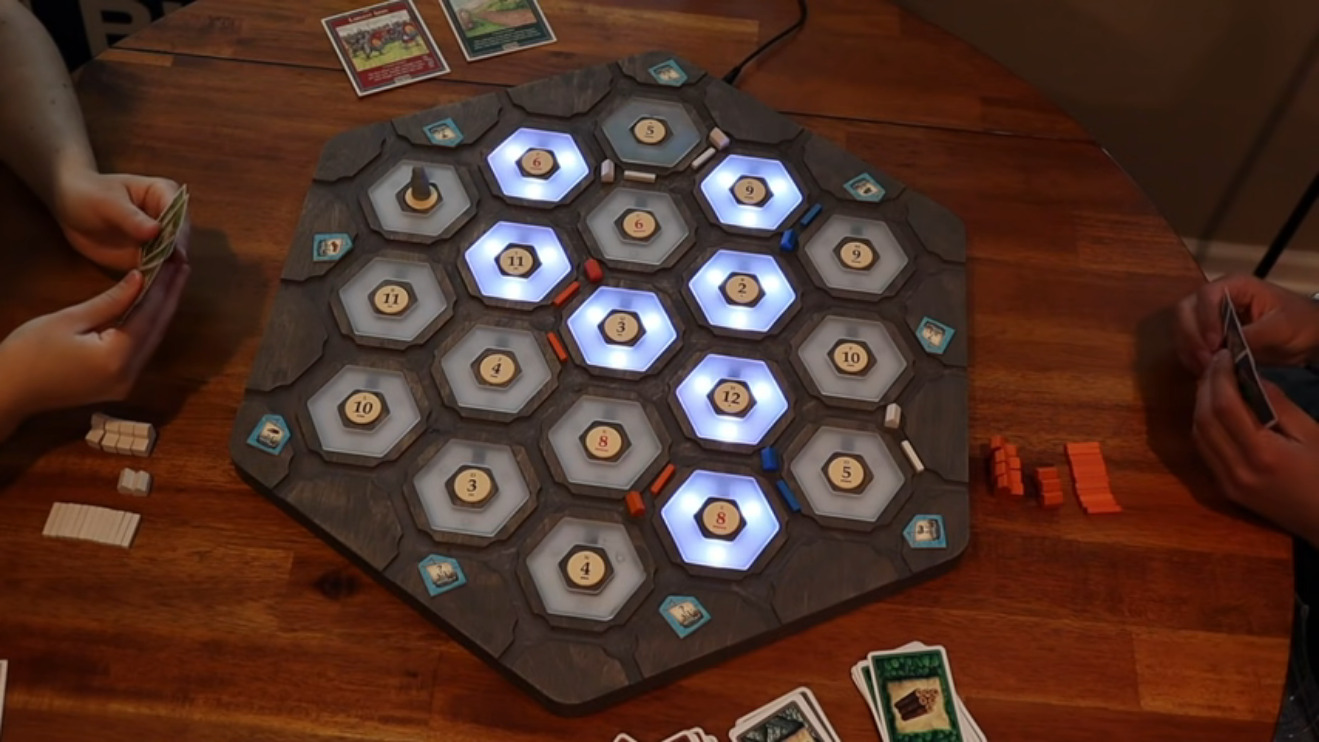
A couple of months ago, we posted about the one day design [Sam March] did of an electronic Settlers of Catan board. Now he’s released a video with the second half. His first video was about the design of the game, specifically the electronic components. In this video, [Sam] takes us through the physical build of the board.

A couple of visits to his local maker space allows him to cut both the wooden parts of the board, as well as the acrylic hexes that go on top of each piece. Even with a CNC machine, there’s still some clean-up that needs to be done. After cleaning up the edges of the wood with a chisel and staining it, it’s time to put the circuit boards in, wire them up and program them. The build includes a dice roller – pushing a button shows the number rolled by lighting up the tiles in the form of the rolled number. The final touch is having some friends over to actually play the game.

Between the design process in the last article and the build process in this one, we get a good look at the way [Sam] designs things from beginning to finished product. Take a look at our previous article on [Sam]’s design as well as some other Catan articles.

Continue reading “Build That Catan Board You Designed”

Cloud-Based Atari Gaming

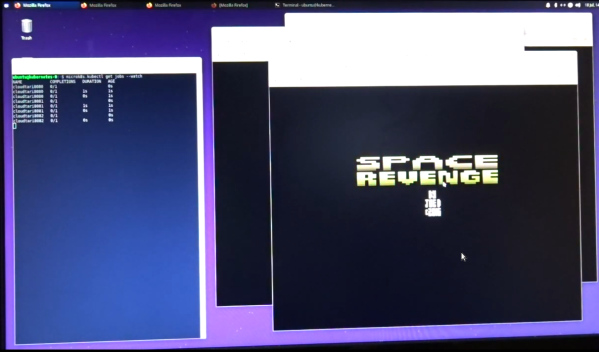
While the Google Stadia may be the latest and greatest in the realm of cloud gaming, there are plenty of other ways to experience this new style of gameplay, especially if you’re willing to go a little retro. This project, for example, takes the Atari 2600 into the cloud for a nearly-complete gaming experience that is fully hosted in a server, including the video rendering.

[Michael Kohn] created this project mostly as a way to get more familiar with Kubernetes, a piece of open-source software which helps automate and deploy container-based applications. The setup runs on two Raspberry Pi 4s which can be accessed by pointing a browser at the correct IP address on his network, or by connecting to them via VNC. From there, the emulator runs a specific game called Space Revenge, chosen for its memory requirements and its lack of encumbrance of copyrights. There are some limitations in that the emulator he’s using doesn’t implement all of the Atari controls, and that the sound isn’t available through the remote desktop setup, but it’s impressive nonetheless

[Michael] also glosses over this part, but the Atari emulator was written by him “as quickly as possible” so he could focus on the Kubernetes setup. This is impressive in its own right, and of course he goes beyond this to show exactly how to set up the cloud-based system on his GitHub page as well. He also thinks there’s potential for a system like this to run an NES setup as well. If you’re looking for something a little more modern, though, it is possible to set up a cloud-based gaming system with a Nintendo Switch as well.

Continue reading “Cloud-Based Atari Gaming”

Tabletop Basketball With Tentacles

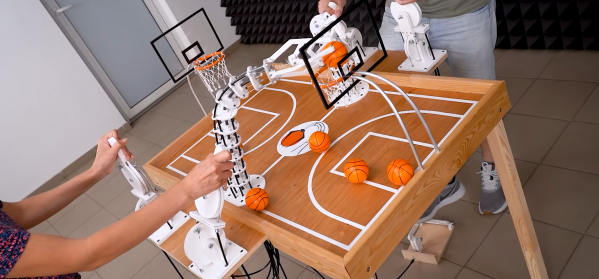
Unlike football/soccer and foosball, basketball doesn’t really lend itself to being turned into a tabletop game quite that easily. [The Q] has found a way around that, employing tentacle mechanisms to create a two-player, basketball-like game.

Each player uses a pair of two-axis control sticks and a foot pedal to operate a cable-driven tentacle with a gripper on the end. These are two stage tentacles, meaning that the top and bottom halves are independently controlled. The tentacles consist of a series of laminated foam discs clued onto bicycle cable sleeves. The cables are open in the section they control, and operate in a push-pull arrangement. The spring-loaded grippers are operated by the foot pedals, with a single cable running down the center of the tentacle.

The game looks quite fun and challenging, and we can imagine it being even more entertaining with teams of two or three people operating each tentacle. Add a bit of alcohol to adult players, and it might become downright hilarious, although the mechanisms would need to be beefed up a bit to survive that level of punishment.

We suspect [The Q] read [Joshua Vasquez]’s incredibly detailed three-part guide on two-stage tentacle mechanisms. Combine that with his guide to cable mechanism math, and you’d be well-equipped to build your own. Continue reading “Tabletop Basketball With Tentacles”