This excellent content from the Hackaday writing crew highlights recurring topics and popular series like Linux-Fu, 3D-Printering, Hackaday Links, This Week in Security, Inputs of Interest, Profiles in Science, Retrotechtacular, Ask Hackaday, Teardowns, Reviews, and many more.
In our “Mechanisms” series, we’ve featured the fascinating bits and pieces that go into making our mechanical world work. From simple machines such as screws and levers, from springs to couplings, and even more complex mechanisms like zippers and solenoids, we’ve covered the gamut. But we haven’t talked about one of the very earliest mechanisms, captured from nature by our clever ancestors to do useful work like grinding grain and shaping materials into tools: grit, sand, abrasives.
It may be hard for those raised on cinematic video games to conceive of the wonder of watching a plain white dot tracing across a black screen, reflecting off walls and bounced by a little paddle that responded instantly to the twist of a wrist. But there was a time when Pong was all we had, and it was fascinating. People lined up for hours for the privilege of exchanging a quarter for a few minutes of monochrome distraction. In an arcade stuffed with noisy pinball machines with garish artwork and flashing lights, Pong seemed like a calm oasis, and you could almost feel your brain doing the geometry to figure out where to place the paddle so as not to miss the shot.
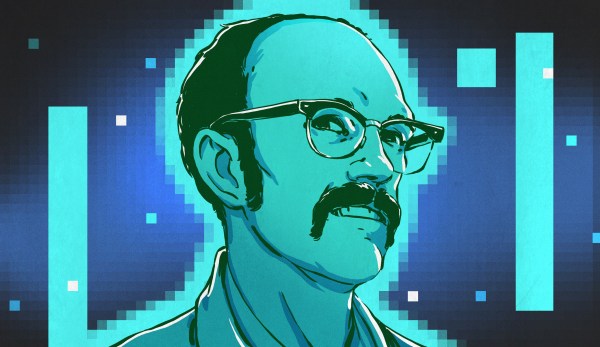
As primitive as it now seems, Pong was at the forefront of the video game revolution, and that little game spawned an industry that raked in $108 billion last year alone. It also spawned one of the early success stories of the industry, Atari, a company founded in 1972. Just last week, Ted Dabney, one of the co-founders of Atari, died at the age of 81. It’s sad that we’re getting to the point where we’re losing some of the pioneers of the industry, but it’s the way of things. All we can do is reflect on Dabney’s life and legacy, and examine the improbable path that led him to be one of the fathers of the video game industry.
It’s a brand new day as the Power Harvesting Challenge begins. This is the newest part of the 2018 Hackaday Prize and we’re looking for 20 entries who will each receive $1,000 and move onto the finals to compete for the top five spots, scoring cash prizes of $50k, $25k, $15k, $10k, and $5k.
Put simply, Power Harvesting is anything you can do that will pull some of the energy you need from a source other than wall-power or traditional battery tech. The most obvious power harvesting technologies are solar and wind. Ditch the battery in your doorbell for a solar panel, or turn your time-lapse camera rig into one that tops its battery with a tiny wind turbine. On the other end of the spectrum you could go nuts with chemistry and develop your own take on harvesting power from saltwater, or sip off the ambient RF waves all around us.
Every Idea Matters
We live in an amazing time as chip manufacturers have squeezed every low power trick out of their silicon dies that they possibly can. The Power Harvesting Challenge is the complement to those achievements: can we now squeeze as much energy out of non-traditional sources as possible to further reduce our energy footprints?
Hackers, Designers, and Engineers flooded into Dom Omladine on Saturday for what can only be described as an epic celebration of hardware culture. This is the second time Hackaday has organized a huge conference in Belgrade, and lightning really did strike twice.
A Gathering of New Friends and Old
We got things started off with a meetup the night before the conference. The first Hackaday Belgrade was held in 2016 and we didn’t reserve a bar on Friday night — we ended up taking over one just through sheer numbers. This year we called ahead for a large outdoor space, then made good use of it.
A great kickoff to the weekend
LED cube animation emulation demo
*No beers were wasted during this meetup
Everyone was giddy with anticipation of the next day to come. There is always a sizzling energy of meeting up in real life. Most of this group hangs out on Hackaday.io, but only some of them have met in person. Add to that the reunions of those who became friends at the previous Hackaday Belgrade and at other cons around Europe and you have the feeling of coming home. These really are your people.
Yes, a Conference. But the Cool Kind
Hackaday conferences are more than just parties… they’re conferences. If you approach it the right way you can get your employer on board with you attending because you’re going to meet incredible people, learn lots of stuff, and come back excited to take on the Universe. Actually, bring your boss along for the ride too!
Flooding into Hackaday Belgrade
Breakfast spread as the doors open
This year we had thirteen incredible talks. As is our practice, we started off with a super-technical talk as Rachel Wong (aka @konichiwakitty) discussed her Ph.D research which involves growing eye tissue in the lab. But like all incredibly brilliant minds, she has a creative outlet which she also covered as part of her Keynote address. Rachel has a passion for building wearables that are reaching for the future by embracing things we really do need in our garments and gear.
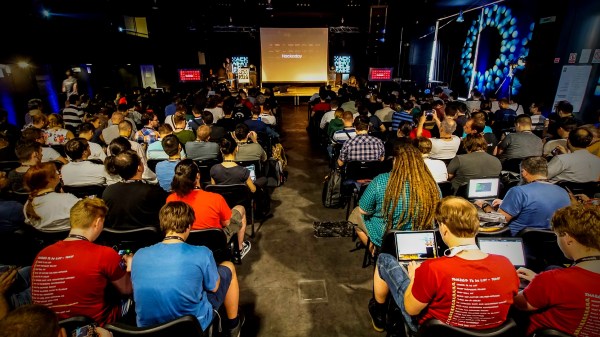
Main hall packed for the keynote address
The workshop area full to the brim
From drone monitoring networks to robot soldering machines, and concepts for designing meaningful hardware to using code to automate tedious PCB layout, there was plenty in these talks for everyone.
Rachel Wong on the growing of eye tissue
Elliot Williams demos Logic Noise live on stage
I really enjoyed Elliot Williams’ talk on Logic Noise for his live demos using simple logic chips to build up complex music. Marcel van Kervinck took us on a journey of TTL computer design. And Sophi Kravitz’s talk on building non-rigid airships had at least two people at the con get inspired and spin their own blimp design during the conference! There was a live-feed of the talks so keep your eye on Hackaday as we pull those out to be featured individually.
Some of the demo hardware: Acoustic levitation for lab work
The workshops were standing room only as people who weren’t able to grab a ticket audited the course. We had three hands-on session that built wearable circuitry, brough art to PCB design, and dove into the world of FPGAs.
Welcome, Here’s Your Neck-Mounted Retro Computer
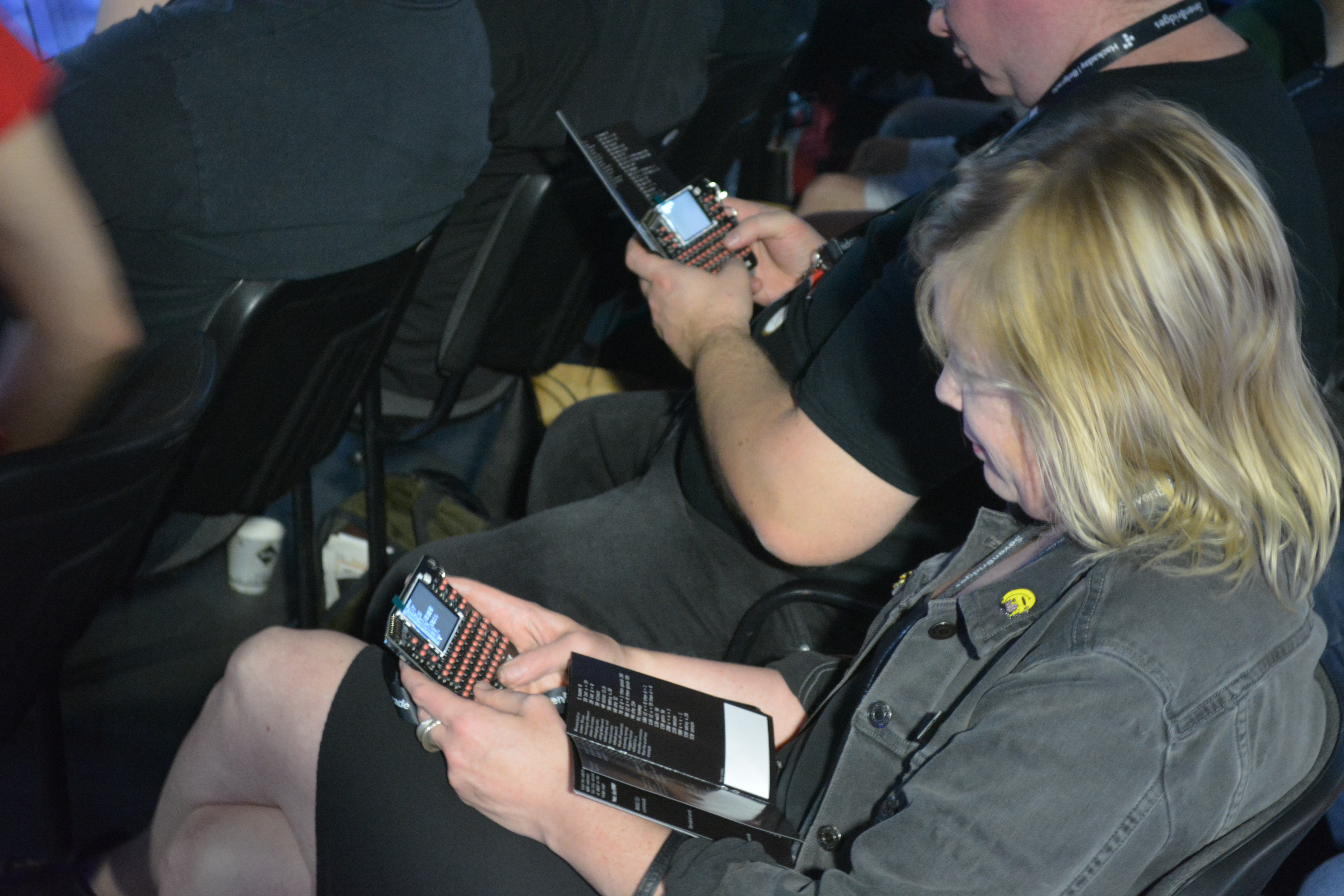
Everyone through the door received a custom electronic badge to hack on during Hackaday Belgrade. Voja Antonic designed the hardware and oversaw the manufacture. We had excellent yield which is great because we had nearly (if not more than) 100% attendance at the conference. We ended the day with just 5 badges to spare!
These handheld computers are truly hot! The badges each have 55 really clicky keys. With at least 350 people in the room, that’s approaching 20k momentary push switches and at one point, a brief “silence” fell and all that could be heard were clicking buttons. That and we asked everyone to play the Mario Overworld tune at the same time as hundreds of badges rose in a glorious chorus. There’s also a 16-page user manual to go along with them which included sample code to get started.
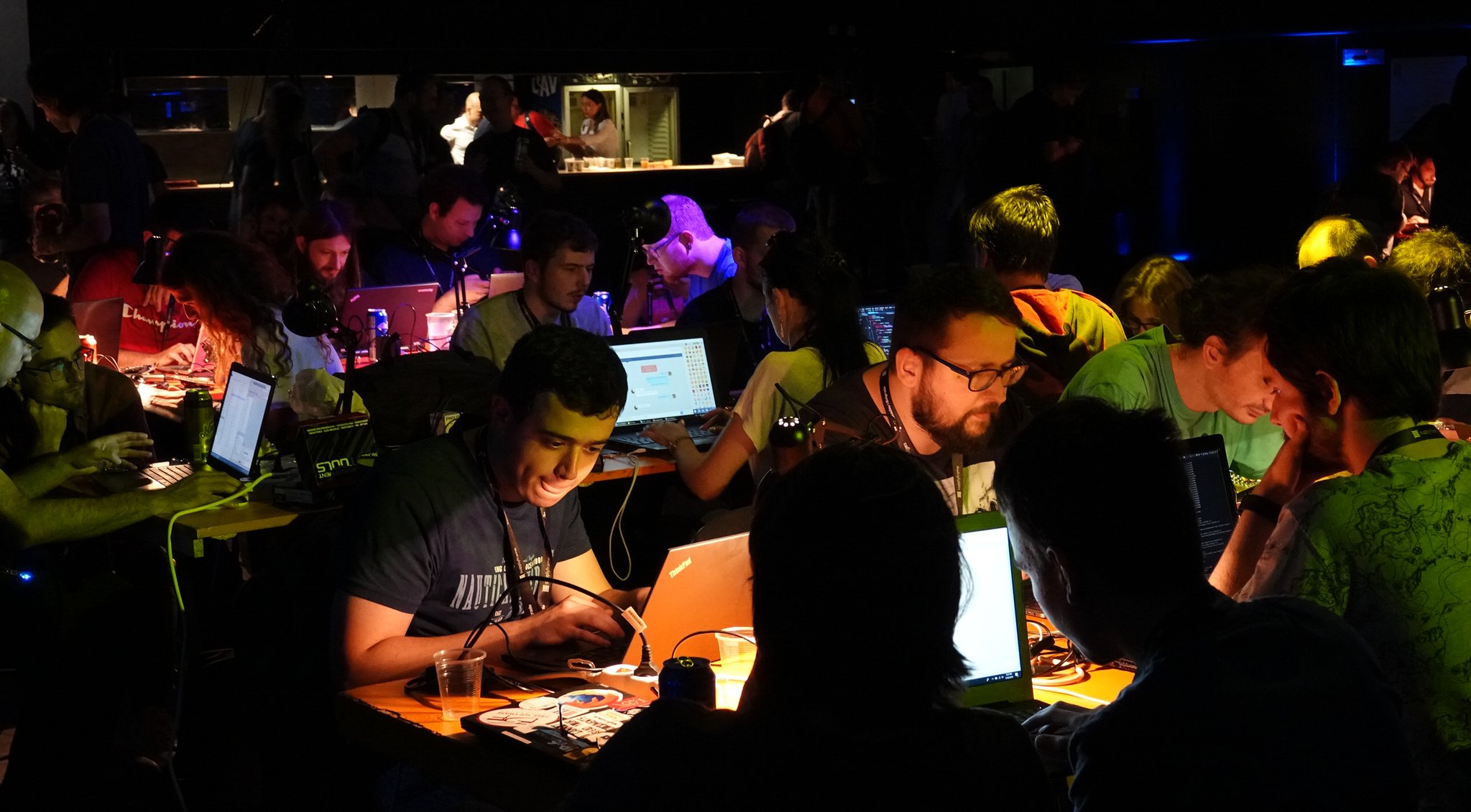
Hacking went on throughout the day but as the talk session wrapped up we transformed the hall into a Hacker Village. Tables were brought in and immediately filled. Live music filled the room as Bogdan Rosu and Richard Hogben each played IDM sets. If you’ve been watching Hackaday videos you’ve heard their work and their performances this night were epic.
What is better than hacking to live music?
Still going strong as midnight approaches
Rich and Bogdan join forces for the final live music set
So much hacking, so little time
Head to head game called ‘Shoot my Valentine’
Head to head Tic Tac Toe
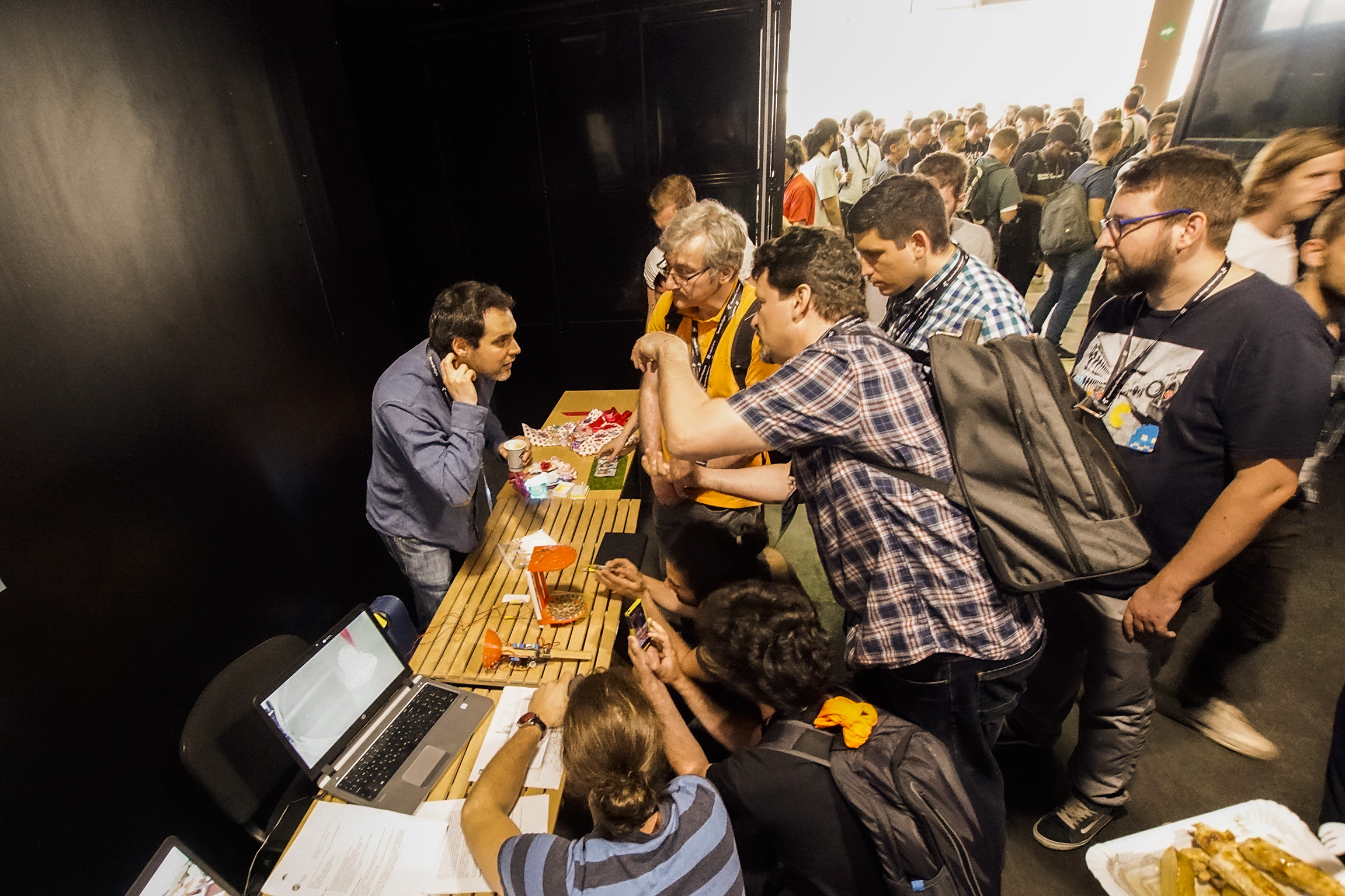
There were other hardware demos on display too
This badge was put on WiFi by lunchtime
[Flummer]’s badge displays minimalist style
Detail of [Larissa Koncz]’s Interactive Poetic Glove from the workshop
The world’s slowest sinewave, calculated in BASIC: [Tom van Dijk]
So much ASCII art!
[Frederic] and [Manoel] got their badges talking over AFSK, when the RF interference didn’t get them…
The RevSpace crew at work in the quiet workshop room
There was food, there was beer, and there were the tools of our lifestyle; laptops, programmers, jumper wires, blinky add-ons, and the excitement that goes along with all of them. The badge hacking presentations began at midnight and the place was still alive with excitement. It is truly great to see how supportive our community is of exploring hardware and trying things out. Publish your badge hacks and stories from the conference on Hackaday.io as we’ll be featuring those in the coming days and want to make sure we have all the juicy details.
Why Belgrade?
Keep your eye on Hackaday as there is much more coverage to come on this wonderful event. Many have asked: “Why Belgrade?”. It’s a fantastic city and the engineering community in the area is passionate about getting together to learn and share ideas. This includes the Supplyframe engineers who live in Belgrade and did the heavy lifting to organize and staff Hackaday Belgrade. You all did an amazing job and everyone at the con owes you a debt of gratitude, thank you so much! We also want to thank Supplyframe and SevenBridges, our sponsors for the event.
To all who attended, it wouldn’t have happened without you! I can speak for everyone on the Hackaday crew in saying the culture we share is energizing, encouraging, and humbling. It’s exactly the kind of recharge everyone looks for to keep life interesting! We’ll see you at the next one. Now over the next five months we have our sights set on the Hackaday Superconference. See you there!
If you’ve done anything with a modern Linux system — including most variants for the Raspberry Pi — you probably know about sudo. This typically allows an authorized user to elevate themselves to superuser status to do things.
However, there is a problem. If you have sudo access, you can do anything — at least, anything the sudoers file allows you to do. But what about extremely critical operations? We’ve all seen the movies where launching the nuclear missile requires two keys counter-rotated at the same time and third firing key. Is there an equivalent for Linux systems?
It isn’t exactly a counter-rotating key, but the sudo_pair project — a prelease open-source project from Square — gives you something similar. The project is a plugin for sudo that allows you to have another user authorize a sudo request. Not only do they authorize it, but they get to see what is happening, and even abort it if something bad is happening.
Today we take the concept of a centralized software repository for granted. Whether it’s apt or the App Store, pretty much every device we use today has a way to pull applications in without the user manually having to search for them on the wilds of the Internet. Not only is this more convenient for the end user, but at least in theory, more secure since you won’t be pulling binaries off of some random website.
But centralized software distribution doesn’t just benefit the user, it can help developers as well. As platforms like Steam have shown, once you lower the bar to the point that all you need to get your software on the marketplace is a good idea, smaller developers get a chance to shine. You don’t need to find a publisher or pay out of pocket to have a bunch of discs pressed, just put your game or program out there and see what happens. Markus “Notch” Persson saw his hobby project Minecraft turn into one of the biggest entertainment franchises in decades, but one has to wonder if it would have ever gotten released commercially if he first had to convince a publisher that somebody would want to play a game about digging holes.
In the days before digital distribution was practical, things were even worse. If you wanted to sell your game or program, it needed to be advertised somewhere, needed to be put on physical media, and it needed to get shipped out to the customer. All this took capital that would easily be beyond many independent developers, to say nothing of single individuals.
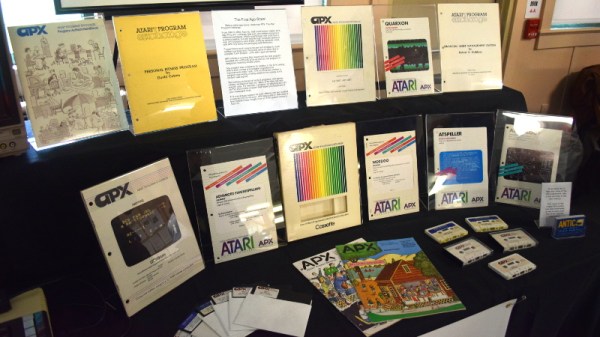
But at the recent Vintage Computer Festival East, [Allan Bushman] showed off relics from a little known chapter of early home computing: the Atari Program Exchange (APX). In a wholly unique approach to software distribution at the time, individuals were given a platform by which their software would be advertised and sold to owners of 8-bit machines such as the Atari 400/800 and later XL series computers. In the early days, when the line between computer user and computer programmer was especially blurry, the APX let anyone with the skill turn their ideas into profit. Continue reading “VCF East 2018: The Mail Order App Store”→
If you like your synthesizers glitchy, squawky, or simply quick-and-dirty, you won’t want to miss this week’s Hack Chat with Hackaday’s own [Elliot Williams], because he’ll be brain-dumping everything he knows about making music with 4000-series CMOS logic chips. Break out your breadboards!







![[Flummer]'s badge displays minimalist style](https://i0.wp.com/hackaday.com/wp-content/uploads/2018/05/dscf0774.jpg?w=242&h=182&ssl=1 "DSCF0774")
![Detail of [Larissa Koncz]'s Interactive Poetic Glove from the workshop](https://i0.wp.com/hackaday.com/wp-content/uploads/2018/05/dscf0785.jpg?w=242&h=181&ssl=1 "DSCF0785")
![The world's slowest sinewave, calculated in BASIC: [Tom van Dijk]](https://i0.wp.com/hackaday.com/wp-content/uploads/2018/05/dscf0776.jpg?w=225&h=168&ssl=1 "DSCF0776")

![[Frederic] and [Manoel] got their badges talking over AFSK, when the RF interference didn't get them...](https://i0.wp.com/hackaday.com/wp-content/uploads/2018/05/dscf0748_bright.png?w=126&h=168&ssl=1 "DSCF0748_bright")