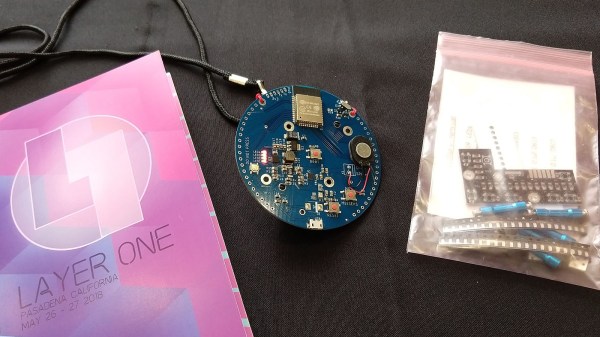
The security conference LayerOne 2018 took place this past weekend in Pasadena, California. A schedule conflict meant most of our crew was at Hackaday Belgrade but I went to LayerOne to check it out as a first-time attendee. It was a weekend full of deciphering an enigmatic badge, hands-on learning about physical security, admiring impressive demos, and building a crappy robot.
Hackaday Columns4820 Articles
This excellent content from the Hackaday writing crew highlights recurring topics and popular series like Linux-Fu, 3D-Printering, Hackaday Links, This Week in Security, Inputs of Interest, Profiles in Science, Retrotechtacular, Ask Hackaday, Teardowns, Reviews, and many more.
Biasing That Transistor: The Emitter Follower
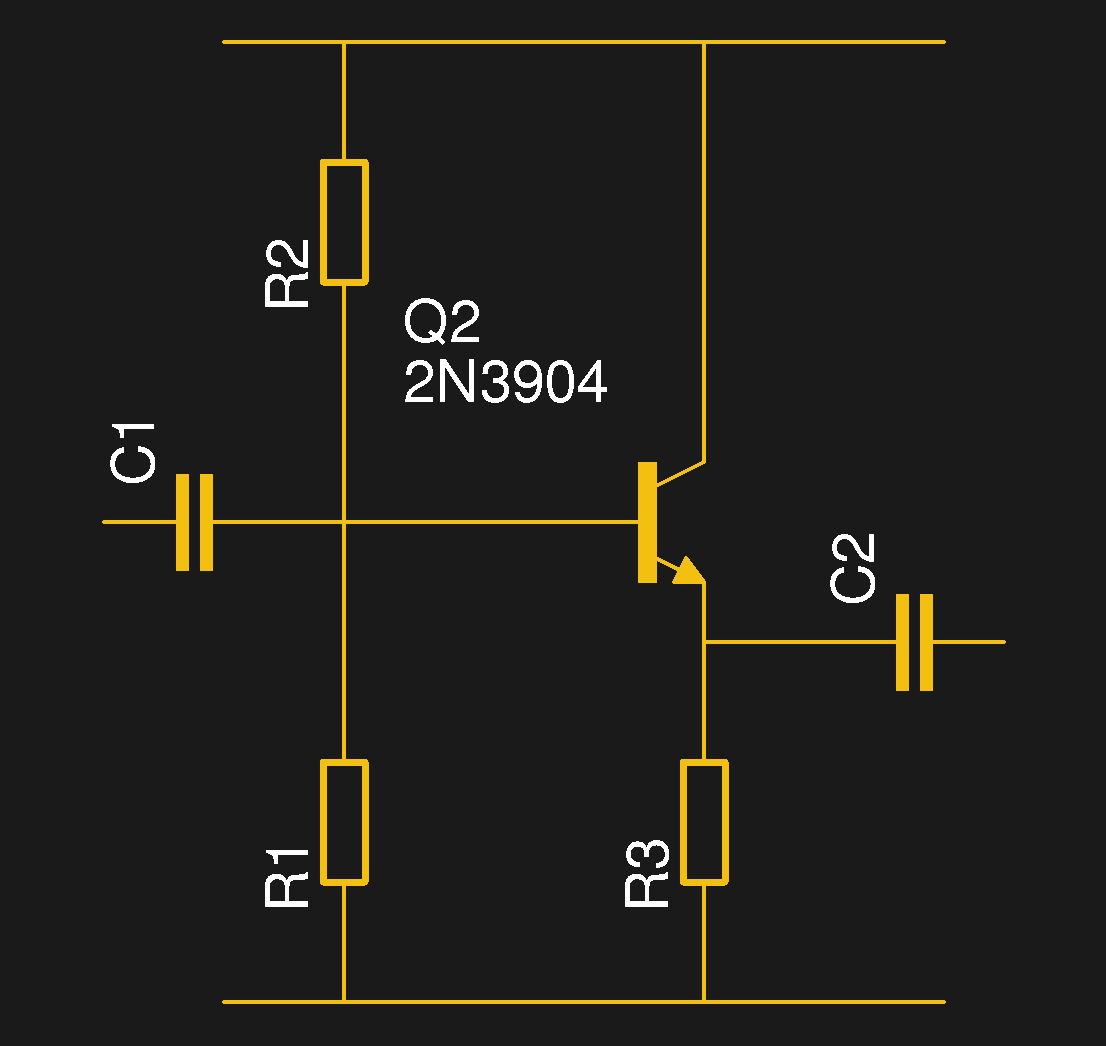
We were musing upon the relative paucity of education with respect to the fundamentals of electronic circuitry with discrete semiconductors, so we thought we’d do something about it. So far we’ve taken a look at the basics of transistor biasing through the common emitter amplifier, then introduced a less common configuration, the common base amplifier. There is a third transistor amplifier configuration, as you might expect for a device that has three terminals: the so-called Common Collector amplifier. You might also know this configuration as the Emitter Follower. It’s called a “follower” because it tracks the input voltage, offering increased current capability and significantly lower output impedance.

Just as the common emitter amplifier and common base amplifier each tied those respective transistor terminals to a fixed potential and used the other two terminals as amplifier input and output, so does the common collector circuit. The base forms the input and its bias circuit is identical to that of the common emitter amplifier, but the rest of the circuit differs in that the collector is tied to the positive rail, the emitter forms the output, and there is a load resistor to ground in the emitter circuit.
As with both of the other configurations, the bias is set such that the transistor is turned on and passing a constant current that keeps it in its region of an almost linear relationship between small base current changes and larger collector current changes. With variation of the incoming signal and thus the base current there is a corresponding change in the collector current dictated by the transistor’s gain, and thus an output voltage is generated across the emitter resistor. Unlike the common emitter amplifier this voltage increases or decreases in step with the input voltage, so the emitter follower is not an inverting amplifier.
Continue reading “Biasing That Transistor: The Emitter Follower”
VCF East 2018: The Desktop ENIAC
The ENIAC, or Electronic Numerical Integrator and Computer, is essentially the Great Great Grandfather of whatever device you’re currently reading these words on. Developed during World War II for what would be about $7 million USD today, it was designed to calculate artillery firing tables. Once word got out about its capabilities, it was also put to work on such heady tasks as assisting with John von Neumann’s research into the hydrogen bomb. The success of ENIAC lead directly into the development of EDVAC, which adopted some of the now standard computing concepts such as binary arithmetic and the idea of stored programs. The rest, as they say, is history.
But ENIAC wasn’t just hugely expensive and successful, it was also just plain huge. While it’s somewhat difficult for the modern mind to comprehend, ENIAC was approximately 100 feet long and weighed in at a whopping 27 tons. In its final configuration in 1956, it contained about 18,000 vacuum tubes, 7,000 diodes, 70,000 resistors, 10,000 capacitors, and 6,000 switches. All that hardware comes with a mighty thirst for power: the ENIAC could easily suck down 150 kW of electricity. At the time this all seemed perfectly reasonable for a machine that could perform 5,000 instructions per second, but today an Arduino would run circles around it.
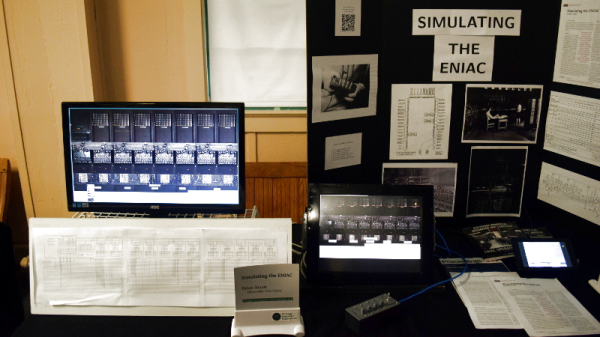
This vast discrepancy between the power and size of modern hardware versus such primordial computers was on full display at the Vintage Computer Festival East, where Brian Stuart demonstrated his very impressive ENIAC emulator. Like any good vintage hardware emulator, his project not only accurately recreates the capabilities of the original hardware, but attempts to give the modern operator a taste of the unique experience of operating a machine that had its heyday when “computers” were still people with slide rules. Continue reading “VCF East 2018: The Desktop ENIAC”
Hackaday Belgrade 2018 Is Sold Out: We Can’t Wait For Saturday
Greetings from beautiful Belgrade! With the Hackaday crew arriving over the last couple of days, preparations are in full swing, and the excitement is building for Hackaday Belgrade 2018 on Saturday. Here’s all the news you need to know.
If you haven’t gotten tickets yet, you can’t say we didn’t warn you! We’ve sold out. But don’t despair: there’s a waitlist, so get your name in now if you still want to get in.
- The final conference schedule has just been released and it’s super.
- We’re having a meetup Friday night at 20:00 at the Bajloni Bar and Beyond, join us!
- Folks are already meeting up using the conference’s chat. Hang out there even if you’re not in town.
- Subscribe to Hackaday’s YouTube channel so that you don’t miss out when we start the live stream
If you’re looking for something to do in town this weekend, don’t miss [Brian Benchoff]’s Ode to Belgrade and especially some great local info in the comments. From which taxis to take, to finding a hardware store, to touring monuments of brutalist architecture, this post has it all.
And last but not least, the badges are in the final stages of production. [Voja] and [Mike] are temporarily distracted by watching themselves on N1, the Serbian CNN affiliate, for which they were interviewed this morning about hacker culture, and about building badge hardware and writing the firmware for it. They’ll get back to epoxying speakers and writing code any time now.
In short, Hackaday Belgrade is a sold-out, unstoppable force of nature. We’re so excited to be here and can’t wait to see you all on Saturday!
Ask Hackaday: How Do You DIY A Top-Octave Generator?
One of the great joys of Hackaday are the truly oddball requests that we sometimes get over the tip line. Case in point: [DC Darsen] wrote in with a busted 1970s organ in need of a new top-octave generator, and wondered if we could help. He had found a complicated but promising circuit online, and was wondering if there was anything simpler. I replied “I should be able to get that done with a single Arduino” and proceeded to prove myself entirely wrong in short order.
So we’re passing the buck on to you, dear Hackaday reader. Can you help [DC Darsen] repair his organ with a minimum amount of expenditure and hassle? All we need to do is produce twelve, or maybe thirteen, differently pitched square waves simultaneously.
Continue reading “Ask Hackaday: How Do You DIY A Top-Octave Generator?”
Mechanisms: Solenoids
Since humans first starting playing with electricity, we’ve proven ourselves pretty clever at finding ways to harness that power and turn it into motion. Electric motors of every type move the world, but they are far from the only way to put electricity into motion. When you want continuous rotation, a motor is the way to go. But for simpler on and off applications, where fine control of position is not critical, a solenoid is more like what you need. These electromagnetic devices are found everywhere and they’re next in our series on useful mechanisms.
Friday Hack Chat: Making Programming Easier
There is a long history of graphical programming languages. Some people don’t like to code, and for them, graphical programming languages replace semicolons and brackets with easy-to-understand boxes and wires.

This Friday, we’re going to be talking about graphical programming languages with [Boian Mitov]. He’s a software developer, founder of Mitov Software, and the creator of Visuino, a graphical programming language for the embedded domain. He specialized in video, audio, DSP, DAQ, industrial automation, communications, computer vision, artificial intelligence, as well as parallel and distributed computing. [Boian] is the author of the OpenWire open source technology, the IGDI+ open source library, the VideoLab, SignalLab, AudioLab, PlotLab, InstrumentLab, VisionLab, IntelligenceLab, AnimationLab, LogicLab, CommunicationLab, and ControlLab libraries, OpenWire Studio, Visuino, and author of the “VCL for Visual C++” technology.
For this Hack Chat, we’re going to be talking about ways to make programming microcontrollers easier. The focus of this discussion is Visuino, a graphical programming environment. Visuino allows anyone to program an Arduino, Teensy, or an ESP simply by connecting wires and choosing some logic. Think of it as a step above the programming environment that came with the Lego Mindstorms, Scratch, or whatever else MIT was coming out with in the early ‘aughts.
You are, of course, encouraged to add your own questions to the discussion. You can do that by leaving a comment on the Hack Chat Event Page and we’ll put that in the queue for the Hack Chat discussion.

Our Hack Chats are live community events on the Hackaday.io Hack Chat group messaging. This week is just like any other, and we’ll be gathering ’round our video terminals at noon, Pacific, on Friday, May 25th. Here’s a clock counting down the time until the Hack Chat starts.
Click that speech bubble to the right, and you’ll be taken directly to the Hack Chat group on Hackaday.io.
You don’t have to wait until Friday; join whenever you want and you can see what the community is talking about.