Retrotechtacular: Constructing A Car Engine

Oxford is a city world-famous for its university, and is a must-see stop on the itinerary of many a tourist to the United Kingdom. It features mediaeval architecture, unspoilt meadows, two idylic rivers, and a car plant. That’s the part the guide books don’t tell you, if you drive a BMW Mini there is every chance that it was built in a shiny new factory on the outskirts of the historic tourist destination.

A 1930s Morris Ten Series II. Humber79 [CC BY-SA 3.0].
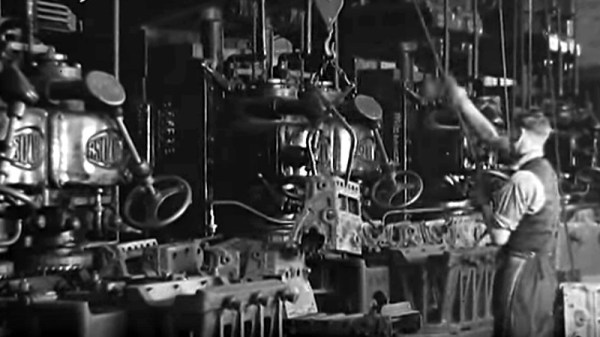
The origins of the Mini factory lie over the road on a site that now houses a science park but was once the location of the Morris Motors plant, at one time Britain’s largest carmaker. In the 1930s they featured in a British Pathé documentary film which we’ve placed below the break, part of a series on industry in which the production of an internal combustion engine was examined in great detail. The music and narration is charmingly of its time, but the film itself is not only a fascinating look inside a factory of over eight decades ago, but also an insight into engine manufacture that remains relevant today even if the engine itself bears little resemblance to the lump in your motor today.

Morris produced a range of run-of-the-mill saloon cars in this period, and their typical power unit was one of the four-cylinder engines from the film. It’s a sidevalve design with a three-bearing crank, and it lacks innovations such as bore liners. The metallurgy and lubrication in these engines was not to the same standard as an engine of today, so a prewar Morris owner would not have expected to see the same longevity you’d expect from your daily.

Continue reading “Retrotechtacular: Constructing A Car Engine”

Fatalities Vs False Positives: The Lessons From The Tesla And Uber Crashes

In one bad week in March, two people were indirectly killed by automated driving systems. A Tesla vehicle drove into a barrier, killing its driver, and an Uber vehicle hit and killed a pedestrian crossing the street. The National Transportation Safety Board’s preliminary reports on both accidents came out recently, and these bring us as close as we’re going to get to a definitive view of what actually happened. What can we learn from these two crashes?

There is one outstanding factor that makes these two crashes look different on the surface: Tesla’s algorithm misidentified a lane split and actively accelerated into the barrier, while the Uber system eventually correctly identified the cyclist crossing the street and probably had time to stop, but it was disabled. You might say that if the Tesla driver died from trusting the system too much, the Uber fatality arose from trusting the system too little.

But you’d be wrong. The forward-facing radar in the Tesla should have prevented the accident by seeing the barrier and slamming on the brakes, but the Tesla algorithm places more weight on the cameras than the radar. Why? For exactly the same reason that the Uber emergency-braking system was turned off: there are “too many” false positives and the result is that far too often the cars brake needlessly under normal driving circumstances.

The crux of the self-driving at the moment is precisely figuring out when to slam on the brakes and when not. Brake too often, and the passengers are annoyed or the car gets rear-ended. Brake too infrequently, and the consequences can be worse. Indeed, this is the central problem of autonomous vehicle safety, and neither Tesla nor Uber have it figured out yet.

Continue reading “Fatalities Vs False Positives: The Lessons From The Tesla And Uber Crashes”

Retrotechtacular: Car Navigation Like It’s 1971

Anyone old enough to have driven before the GPS era probably wonders, as we do, how anyone ever found anything. Navigation back then meant outdated paper maps, long detours because of missed turns, and the far too frequent stops at dingy gas stations for the humiliation of asking for directions. It took forever sometimes, and though we got where we were going, it always seemed like there had to be a better way.

Indeed there was, but instead of waiting for the future and a constellation of satellites to guide the way, some clever folks in the early 1970s had a go at dead reckoning systems for car navigation. The video below shows one, called Cassette Navigation, in action. It consisted of a controller mounted under the dash and a modified cassette player. Special tapes, with spoken turn-by-turn instructions recorded for a specific route, were used. Each step was separated from the next by a tone, the length of which encoded the distance the car would cover before the next step needed to be played. The controller was hooked to the speedometer cable, and when the distance traveled corresponded to the tone length, the next instruction was played. There’s a long list of problems with this method, not least of which is no choice in road tunes while using it, but given the limitations at the time, it was pretty ingenious.

Dead reckoning is better than nothing, but it’s a far cry from GPS navigation. If you’re still baffled by how that cloud of satellites points you to the nearest Waffle House at 3:00 AM, check out our GPS primer for the details.

Continue reading “Retrotechtacular: Car Navigation Like It’s 1971”

Titanium Knob Doesn’t Grind Our Gears

Manual transmissions! Those blessed things that car enthusiasts swear by and everyone else pretends no longer exists. They’re usually shifted by using the gearstick, mounted in the centre console of the car. Swapping out the knob on the gearstick is a popular customization; you can have everything from 8-balls to skulls, to redback spiders mounted in epoxy, sitting proud atop your gearstick. It’s rare to see anything new under the sun, but [John Allwine] came up with something we’d never seen before.

[John]’s design leans heavily on the unique ability of additive manufacturing to produce complex hollow geometries that are incredibly difficult or impossible to produce with traditional subtractive methods. The part was designed in CAD software, and originally printed on a Makerbot in plastic. After this broke, it was decided to instead produce the part in stainless steel using Shapeway’s custom order process. You can even buy one yourself. This is a much smarter choice for a part such as a gearknob which undergoes heavy use in an automotive application. The part is printed with threads, but due to the imperfect printing process, these should be chased with a proper tap to ensure good fitment.

The design was eyecatching enough to grab the attention of a professional engineer from a 3D printing company, who worked with [John] to make the part out of titanium. It’s a very tough and hardy material, though [John] notes it was an arduous task to go about tapping the threads because of this.

It’s a great example of what can now be achieved with 3D printing technology. No longer must we settle for plastic – through services like Shapeways, it’s now possible to 3D print attractive metal parts in complex designs! And, if you’ve got the right friends, you can even step it up to titanium, too.

We’ve seen other takes on the 3D shifter handle, too – like this head.


Roll A Black Box For Your Wheels

Telemetric devices for vehicles, better known as black boxes, cracked the consumer scene 25 years ago with the premiere of OnStar. These days, you can get one for free from your insurance company if you want to try your luck at the discounts for safe driving game. But what if you wanted a black box just to mess around with that doesn’t share your driving data with the world? Just make one.

[TheForeignMan]’s DIY telematics box was designed to pull reports of the car’s RPM, speed, and throttle depression angle through the ODBII port. An ODBII-to-Bluetooth module sends the data to an Arduino Mega and logs it on an SD card along with latitude and longitude from a NEO-6M GPS module. Everything is powered by the car’s battery through a cigarette lighter-USB adapter.

He’s got everything tightly wrapped up inside a 3D printed box, which makes it pretty hard to retrieve the SD card. In the future, he’d like to send the data to a server instead to avoid accidentally dislodging a jumper wire.

If this one isn’t DIY enough for you to emulate, start by building your own CAN bus reader.

The Hacky Throttle Repair That Got Me On The Road Again

Old cars are great. For the nostalgia-obsessed like myself, getting into an old car is like sitting in a living, breathing representation of another time. They also happen to come with their fair share of problems. As the owner of two cars which are nearing their 30th birthdays, you start to face issues that you’d never encounter on a younger automobile. The worst offender of all is plastics. Whether in the interior or in the engine bay, after many years of exposure to the elements, parts become brittle and will crack, snap and shatter at the slightest provocation.

You also get stuck bolts. This was the initial cause of frustration with my Volvo 740 Turbo on a cold Sunday afternoon in May. As I tried in vain to free the fuel rail from its fittings, I tossed a spanner in frustration and I gave up any hope of completing, or indeed, starting the job that day. As I went to move the car back into the driveway, I quickly noticed a new problem. The accelerator was doing approximately nothing. Popping the hood, found the problem and shook my head in resignation. A Volvo 740 Turbo is fitted with a ball-jointed linkage which connects the accelerator cable to the throttle body itself. In my angst, the flying spanner had hit the throttle body and snapped the linkage’s plastic clips. It was at this point that I stormed off, cursing the car that has given me so much trouble over the past year.

Continue reading “The Hacky Throttle Repair That Got Me On The Road Again”

Reverse Engineered Media Controller From Car Is Best Friends With Android

The CAN bus is a rich vein to mine for a hacker: allowing the electronic elements of most current vehicles to be re-purposed and controlled with ease. [MikrocontrollerProjekte] has reverse engineered a CAN bus media and navigation controller and connected it to an STM32F746G-Discovery board. The STM32 is in turn connected to an Android phone, and allows the media controller to trigger a large number of functions on the phone, including music playback, maps, and general Android navigation.

When reverse engineering the controller, [MikrocontrollerProjekte] employed a variety of approaches. A small amount of information was found online, some fuzzing was done with random CAN bus IDs and messages, as well as some data logging with the device inside the car to identify message data to the relevant IDs on the bus.

The STM32F746G-Discovery board acts as a Human Interface Device (HID), emulating a mouse and keyboard connected to the Android phone via USB OTG. The LCD screen shows the output of the keystrokes and touchpad area. We’re not sure how useful the mouse-emulation would be, given that the phone has a touchscreen, but the media functions work really well, and would also make a really snazzy music controller for a PC.

We’ve covered plenty of other cool CAN bus hacks, like reverse-engineering this Peugeot 207, or this general purpose CAN sniffer.

Continue reading “Reverse Engineered Media Controller From Car Is Best Friends With Android”