A Vintage Morse Key Turned Into USB Keyboard

Time was when only the cool kids had new-fangled 102-key keyboards with a number pad, arrow keys, and function keys. They were such an improvement over the lame old 86-key layout that nobody would dream of going back. But going all the way back to a one-key keyboard is pretty cool, in the case of this Morse keyer to USB keyboard adapter.

To revive her dad’s old straight key, a sturdy mid-20th century beast from either a military or commercial setup, [Nomblr] started with a proper teardown and cleaning of the brass and Bakelite pounder. A Teensy was chosen for the job of converting Morse to keyboard strokes; careful consideration to the timing of dits and dahs and allowances for contact debouncing were critical to getting the job done. A new wooden base not only provides stability for the key but hides the Teensy and makes for a new presentation. The video below shows it in action; our only complaint is the lack of sidetone to hear the Morse as you pound out that next great novel one click at a time.

Lovingly restored telegraph gear is a bit of a thing around here; we featured this vintage telegraph sounder revived with a Morse code sender not too long ago.

https://www.youtube.com/watch?v=qh_apYcr4xI

[via r/DIY]

Thanks to [Liz] for the tip

A Very 2017 Take On A BBC Micro

In the early 1980s, there were a plethora of 8-bit microcomputers on the market, and the chances are that if you were interested in such things you belonged to one of the different tribes of enthusiasts for a particular manufacturer’s product. If you are British though there is likely to be one machine that will provide a common frame of reference for owners of all machines of that era: The Acorn BBC Microcomputer which was ubiquitous in the nation’s schools. This 6502-driven machine is remembered today as the progenitor and host of the first ARM processors, but at the time was notable for the huge array of built-in interfaces it contained. Its relatively high price though meant that convincing your parents to buy you one instead of a ZX Spectrum was always going to be an uphill struggle.

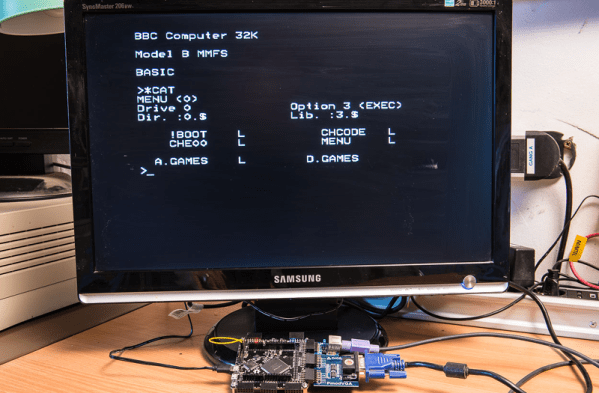
So, you never owned a BBC Micro, and this has scarred you for life. Never mind, all is not lost, for now you can have that Acorn experience without scouring eBay for a classic micro, by running one entirely in silicon on a myStorm FPGA board.

To be fair, running classic hardware on an FPGA is nothing new and there have been a few BBC Micros implemented in this way, not to mention an Acorn Atom. But this project builds on the previous FPGA BBC Micros by porting it entirely to Verilog and incorporating some of the bug fixes from their various forks. There are screenshots of the result running several classic games, as well as test screens and a benchmark revealing it to be a faithful reproduction of a 2MHz BBC Micro.

We covered the myStorm board when it arrived last year. We’ve also brought you another FPGA board running as a coprocessor for a real BBC micro.

Thanks [monsonite] for the tip. He also alerts us that the myStorm board’s ARM microcontroller can now be programmed from the Arduino IDE.

The Longest Tech Support Call: Apollo 14 Computer Hack

Deep-voiced and aptly named [Scott Manley] posted a video about the computer hack that saved Apollo 14. Unlike some articles about the incident, [Scott] gets into the technical details in an entertaining way. If you don’t remember, Apollo 14 had an issue where the abort command button would occasionally signal when it shouldn’t.

The common story is that a NASA engineer found a way to reprogram the Apollo guidance computer. However, [Scott] points out that the rope memory in the computer wasn’t reprogrammable and there was no remote way to send commands to the computer anyway.

Continue reading “The Longest Tech Support Call: Apollo 14 Computer Hack”

The 1980s Called – Asking For The Z80 Membership Card

The ’80’s and early ’90’s saw a huge proliferation of “personal” computers, spawning an army of hacker kids who would go on to hone their computing chops on 8-bit and 16-bit computers from brands such as Sinclair, Commodore, Acorn, Apple, Atari, Tandy/RadioShack and Texas Instruments. Fast forward to 2017, and Raspberry-Pi, BeagleBone and micro:bit computers reign supreme. But the old 8-bit and 16-bit computer systems can still teach us a lot.

[Lee Hart] has built the amazing Z80 Membership Card — a Z80 computer that fits in an Altoids tin. His design uses generic through hole parts mounted on a PCB with large pads, thick tracks and lots of track clearances, making assembly easy. Add to this his detailed documentation, where he weaves some amazing story telling, and it makes for a really enjoyable, nostalgic build. It makes you want to get under the hood and learn about computers all over again. The Z80 Membership Card features a Zilog Z80 microprocessor running at 4 MHz with 32k RAM and 32K EPROM, loaded with BASIC interpreter and monitor programs. A pair of 30-pin headers provide connections to power, I/O pins, data, address and control signals.

To accompany this board, he’s built a couple of companion “shield” boards. The Front Panel Card has a 16-key hex pad, 7-digit 7-segment LED display and Serial port. [Lee] has packed in a ton of features on the custom monitor ROM for the front panel card making it a versatile, two board, 8-bit system. Recently, he finished testing a third board in this series — a Serial/SD-Card/RAM shield which adds bank-switchable RAM and SD-card interface to provide “disk” storage. He’s managed to run a full CP/M-80 operating system on it using 64k of RAM. The two-board stack fits nicely in a regular Altoids tin. A fellow hacker who built the three-board sandwich found it too tall for the Altoids tin, and shared the design for a 3D printable enclosure.

[Lee] provides detailed documentation about the project on his blog with schematics, assembly instructions and code. He’s happy to answer questions from anyone who wants help building this computer. Do check out all of his other projects, a couple of which we’ve covered in the past. Check out Lee Hart’s Membership Card — a similar Altoids tin sized tribute to the 1802 CMOS chip and how he’s Anthropomorphizing Microprocessors.

Finally, we have to stress this once again — check out his Assembly Manuals [PDF, exhibit #1] — they are amazingly entertaining.

Thanks to [Matthew Kelley] who grabbed one of [Lee]’s kits and then tipped us off.

Hacked Headset Brings VR To The Commodore 64

The venerable Commodore 64 got a lot of people started in computers, and a hard core of aficionados keeps the platform very much alive to this day. But a C64 just doesn’t have the horsepower to do anything more than some retro 8-bit graphics games, right?

Not if [jim_64] has anything to say about it. He’s created a pair of virtual-reality goggles for the C64, and the results are pretty neat. Calling them VR is a bit of a stretch, since that would imply the headset is capable of sensing the wearer’s movements, which it’s not. With just a small LCD screen tucked into the slot normally occupied by a smartphone in the cheap VR goggles [jim64] used as a foundation for his build, this is really more of a 3D wearable display — so far. The display brings 3D-graphics to the C64, at least for the “Street Defender” game that [jim64] authored, a demo of which can be seen below. We’ll bet position sensing could be built into the goggles to control the game too. Even then it won’t be quite the immersive (and oft-times nauseating) experience that VR has become, but for a 35-year old platform, it’s not too shabby.

Looking for more C64 love? We’ve got a million of ’em — case mods, C64 laptops, tablets, even CPU upgrades.

Continue reading “Hacked Headset Brings VR To The Commodore 64”

Relay Computer: You Can Hear It Think

Modern digital computers have complex instruction sets that runs on state-of-the-art ALUs which in turn are a consequence of miniaturized logic gates that are built with tiny transistors. These tiny transistors are essentially switches. You could imagine replacing with electromagnetic relays, and get what is called a relay computer. If you can imagine it, someone’s done it. In this case, [jhallenworld].

The Z3 was the first working programmable, fully automatic digital computer designed by Konrad Zuse. The board employs modern semiconductor devices such as memory and microcontrollers, however, the CPU is all relays. A hexadecimal keyboard allows for program entry and a segment display allows tracking the address and data. The program is piped into serial to the parallel decoder and fed to the CPU where the magic happens. Since the core is electromechanical it is possible to connect the output to peripherals such as a bell as demonstrated near the end of the video.

This project is a good balance of retro and modern to be useful to anyone interested in mechanical computers and should be a lot of fun for the geek kind. Hacking this computer to modify the instruction set should be equally rewarding and a good exercise for students of computing theory.

There is a SourceForge page dedicated to the project with the details on the project including the instruction set and architecture. Check out the video below and if you are inspired by the project, be sure to check out the [Clickity Clack]’a Videos on designing a relay computer bit by bit.

If You’re Going To Make A Model Engine, You Might As Well Make It A Merlin

It has been remarked before in more than one Hackaday post, that here are many communities like our own that exist in isolation and contain within them an astonishing level of hardware and engineering ability. We simply don’t see all the work done by the more engineering-driven and less accessory-driven end of the car modification scene, for example, because by and large we do not move in the same circles as them.

One such community in which projects displaying incredible levels of skill are the norm is the model making world. We may all have glued together a plastic kit of a Spitfire or a Mustang in our youth, but at the opposite end of the dial when it comes to models you will find craftsmanship that goes well beyond that you’d find in many high-end machine shops.

A project that demonstrates this in spades is [mayhugh1]’s quarter-scale model of a vintage Rolls-Royce Merlin V12 piston aero engine. This was the power plant that you would have found in many iconic Allied aircraft of the WW2 era, including the real-life Spitfires and all but the earliest of those Mustangs. And what makes the quarter-scale Merlin just that little bit more special, is that it runs. Just add fuel.

The build took place over a few years and many pages of a forum thread, and includes multiple blow-by-blow accounts, photos, and videos. It started with a set of commercial castings for the engine block, but their finishing and the manufacture of all other engine parts is done in the shop. In the final page or so we see the video we’ve placed below the break, of the finished engine in a test frame being run up on the bench, with a somewhat frightening unguarded airscrew attached to its front and waiting to decapitate an unwary cameraman. Sit down with a cup of your favourite beverage, and read the build from start to finish. We don’t think you’ll be disappointed.

Continue reading “If You’re Going To Make A Model Engine, You Might As Well Make It A Merlin”