Anti-Bacterial Plastic Wrap Clings To Hope Of Stopping Superbugs’ Spread

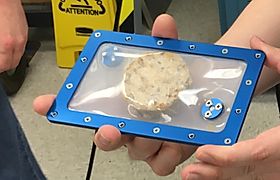
Researchers at McMaster University in Ontario have developed a plastic wrap that repels viruses and bacteria, including some of the scariest antibiotic-resistant superbugs known to science. With the help of a scanning electron microscope, the researchers were able to watch superbugs like MRSA and Pseudomonas bounce right off the surface.

The wrap can be applied to things temporarily, much like that stuff you wrestle from the box and stretch over your leftovers. It can also be shrink-wrapped to any compatible surface without losing effectiveness. The ability to cover surfaces with bacteria-shielding armor could have an incredible impact on superbug populations inside hospitals. It could be shrink-wrapped to all kinds of things, from door handles to railings to waiting room chair armrests to the pens that everyone uses to sign off on receiving care.

Continue reading “Anti-Bacterial Plastic Wrap Clings To Hope Of Stopping Superbugs’ Spread”

The Barcode Revolution: Welcome To Our Automated World

Featured in many sci-fi stories as a quicker, more efficient way to record and transfer information, barcodes are both extremely commonplace today, and still amazingly poorly understood by many. Originally designed as a way to allow for increased automation by allowing computer systems to scan a code with information about the item it labels, its potential as an information carrier is becoming ever more popular.

Without the tagging ability of barcodes (and their close cousin: RFID tags), much of today’s modern world would grind to a halt. The automated sorting and delivery systems for mail and parcels, entire inventory management systems, the tracing of critical avionics and rocketry components around the globe, as well as seemingly mundane but widely utilized rapid checkout at the supermarket, all depends on some variety of barcodes.

Join me on a trip through the past, present and future of the humble barcode.

Continue reading “The Barcode Revolution: Welcome To Our Automated World”

Happy 50th Birthday To All You Epoch Birthers

Good morning everyone, and what a lovely start to the new year it is, because it’s your birthday! Happy birthday, it’s your 50th! What’s that you say, you aren’t 50 today? (Looks…) That’s what all these internet databases say, because you’ve spent the last decade or so putting 1970-01-01 as your birth date into every online form that doesn’t really need to know it!

It’s been a staple for a subset of our community for years, to put the UNIX epoch, January 1st 1970, into web forms as a birth date. There are even rumours that some sites now won’t accept that date as a birthday, such is the volume of false entries they have with that date. It’s worth taking a minute though to consider UNIX time, some of its history and how its storage has changed over the years.

Continue reading “Happy 50th Birthday To All You Epoch Birthers”

2019: As The Hardware World Turns

Well, this is it. The end of the decade. In a few days the 2010s will be behind us, and a lot of very smug people will start making jokes on social media about how we’re back in the “Roaring 20s” again. Only this time around there’s a lot more plastic, and drastically less bathtub gin. It’s still unclear as to how much jazz will be involved.

Around this time we always say the same thing, but once again it bears repeating: it’s been a fantastic year for Hackaday. Of course, we had our usual honor of featuring literally thousands of incredible creations from the hacking and making community. But beyond that, we also bore witness to some fascinating tech trends, moments that could legitimately be called historic, and a fair number of blunders which won’t soon be forgotten. In fact, this year we’ve covered a wider breadth of topics than ever before, and judging by the record setting numbers we’ve seen in response, it seems you’ve been just as excited to read it as we were to write it.

To close out the year, let’s take a look at a few of the most popular and interesting stories of 2019. It’s been a wild ride, and we can’t wait to do it all over again in 2020.

Continue reading “2019: As The Hardware World Turns”

See You On The Dark Side Of The Moon: China’s Lunar Radio Observatory

For nearly as long as there has been radio, there have been antennas trained on the sky, looking at the universe in a different light than traditional astronomy. Radio astronomers have used their sensitive equipment to study the Sun, the planets, distant galaxies, and strange objects from the very edge of the universe, like pulsars and quasars. Even the earliest moments of the universe have been explored, a portrait in microwave radiation of the remnants of the Big Bang.

And yet with all these observations, there’s a substantial slice of the radio spectrum that remains largely a mystery to radio astronomers. Thanks to our planet’s ionosphere, most of the signals below 30 MHz aren’t observable by ground-based radio telescopes. But now, thanks to an opportunity afforded by China’s ambitious lunar exploration program, humanity is now listening to more of what the universe is saying, and it’s doing so from a new vantage point: the far side of the moon.

Continue reading “See You On The Dark Side Of The Moon: China’s Lunar Radio Observatory”

The Birth Of The Modern Robot

When Isaac Asmiov was writing I, Robot, the field of robotics was still in its infancy. As he notes in The Complete Robot, as the field began to mature, it started showing signs of conforming to the popular ideas held by science fiction writers about what robotics ought to be. Notions of humanoid robots, the functions that robots would have in domestic settings, even the ethical quandaries that AI ethicists face today were all themes of early sci-fi writers.

The idea of a robot – at least of automata – predates the field of robotics. The idea of an independent automata may have existed as early as the ancient Egyptians Chinese, and Greeks, who attempted to build self-operated machines that resembled animals and humans. Myths of clay golems in Jewish legends and clay giants in Norse legends perpetuated the idea of an artificial being that could mimic the actions of living creatures. A 400 BC myth from Crete spoke of a man of bronze who guarded their island from pirates.

Continue reading “The Birth Of The Modern Robot”

Reflection On A Decade Of Hackerspace Expansion

A few days ago I was invited to a party. Party invites are always good, and if I can make it to this one I’ll definitely go. It’s from a continental European hackerspace, and it’s for their tenth birthday party. As I spent a while checking ferries and flights it struck me, a lot of the spaces in my sphere are about a decade old. I went to London Hackspace’s 10th earlier in the year, and a host of other British hackerspaces aren’t far behind. Something tells me I’ll be knocking back the Club Mate and listening to EDM of some form at more than one such party in the coming year.

For most of the decade since I found the then-recently-established mailing list of my local hackerspace I’ve spent a lot of my time involved in more than one space. I’ve been a hackerspace director, a member, and many roles in between and I’ve seen them in both good times and bad ones. Perhaps it’s time to sit back and take stock of that decade and ask a few questions about hackerspaces. How have they fared, what state are they in now, and where are they going?

Continue reading “Reflection On A Decade Of Hackerspace Expansion”