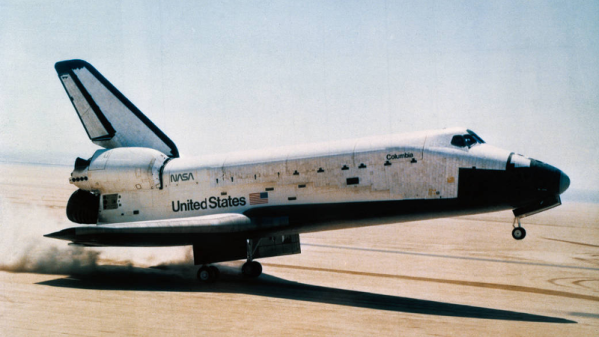
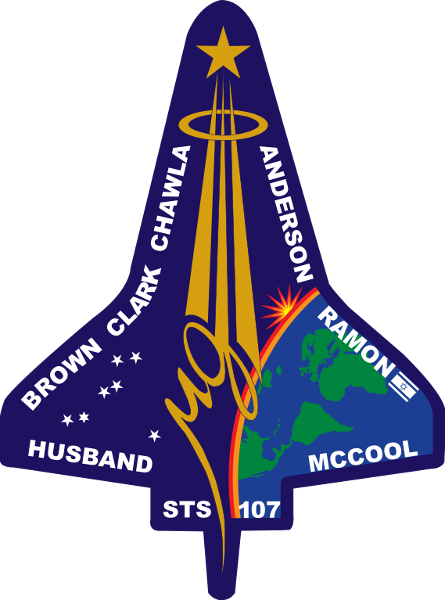
On February 1st, 2003 at eighteen seconds past 9:00 AM Eastern Standard Time, the Space Shuttle Columbia broke up during atmospheric entry over Texas. Still traveling at approximately Mach 18.3, the disintegration of Columbia was complete and nearly instantaneous. According to the official accident investigation, the crew had at most one minute from realizing they were in a desperate situation to complete destruction of the spacecraft. Due to the design of the Space Shuttle, no contingency plan or emergency procedure could have saved the crew at this point in the mission: all seven crew members were lost in this tragedy.
While the Space Shuttle, officially known as the Space Transportation System (STS) would fly again after the Columbia disaster, even the program’s most ardent supporters had to admit fundamental design of the Shuttle was flawed. Steps needed to be taken to ensure no future astronauts would be lost, and ultimately, the decision was made to retire the Shuttle fleet after primary construction of the International Space Station (ISS) was complete. There was simply too much invested in the ISS at this point to cancel the only spacecraft capable of helping to assemble it, so the STS had to continue despite the crushing loss of human life it had already incurred.
Between the loss of Challenger and Columbia, the STS program claimed fourteen lives in its thirty year run. Having only flown 135 missions in that time, the STS is far and away the most deadly spacecraft to ever fly. A grim record that, with any luck, is never to be broken.
The real tragedy was, like Challenger, the loss of Columbia could have been prevented. Ground Control knew that the Shuttle had sustained damage during launch, but no procedures were in place to investigate or repair damage to the spacecraft while in orbit. Changes to the standard Shuttle mission profile gave future crews a chance of survival that the men and women aboard Columbia never had.
Quantum computing (QC) is a big topic, and last time I was only able to walk you through the construction of a few logic gates, but you have to start somewhere. If you haven’t read that part, you probably should, because you’ll need to understand the simulator I’m using and some basic concepts.
I like to get right into practice, but with this topic, there’s no avoiding some theory. But don’t despair. We’ll have a little science fiction story you can try by the end of this installment, where we manage to pack two bits of information into a single physical qubit. Last time I mentioned that qubits have 1 and 0 states and I hinted that they were really |1> and |0> states. Why create new names for the two normal binary states? Turns out there is more to the story.
What’s the Vector, Victor?
In Dirac notation, |1> is a vector. So is |hackaday> and |123>. You can get into a lot of math with these, but I’m going to try to avoid most of that. This is also called ket notation (the last part of the word bracket) so you’ll hear people say “one ket” or “hackaday ket.” Either way, the vector can represent one or more qubits and there are several ways to represent them.
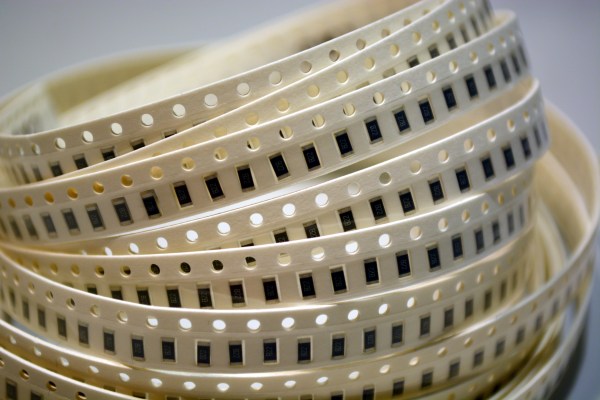
The passive component industry — the manufacturers who make the boring but vital resistors, capacitors, and diodes found in every single electronic device — is on the cusp of a shortage. You’ll always be able to buy a 220 Ω, 0805 resistor, but instead of buying two for a penny like you can today, you may only get one in the very near future.
Yageo, one of the largest manufacturers of surface mount (SMD) resistors and multilayer ceramic capacitors, announced in December they were not taking new chip resistor orders. Yageo was cutting production of cheap chip resistors to focus on higher-margin niche-market components for automotive, IoT, and other industrial uses, as reported by Digitimes. Earlier this month, Yaego resumed taking orders for chip resistors, but with 15-20% higher quotes (article behind paywall, try clicking through via this Tweet).
As a result, there are rumors of runs on passive components at the Shenzhen electronics market, and several tweets from members of the electronics community have said the price of some components have doubled. Because every electronic device uses these ‘jellybean’ parts, a decrease in supply or increase in price means some products won’t ship on time, margins will be lower, or prices on the newest electronic gadget will increase.
The question remains: are we on the brink of a resistor shortage, and what are the implications of manufacturers that don’t have the parts they need?
What must it be like to devote your life to answering a single simple but monumental question: Are we alone? Astronomer Jill Tarter would know better than most what it’s like, and knows that the answer will remain firmly stuck on “Yes” until she and others in the Search for Extraterrestrial Intelligence project (SETI) prove it otherwise. But the path she chose to get there was an unconventional as it was difficult, and holds lessons in the power of keeping you head down and plowing ahead, no matter what.
Endless Hurdles
To get to the point where she could begin to answer the fundamental question of the uniqueness of life, Jill had to pass a gauntlet of obstacles that by now are familiar features of the biography of many women in science and engineering. Born in 1944, Jill Cornell grew up in that postwar period of hope and optimism in the USA where anything seemed possible as long as one stayed within established boundaries. Girls were expected to do girl things, and boys did boy things. Thus, Jill, an only child whose father did traditional boy things like hunting and fixing things with her, found it completely natural to sign up for shop class when she reached high school age. She was surprised and disappointed to be turned down and told to enroll in “Home Economics” class like the other girls.
She eventually made it to shop class, but faced similar obstacles when she wanted to take physics and calculus classes. Her guidance counselor couldn’t figure why a girl would need to take such classes, but Jill persisted and excelled enough to get accepted to Cornell, the university founded by her distant relation, Ezra Cornell. Jill applied for a scholarship available to Cornell family members; she was turned down because it was intended for male relatives only.
Undeterred, Jill applied for and won a scholarship from Procter & Gamble for engineering, and entered the engineering program as the only woman in a class of 300. Jill used her unique position to her advantage; knowing that she couldn’t blend into the crowd like her male colleagues, she made sure her professors always knew who she was. Even still, Jill faced problems. Cornell was very protective of their students in those days, or at least the women; they were locked in their dorms at 10:00 each night. This stifled her ability to work on projects with the male students and caused teamwork problems later in her career.
No Skill is Obsolete
Despite these obstacles, Jill, by then married to physics student Bruce Tarter, finished her degree. But engineering had begun to bore her, so she changed fields to astrophysics for her post-graduate work and moved across the country to Berkeley. The early 70s were hugely inspirational times for anyone with an eye to the heavens, with the successes of the US space program and leaps in the technology available for studies the universe. In this environment, Jill figured she’d be a natural for the astronaut corps, but was denied due to her recent divorce.
Disappointed, Jill was about to start a research job at NASA when X-ray astronomer Stu Boyer asked her to join a ragtag team assembled to search for signs of intelligent life in the universe. Lacking a budget, Boyer had scrounged an obsolete PDP-8 from Berkeley and knew that Jill was the only person who still knew how to program the machine. Jill’s natural tendency to fix and build things began to pay dividends, and she would work on nothing but SETI for the rest of her career.
SETI efforts have been generally poorly funded over the years. Early projects were looked at derisively by some scientists as science fiction nonsense, and bureaucrats holding the purse strings rarely passed up an opportunity to score points with constituents by ridiculing efforts to talk to “little green men.” Jill was in the thick of the battles for funding, and SETI managed to survive. In 1984, Jill was one of the founding members of the SETI Institute, a private corporation created to continue SETI research for NASA as economically as possible.
The SETI Institute kept searching the skies for the next decade, developing bigger and better technology to analyze data from thousands of frequencies at a time from radio telescopes around the world. But in 1993, the bureaucrats finally landed the fatal blow and removed SETI funding from NASA’s budget, saving taxpayers a paltry $10 million. Jill and the other scientists kept going, and within a year, the SETI Institute had raised millions in private funds, mostly from Silicon Valley entrepreneurs, to continue their work.
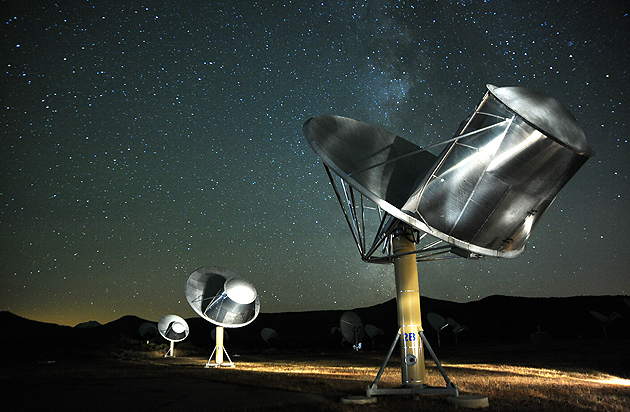
Part of the Allen Telescope Array. Source: SETI Institute
The Institute’s Project Phoenix, of which Jill was Director until 1999, kept searching for signs of life out there until 2004, with no results. They proposed an ambitious project to improve the odds — an array of 350 radio telescopes dedicated to SETI work. Dubbed the Allen Telescope Array after its primary patron, Microsoft co-founder Paul Allen, the array has sadly never been completed. But the first 42 of the 6-meter dishes have been built, and the ATA continues to run SETI experiments every day.
Jill Tarter retired as Director of SETI Research for the Institute in 2012, but remains active in the SETI field. Her primary focus now is fundraising, leveraging not only her years of contacts in the SETI community but also some of the star power she earned when it became known that she was the inspiration for the Ellie Arroway character in Carl Sagan’s novel Contact, played by Jodie Foster in the subsequent Hollywood film.
Without a reasonable SETI program, the answer to “Are we alone?” will probably never be known. But if it is answered, it’ll be thanks in no small part to Jill Tarter and her stubborn refusal to stay within the bounds that were set for her.
We recently looked at the origins of the integrated circuit (IC) and the calculator, which was the IC’s first killer app, but a surprise twist is that the calculator played a big part in the invention of the next world-changing marvel, the microprocessor.
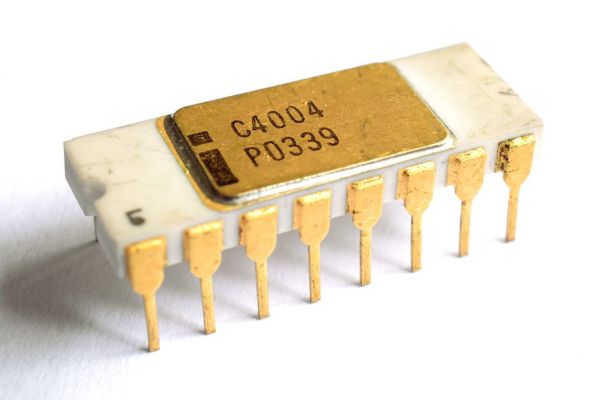
There is some dispute as to which company invented the microprocessor, and we’ll talk about that further down. But who invented the first commercially available microprocessor? That honor goes to Intel for the 4004.
Path To The 4004
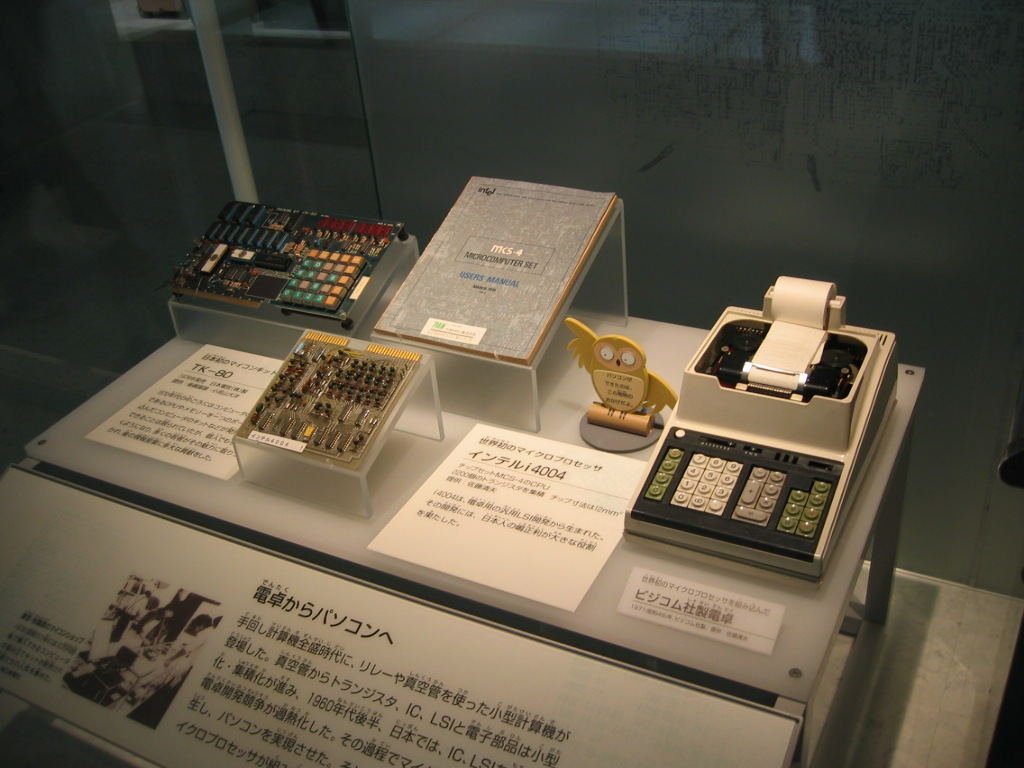
Busicom calculator motherboard based on 4004 (center) and the calculator (right)
We pick up the tale with Robert Noyce, who had co-invented the IC while at Fairchild Semiconductor. In July 1968 he left Fairchild to co-found Intel for the purpose of manufacturing semiconductor memory chips.
While Intel was still a new startup living off of their initial $3 million in financing, and before they had a semiconductor memory product, as many start-ups do to survive they took on custom work. In April 1969, Japanese company Busicom hired them to do LSI (Large-Scale Integration) work for a family of calculators.
Busicom’s design, consisting of twelve interlinked chips, was considered a complicated one. For example, it included shift-register memory, a serial type of memory which complicates the control logic. It also used Binary Coded Decimal (BCD) arithmetic. Marcian Edward Hoff Jr — known as “Ted”, head of the Intel’s Application Research Department, felt that the design was even more complicated than a general purpose computer like the PDP-8, which had a fairly simple architecture. He felt they may not be able to meet the cost targets and so Noyce gave Hoff the go-ahead to look for ways to simplify it.
People who exercise with fitness trackers have a digital record of their workouts. They do it for a wide range of reasons, from gathering serious medical data to simply satisfying curiosity. When fitness data includes GPS coordinates, it raises personal privacy concerns. But even with individual data removed, such data was still informative enough to spill the beans on secretive facilities around the world.
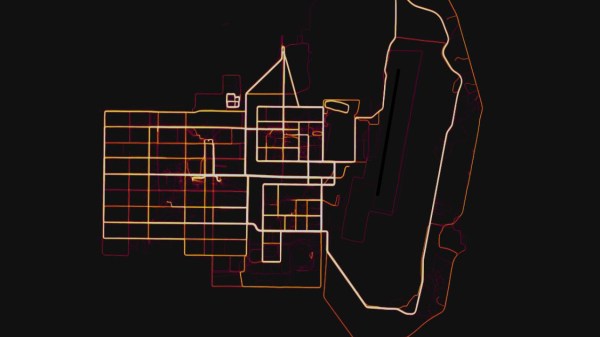
Strava is a fitness tracking service that gathers data from several different brands of fitness tracker — think Fitbit. It gives athletes a social media experience built around their fitness data: track progress against personal goals and challenge friends to keep each other fit. As expected of companies with personal data, their privacy policy promised to keep personal data secret. In the same privacy policy, they also reserved the right to use the data shared by users in an “aggregated and de-identified” form, a common practice for social media companies. One such use was to plot the GPS data of all their users in a global heatmap. These visualizations use over 6 trillion data points and can be compiled into a fascinating gallery, but there’s a downside.
This past weekend, [Nathan Ruser] announced on Twitter that Strava’s heatmap also managed to highlight exercise activity by military/intelligence personnel around the world, including some suspected but unannounced facilities. More worryingly, some of the mapped paths imply patrol and supply routes, knowledge security officers would prefer not to be shared with the entire world.
This is an extraordinary blunder which very succinctly illustrates a folly of Internet of Things. Strava’s anonymized data sharing obsfucated individuals, but didn’t manage to do the same for groups of individuals… like the fitness-minded active duty military personnel whose workout habits are clearly defined on these heat maps. The biggest contributor (besides wearing a tracking device in general) to this situation is that the data sharing is enabled by default and must be opted-out:
“You can opt-out of contributing your anonymized public activity data to Strava Metro and the Heatmap by unchecking the box in this section.” —Strava Blog, July 2017
Look around yourself right now and chances are pretty good that you’ll quickly lay eyes on a zipper. Zippers are incredibly commonplace artifacts, a commodity item produced by the mile that we rarely give a second thought to until they break or get stuck. But zippers are a fairly modern convenience, and the story of their invention is one that shows even the best ideas can be delayed by overly complicated designs and lack of a practical method for manufacturing.
Try and Try Again
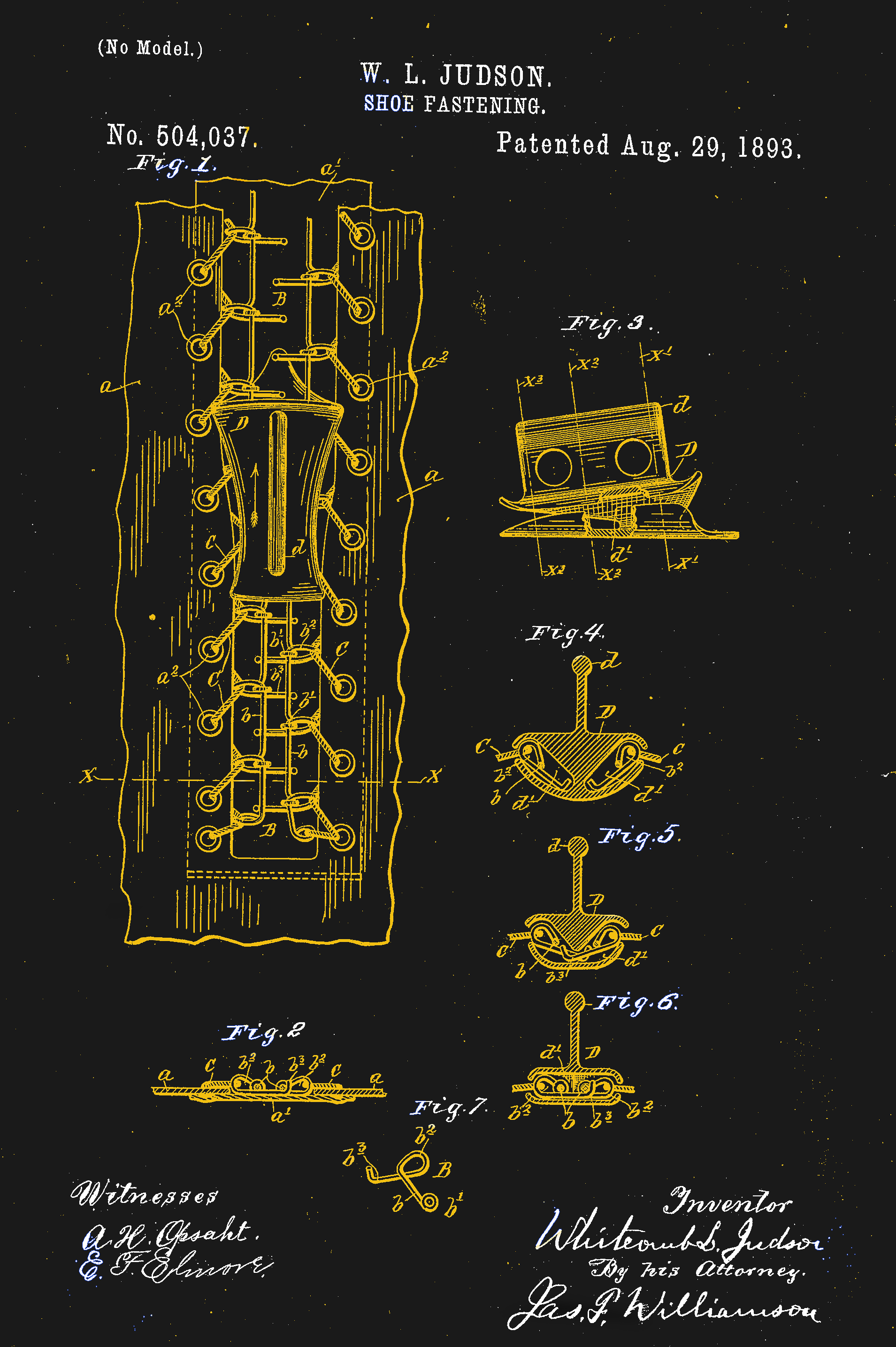
US Patent #504,307. One of the many iterations of Judson’s design. Like the others, it didn’t work.
Ideas for fasteners to replace buttons and laces have been kicking around since the mid-19th century. The first patent for a zipper-like fastener was issued to Elias Howe, inventor of the sewing machine. Though he was no slouch at engineering intricate mechanisms, Howe was never able to make his “Automatic, Continuous Clothing Closure” a workable product, and Howe shifted his inventive energies to other projects.
The world would wait another forty years for further development of a hookless fastener, when a Chicago-born inventor of little prior success named Whitcomb Judson began work on a “Clasp Locker or Unlocker.” Intended for the shoe and boot market, Judson’s device has all the recognizable parts of a modern zipper — rows of interlocking teeth with a slide mechanism to mesh and unmesh the two sides. The device was debuted at the Chicago World’s Fair in 1893 and was met with almost no commercial interest.
Judson went through several iterations of designs for his clasp locker, looking for the right combination of ideas that would result in a workable fastener that was easy enough to manufacture profitably. He lined up backers, formed a company, and marketed various versions of his improved products. But everything he tried seemed to have one or more serious drawbacks. When his fasteners were used in shoes, unexpected failure was a mere inconvenience. If a fastener on a lady’s dress opened unexpectedly, it could have been a social catastrophe. Coupled with a price tag that was exorbitantly high to cover the manual labor needed to assemble them, almost every version of Judson’s invention flopped.
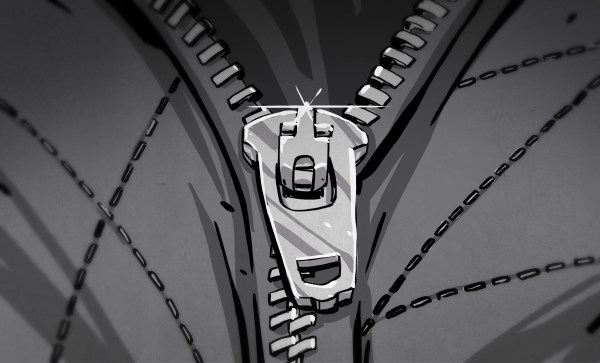
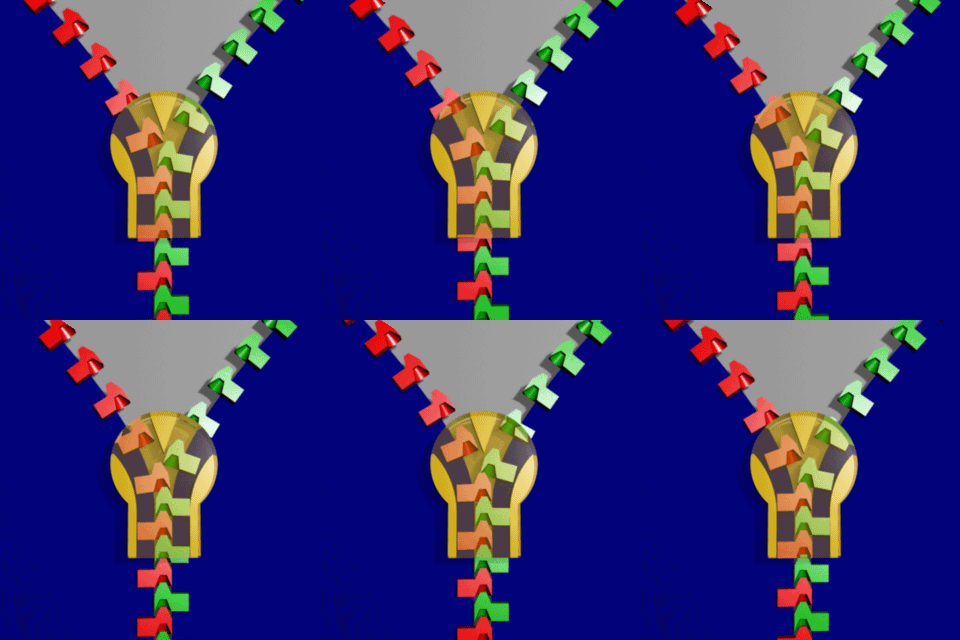
It would take another decade, a change of company name, a cross-country move, and the hiring of a bright young engineer before the world would have what we would recognize as the first modern zipper. Judson hired Gideon Sundback in 1901, and by 1913 he was head designer at the Fastener Manufacturing and Machine Company, newly relocated to Meadville, Pennsylvania after a stop in Hoboken, New Jersey. Sundback’s design called for rows of identical teeth with cups on the underside and nibs on the upper, set on fabric tapes. A slide with a Y-shaped channel bent the tapes to open the gap between teeth, allowing the cups to nest on the nibs and mesh the teeth together strongly.
Sundback’s design had significant advantages over any of Judson’s attempts. First, it worked, and it was reliable enough to start quickly making inroads into fashionable apparel beyond its initial marketing toward more utilitarian products like tobacco pouches. Secondly, and perhaps more importantly, Sundback invented machinery that could make hundreds of feet of the fasteners in a day. This gave the invention an economy of scale that none of Judson’s fasteners could ever have achieved.
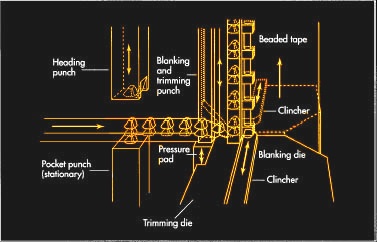
The machinery that Sundback invented to make his “Separable Fastener” has been much improved since the early 1900s, but the current process still looks similar, at least for metal zippers. Stringers, which are the fabric tapes with teeth attached, are formed in a continuous process by a multi-step punching and crimping machine. For metal stringers, a coil of flat metal is fed into a punch and die to form hollow scoops. The strip is then punched again to form a Y-shape around the scoop and cut it free from the web. The legs of the Y straddle the edge of the fabric tape, and a set of dies then crimps the legs to the tape. A modern zipper machine can make stringers at a rate of 2000 teeth per minute.
Plastic zippers are common these days, too, and manufacturing methods vary by zipper style. One method has the fabric tapes squeezed between the halves of a die while teeth are injection molded around the tape to form two parallel stringers. A sprue connected the stringers by the teeth breaks free after molding, and the completed stringers are assembled later.
Zippers have come a long way since Sundback’s first successful design, with manufacturing improvements that have eliminated many of the manual operations once required. Specialized zippers have made it from the depths of the oceans to the surface of the Moon, and chances are pretty good that if we ever get to Mars, one way or another, zippers will go with us.