My buddy Harold recently landed a new job at a great technology company. It came at a perfect time for him, having just been laid off from the corporate behemoth where he’d toiled away as an anonymous cog for 19 years. But the day before he was to start, the new company’s HR folks sent him some last-minute documents to sign. One was a broad and vaguely worded non-compete agreement which essentially said he was barred from working in any related industry for a year after leaving the company.
Harold was tempted not to sign, but eventually relented because one needs to put food on the table. Thankfully he’s now thriving at the new company, but his experience got me thinking about all the complications hackers face with the day jobs that so many of us need to maintain. Non-competes and non-disclosures are bad enough, but there’s one agreement that can really foul things up for a hacker: the Intellectual Property Agreement.
How do you consume your music, these days? Aside from on the radio, that is. Do you play MP3 or other files on your phone and computer, or perhaps do you stream from an online service? If you’re really at the cutting edge though you’ll do none of those things, because you’ll be playing it on vinyl.
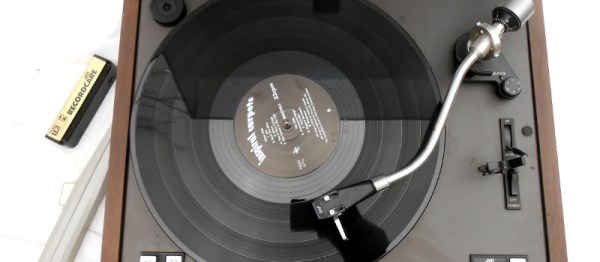
The legendary Technics SL1200 direct-drive turntable, as used by countless DJs. Photo by Dydric CC-BY-SA 2.5A few years ago reporting on a resurgence of sales of vinyl records was something you would never have expected to see, but consumer tastes are unpredictable. Our red-trousered and extravagantly bearded hipster friends have rediscovered the glories of the format, and as a result it’s popping up everywhere. For those of us who are old enough to have genuinely been into the format before it was cool again, the sight of Sergeant Pepper and Led Zeppelin II on 12″ at outrageous prices on a stand at the local supermarket is a source of amusement. It’s good to see your first love back in vogue again, but is it really the £20($25) per album kind of good?
With the turntable having disappeared as an integral part of the typical hi-fi setup the new vinyl enthusiast is faced with a poor choice of equipment. Often the best available without spending serious money at an audiophile store is a USB device with the cheapest possible manufacture, from which the playback will be mediocre at best. We’ve lost the body of collective knowledge about what makes a good turntable to almost thirty years of CDs and MP3s, so perhaps it’s time for a quick primer.
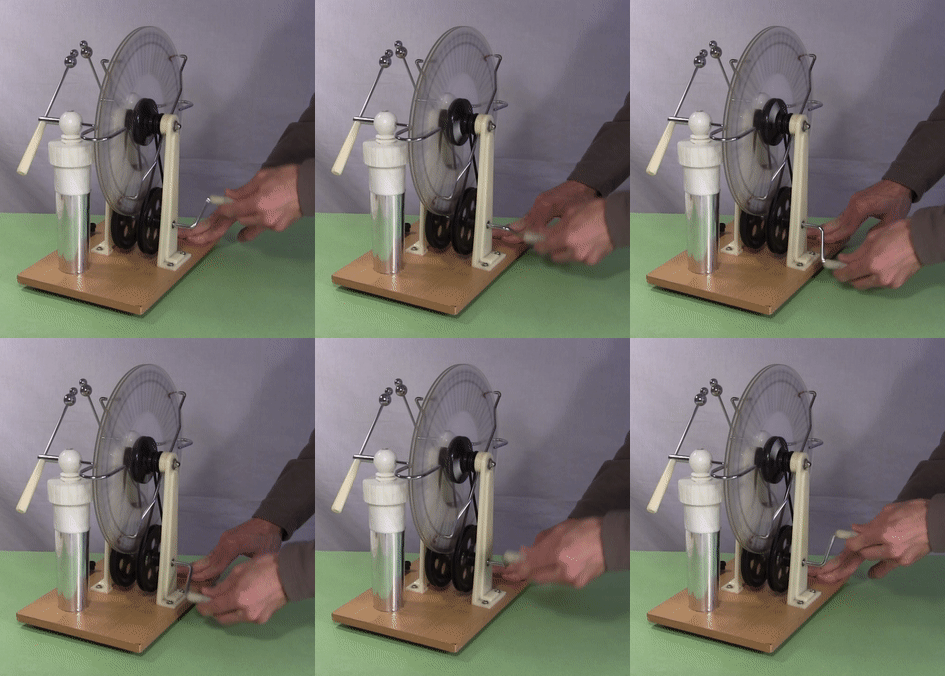
The Wimshurst machine is one of the oldest and best known electrostatic machines, consisting of its iconic two counter rotating disks and two Leyden jars. Most often you see someone hand cranking it, producing sparks, though we’ve seen it used for much more, including for powering a smoke precipitator for cleaning up smoke and even for powering a laser.
It works through an interesting sequence of events. Most explanations attempt to cram it all into one picture, requiring some major mental gymnastics to visualize. This often means people give up, resigned to assume these work through some mythical mechanics that defy a mortal’s ability to understand.
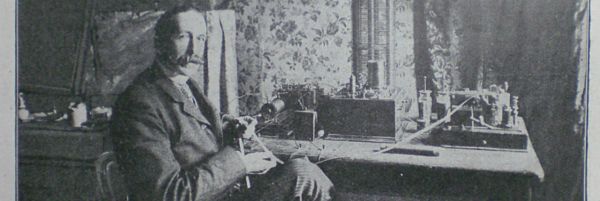
The place is the historic lecture theater of the Royal Institution in London. The date is the 4th of June 1903, and the inventor, Guglielmo Marconi, is about to demonstrate his new wireless system, which he claims can securely send messages over a long distance, without interference by tuning the signal.
The inventor himself was over 300 miles away in Cornwall, preparing to send the messages to his colleague Professor Fleming in the theater. Towards the end of Professor Flemings lecture, the receiver sparks into life, and the morse code printer started printing out one word repeatedly: “Rats”. It then spelled out an insulting limerick: “There was a young man from Italy, who diddled the public quite prettily”. Marconi’s supposedly secure system had been hacked.
Last weekend I ran out of filament for my 3D printer midway through a print. Yes, it’s evidence of poor planning, but I’ve done this a few times and I can always run over to Lowe’s or Home Depot or Staples and grab an overpriced spool of crappy filament to tide me over until the good, cheap filament arrives via UPS.
The Staples in my neck of the woods was one of the few stores in the country to host a, ‘premium, in-store experience’ featuring MakerBot printers. Until a few months ago, this was a great place to pick up a spool of filament that could get you through the next few hours of printing. The filament cost about three times what I would usually pay, but it was still good quality filament and they usually had the color I needed.
This partnership between MakerBot and Staples fell through a few months ago, the inventory was apparently shipped back to Brooklyn, and now Robo3D has taken MakerBot’s space at the endcap in Staples. Last weekend, I picked up a 1kg spool of red PLA for $40. What I found next to this filament left me shocked, confused, and insatiably curious. I walked out of that store with a spool of filament and a USB thumb drive loaded up with twenty-five STL files. This, apparently, is the future of 3D printing.
It’s impossible to know when society began to manicure its front lawns. Truth be told — cutting the grass was, and still is a necessity. But keeping the weeds at bay, trimming, edging and so forth is not. Having a nice lawn has become a status symbol of modern suburbia all across the globe. When the aliens arrive, one of the first things they will surely notice is how nice our front lawns are. This feature of our civilization could have only been made possible with the advent of specialized grass-cutting machines.
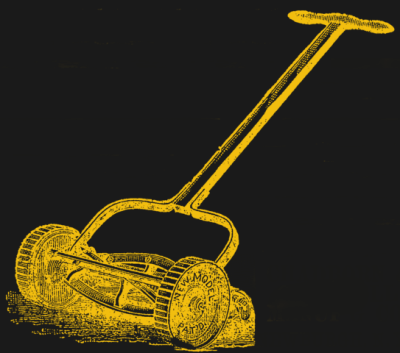
Reel Mower [Public Domain]It could be argued that the very first lawnmowers were live stock. The problem was they were quite high maintenance devices and tended to provide a very uneven cut, which did not bode well for families striving for the nicest front lawn on the dirt road. Coupled with the foul odor of their byproducts, the animals became quite unpopular and were gradually moved out of site into the back yards. Other solutions were sought to maintain the prestigious front yard.
The first mechanical lawnmower was invented in 1830 by a man named Edwin Budding, no doubt in an effort to one-up his neighbor, who still employed a Scythe. Budding’s mower looked much like today’s classic reel mowers, where a rotating cylinder houses the blades and rotates as the mower is pushed forward. Budding was granted a patent for his device by England, much to the dismay of his fellow neighbors — most of whom were forced to buy Budding’s mower due to the fact that everyone else in the neighborhood bought one, even though they weren’t actually needed.
By the early 1930’s, the cold war started by Budding and his neighbor had spread to almost every front yard on earth, with no end in sight. Fast forward to the modern era and the lawn and garden market did 10 billion in sales in 2014 alone. Technological advances have given rise to highly advanced grass-munching machines. For smaller yards, most use push mowers powered by a single cylinder IC engine. Many come with cloth bags to collect the clippings, even though everyone secretly hates using them because they gradually fill and make the mower heavier and therefore more difficult to push. But our neighbors use them, so we have to too. Larger yards require expensive riding mowers, many of which boast hydrostatic transmissions, which owners eagerly brag about at neighborhood get-togethers, even though they haven’t the slightest clue of what it actually is.
Us hackers are no different. We have front lawns just like everyone else. But unlike everyone else (including our neighbors) we have soldering irons. And we know how to use them. I propose we take a shot-across-the-bow and disrupt the neighborhood lawn war the same way Budding did 85 years ago. So break out your favorite microcontroller and let’s get to work!
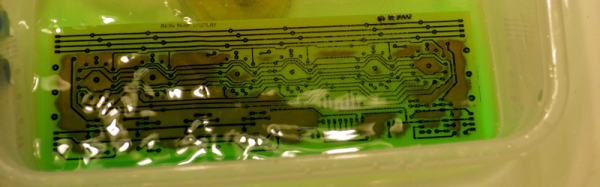
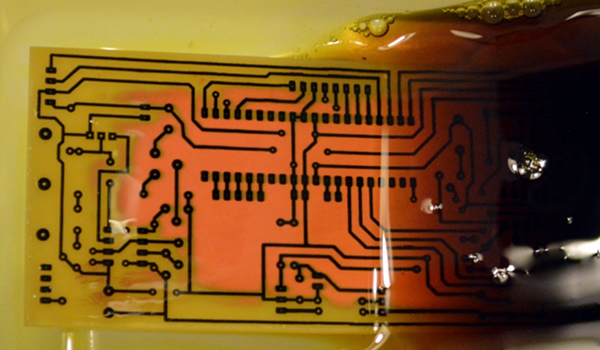
Although the typical cliché for a mad scientist usually involves Bunsen burners, beakers, and retorts, most of us (with some exceptions, of course) aren’t really chemists. However, there are some electronic endeavors that require a bit of knowledge about chemistry or related fields like metallurgy. No place is this more apparent than producing your own PCBs. Unless you use a mill, you are probably using a chemical bath of some sort to strip copper from your boards.
The standard go-to solution is ferric chloride. It isn’t too tricky to use, but it does work better hot and with aeration, although neither are absolutely necessary. However, it does tend to stain just about everything it touches. In liquid form, it is more expensive to ship, although you can get it in dry form. Another common etchant is ammonium or sodium persulphate.
There’s also a variety of homemade etchants using things like muriatic acid and vinegar. Most of these use peroxide as an oxidizer. There’s lots of information about things like this on the Internet. However, like everything on the Internet, you can find good information and bad information.
When [w_k_fay] ran out of PCB etchant, he decided to make his own to replace it and wrote a great guide on how this is done. He found a lot of vague and conflicting information on the Internet. He read that the vinegar solution was too slow and the cupric acid needs a heated tank, a way to oxygenate the solution, and strict pH controls. However, he did have successful experiments with the hydrochloric acid and peroxide. He also used the same materials (along with some others) to make ferric chloride successfully.


![The legendary Technics SL1200 direct-drive turntable, as used by countless DJs. Dydric [CC BY-SA 2.5)], via Wikimedia Commons.](https://hackaday.com/wp-content/uploads/2017/02/640px-technics_sl-1200mk2-2.jpg)