PVC Submersible ROV

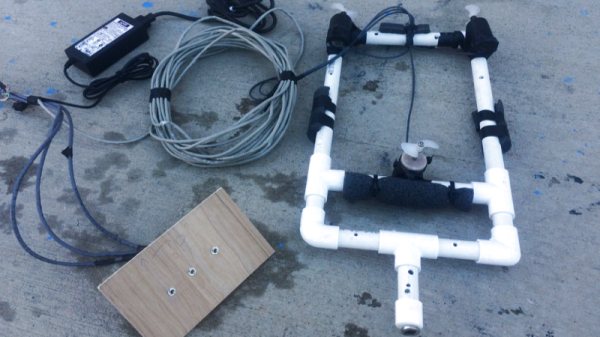
[mark.brubaker.1] and his crew decided to make a submersible for a school project using PVC pipes as a frame. It has two motors on the back to provide forward thrust and steering as well as a horizontal mounted motor in the middle of the PVC chassis to provide up and down thrust. They used regular motors which they waterproofed by inserting them inside a case full of plumbers wax. We’re not sure how long this will hold at the bottom of the ocean, but it works fine for a school project in the pool. Here’s the instructions on how to make one.

The build is completely analog, the controller is a board with three switches which individually control the different motors. So if you want to turn left, you fired up the right motor. For right you do the opposite and fire up the left motor. Up and down, well, you get the picture. If you have a swimming pool, lake or some water body nearby and you’re looking for a weekend project with your kids, this is a great tip. It’s not an Arduino controlled robot fish, but it’s a first step in that direction; you can later on use the frame to improve on the design and add some electronics.
Continue reading “PVC Submersible ROV”

I’m BatBot

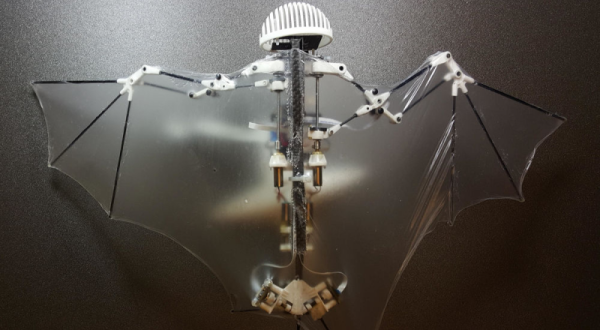
How would you like a bat bot for your next pet drone? Researchers from the University of Illinois at Urbana-Champaign’s Coordinated Science Laboratory and from the California Institute of Technology, created a bat drone. This is not your regular drone; it’s not a styrofoam, bat-shaped, four-propeller kind of drone. It’s a drone that mimics not only the shape but the movement of the bats wings to achieve flight.

The biomimetic robotic platform, dubbed Bat Bot B2, is an autonomous flying robot. The wing mechanics are controlled by a brushless DC motor for the wing flapping along with four wings actuators to provide linear motion that allows the wings to further change shape in flight. The wings are made of a 56-micron, silicone-based membrane (thinner than an average condom), which for sure helps with their elasticity as well as reducing overall weight, which is only 93 grams.

The bat has only made twenty flights so far, ranging up to 30 meters with some rough landings. It’s not much yet, but the prototype looks pretty slick. We covered another bat bot back in 2012 but the original information is no longer available, and we don’t know what happened to that project. There was also no video. In contrast, you can watch Bat Bot B2 glide.

Continue reading “I’m BatBot”

Cheap DIY FPV Micro-Drone

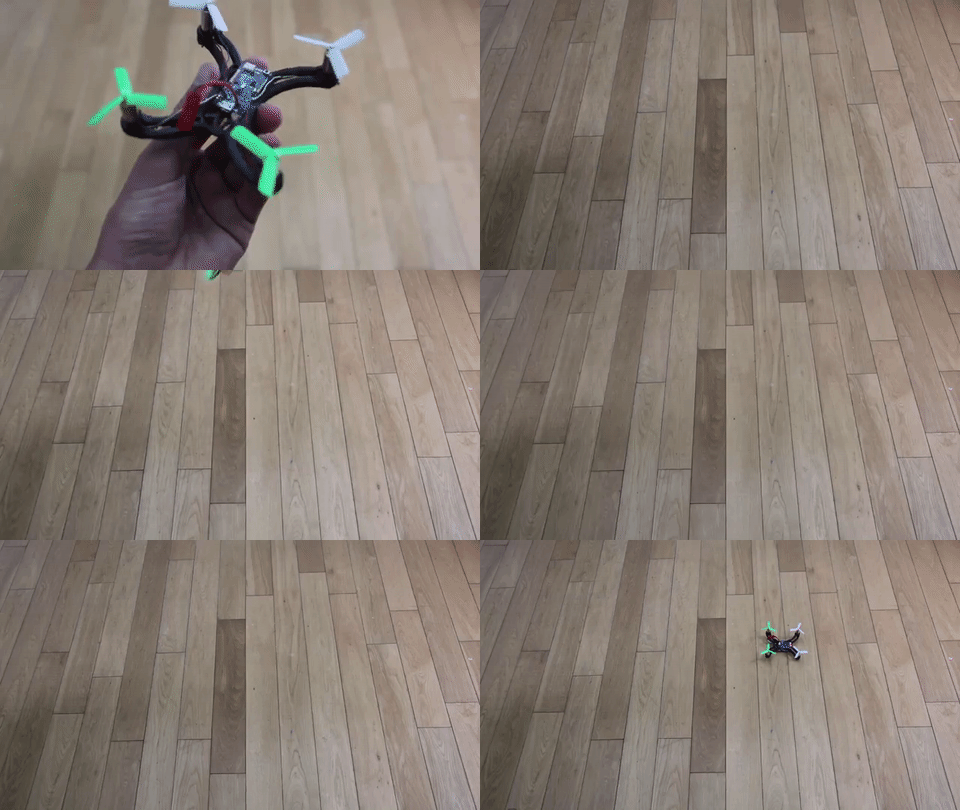
FPV drones are a fun but often costly hobby for beginners. Opting for a smaller drone will reduce the chance of damaging the drone when one invariably crashes and the smaller props are also a lot safer if there are any innocent bystanders. YouTuber and Instructables user [Constructed] wanted a cheap FPV capable drone that they could comfortably fly in-and-out of doors, so of course they built their own.

Once the drone’s frame was 3D printed, the most complex part about soldering four small-yet-powerful 8.5 mm motors to the Micro Scisky control board is ensuring that you attach them in the correct configuration and triple-checking them. A quick reshuffling of the battery connections and mounting the FPV camera all but completed the hardware side of the build.

Before plugging your flight controller into your PC to program, [Constructed] warns that the battery must be disconnected unless you want to fry your board. Otherwise, flashing the board and programming it simply requires patience and a lot of saving your work. Once that’s done and you’ve paired everything together, the sky — or ceiling — is the limit!

Continue reading “Cheap DIY FPV Micro-Drone”

Frankenquad Takes To The Air

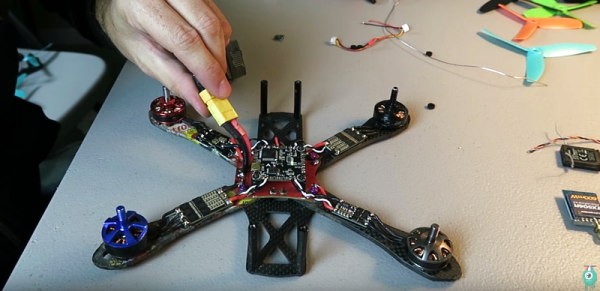
Modern quadcopter flight controllers perform a delicate dance of balancing pitch, yaw, bank, and throttle. They can do this thanks to modern MEMS gyros and accelerometers. The job is easy when the motors, propellers and speed controllers are relatively well matched. But what if they’re not? That’s the questions [SkitzoFPV] set out to answer by building Frankenquad.  Frankenquad is a 250 sized FPV quadcopter with 4 different motors and 4 different propellers. The props are different sizes from different manufacturers, and even include a mix of 3 and 4 blade units. If all that wasn’t enough [SkitzoFPV] used 3 different electronic speed controller. Each speed controller has a micro running different firmware, meaning it will respond slightly differently to throttle inputs.

Keeping all this in check was [SkitzoFPV’s] branded version of the Raceflight Revolt R4 flight controller. The Revolt is powered by an STM32F4 series ARM microcontroller. Most of these controllers run variants of the cleanflight open source flight control software. The question was – would it be able to handle the unbalanced thrust and torque of 4 different power combinations?

The flight tests proved the answer was a resounding yes. The quad hovered easily. As the video shows [SkitzoFPV] went on to burn a few holes in the sky with it. Admittedly [SkitzoFPV] is a much better pilot than any of us. He did notice a bit of a bobble and a definite yaw toward the smaller propeller. Still, it’s rather amazing how easily a modern flight controller was able to turn a pile of junk-box components into a flying quadcopter. You can learn more about flight controllers right here.

Continue reading “Frankenquad Takes To The Air”

Disposable Drones

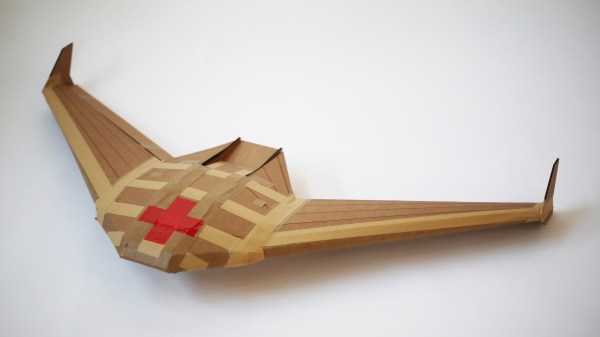
How do you deliver medical supplies to a war zone cheaply? The answer, according to this project, might be to make a disposable drone. Created by friends of Hackaday [Star Simpson] and the Sky Machines group at Otherlab, this project is looking to make drones out of cheap biodegradable products like cardboard.

Rather than risk an expensive drone that might never return, the project imagines a drone that flies to the target, delivers its cargo with an accuracy of about 10 meters and then be easily disposed of. The prototype the team is working on is part of a DARPA project called Inbound, Controlled Air-Releasable Unrecoverable Systems (ICARUS) and is a glider designed to be released from a plane or helicopter. Using a cheap GPS receiver and controller, the drone then glides to the destination.

It’s an interesting take on the drone: making it so simple and cheap that you can use it once and throw it away. And if you want to get a feel for how [Star] and Otherlabs approach problems like this, check out the awesome talk that [Star] gave at our recent SuperConference on making beautiful circuit boards.

Thanks for the tip, [Adrian]!

Taking First Place At IMAV 2016 Drone Competition

The IMAV (International Micro Air Vehicle) conference and competition is a yearly flying robotics competition hosted by a different University every year. AKAMAV – a university student group at TU Braunschweig in Germany – have written up a fascinating and detailed account of what it was like to compete (and take first place) in 2016’s eleven-mission event hosted by the Beijing Institute of Technology.

AKAMAV’s debrief of IMAV 2016 is well-written and insightful. It covers not only the five outdoor and six indoor missions, but also details what it was like to prepare for and compete in such an intensive event. In their words, “If you share even a remote interest in flying robots and don’t mind the occasional spectacular crash, this place was Disney Land on steroids.”

Continue reading “Taking First Place At IMAV 2016 Drone Competition”

The World’s Lightest Brushless FPV Quadcopter

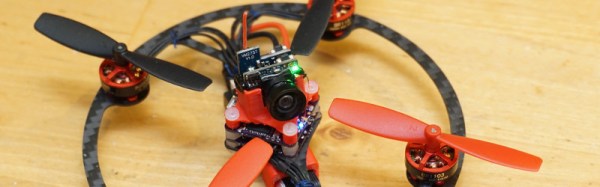
When a claim is made for something being the world’s lightest it is easy to scoff, after all that’s a bold assertion to make. It hasn’t stopped [fishpepper] though, who claims to have made the world’s lightest brushless FPV quadcopter. Weighing in at 32.4 grams (1.143 oz) it’s certainly pretty light.

The frame is a circular design cut from carbon-fiber-reinforced polymer, and on it are mounted four tiny brushless motors. In the center are the camera and battery on a 3D printed mount, as well as custom flight and speed controller boards. There are a series of posts detailing some of the design steps, and the result is certainly a capable aircraft for something so tiny. If you fancy experimenting with the design yourself, the files are available for download on the first page linked above.

There are two aspects to this build that make it interesting to us. First, the lightest in the world claim. We think someone will come along with something a bit lighter, and we can’t wait to see a lightest multirotor arms race. Good things come of technology races, which brings us to the second aspect. Governments are busy restricting the use of larger multirotors, to the extent that in some parts of the world all that will be available for non professionals will be sub-200g toy craft. Any project like this one which aims to push the boundaries of what is possible with smaller multirotors is thus extremely interesting, and we hope the community continue to innovate in this direction if only to make a mockery of any restrictions.

To get some idea of the sort of legislative measures we might be seeing, take a look at our coverage of a consultation in just one country.