Expert Says Don’t Teach Kids To Code

I was a little surprised to see a news report about Andreas Schleicher, the director of education and skills at OECD — the Organization for Economic Cooperation and Development. Speaking at the World Innovation Summit for Education in Paris, Schleicher thinks that teaching kids to code is a waste of time. In particular, he seems to think that by the time a child today grows up, coding will be obsolete.

I can’t help but think that he might be a little confused. Coding isn’t going away anytime soon. It could, of course, become an even deeper specialty, and thus less generally applicable. But the comments he’s made seem to imply that soon we will just tell smart computers what we want and they will just do that. Somewhat like computers work on Star Trek.

What is more likely is that most people will be able to find specific applications that can do what they want without traditional coding. But someone still has to write something for the foreseeable future. What’s more, if you’ve ever tried to tease requirements out of an end user, you know that you can’t just blurt out anything you want to a computer and expect it to make sense. It isn’t the computer’s fault. People — especially untrained people — don’t always make sense or communicate unambiguously.

Continue reading “Expert Says Don’t Teach Kids To Code”

MCAS And The 737: When Small Changes Have Huge Consequences

When the first 737 MAX entered service in May of 2017, it was considered a major milestone for Boeing. For nearly a decade, the aerospace giant had been working on a more fuel efficient iteration of the classic 737 that first took to the skies in 1967. Powered by cutting-edge CFM International LEAP engines, and sporting modern aerodynamic improvements such as unique split wingtips, Boeing built the new 737 to have an operating cost that was competitive with the latest designs from Airbus. With over 5,000 orders placed between the different 737 MAX variants, the aircraft was an instant success.

But now, in response to a pair of accidents which claimed 346 lives, the entire Boeing 737 MAX global fleet is grounded. While the investigations into these tragedies are still ongoing, the preliminary findings are too similar to ignore. In both cases, it appears the aircraft put itself into a dive despite the efforts of the crew to maintain altitude. While the Federal Aviation Administration initially hesitated to suspend operations of the Boeing 737 MAX, they eventually agreed with government regulatory bodies all over the world to call for a temporary ban on operating the planes until the cause of these accidents can be identified and resolved.

For their part, Boeing maintains their aircraft is safe. They say that grounding the fleet was done out of an “abundance of caution”, rather than in direct response to a particular deficiency of the aircraft:

Boeing continues to have full confidence in the safety of the 737 MAX.  However, after consultation with the U.S. Federal Aviation Administration (FAA), the U.S. National Transportation Safety Board (NTSB), and aviation authorities and its customers around the world, Boeing has determined — out of an abundance of caution and in order to reassure the flying public of the aircraft’s safety — to recommend to the FAA the temporary suspension of operations of the entire global fleet of 371 737 MAX aircraft.

Until both accident investigations are completed, nobody can say with complete certainty what caused the loss of the aircraft and their passengers. But with the available information about what changes were made during the 737 redesign, along with Boeing’s own recommendations to operators, industry insiders have started to point towards a fault in the plane’s new Maneuvering Characteristics Augmentation System (MCAS) as a likely culprit in both accidents.

Despite the billions of dollars spent developing these incredibly complex aircraft, and the exceptionally stringent standards their operation is held to, there’s now a strong indication that the Boeing 737 MAX could be plagued with two common issues that we’ve likely all experienced in the past: a software glitch and poor documentation.

Continue reading “MCAS And The 737: When Small Changes Have Huge Consequences”

Spoiler, Use-After-Free, And Ghidra: This Week In Computer Security

The past few days have been busy if you’re trying to keep up with the pace of computer security news. Between a serious Chromium bug that’s actively being exploited on Windows 7 systems, the NSA releasing one of their tools as an open source project, and a new Spectre-like speculative execution flaw in Intel processors, there’s a lot to digest.
Continue reading “Spoiler, Use-After-Free, And Ghidra: This Week In Computer Security”

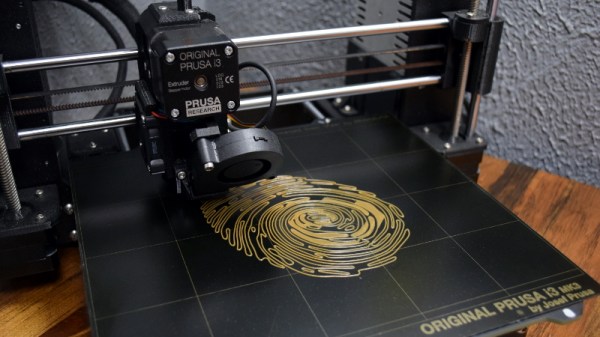
No, Your 3D Printer Doesn’t Have A Fingerprint

Hackers and makers see the desktop 3D printer as something close to a dream come true, a device that enables automated small-scale manufacturing for a few hundred dollars. But it’s not unreasonable to say that most of us are idealists; we see the rise of 3D printing as a positive development because we have positive intentions for the technology. But what of those who would use 3D printers to produce objects of more questionable intent?

We’ve already seen 3D printed credit card skimmers in the wild, and if you have a clear enough picture of a key its been demonstrated that you can print a functional copy. Following this logic, it’s reasonable to conclude that the forensic identification of 3D printed objects could one day become a valuable tool for law enforcement. If a printed credit card skimmer is recovered by authorities, being able to tell how and when it was printed could provide valuable clues as to who put it there.

This precise line of thinking is how the paper “PrinTracker: Fingerprinting 3D Printers using Commodity Scanners” (PDF link) came to be. This research, led by the University at Buffalo, aims to develop a system which would allow investigators to scan a 3D printed object recovered from a crime scene and identify which printer was used to produce it. The document claims that microscopic inconsistencies in the object are distinctive enough that they’re analogous to the human fingerprint.

But like many of you, I had considerable doubts about this proposal when it was recently featured here on Hackaday. Those of us who use 3D printers on a regular basis know how many variables are involved in getting consistent prints, and how introducing even the smallest change can have a huge impact on the final product. The idea that a visual inspection could make any useful identification with all of these parameters in play was exceptionally difficult to believe.

In light of my own doubts, and some of the excellent points brought up by reader comments, I thought a closer examination of the PrinTracker concept was in order. How exactly is this identification system supposed to work? How well does it adapt to the highly dynamic nature of 3D printing? But perhaps most importantly, could these techniques really be trusted in a criminal investigation?

Continue reading “No, Your 3D Printer Doesn’t Have A Fingerprint”

Engineering For The Long Haul, The NASA Way

The popular press was recently abuzz with sad news from the planet Mars: Opportunity, the little rover that could, could do no more. It took an astonishing 15 years for it to give up the ghost, and it took a planet-wide dust storm that blotted out the sun and plunged the rover into apocalyptically dark and cold conditions to finally kill the machine. It lived 37 times longer than its 90-sol design life, producing mountains of data that will take another 15 years or more to fully digest.

Entire careers were unexpectedly built around Opportunity – officially but bloodlessly dubbed “Mars Exploration Rover-B”, or MER-B – as it stubbornly extended its mission and overcame obstacles both figurative and literal. But “Oppy” is far from the only long-duration success that NASA can boast about. Now that Opportunity has sent its last data, it seems only fitting to celebrate the achievement with a look at exactly how machines and missions can survive and thrive so long in the harshest possible conditions.

Continue reading “Engineering For The Long Haul, The NASA Way”

Saving Your Vision From Super Glue In The Eyes

Super glue, or cyanoacrylate as it is formally known, is one heck of a useful adhesive. Developed in the 20th century as a result of a program to create plastic gun sights, it is loved for its ability to bond all manner of materials quickly and effectively. Wood, metal, a wide variety of plastics — super glue will stick ’em all together in a flash.

It’s also particularly good at sticking to human skin, and therein lies a problem. It’s bad enough when it gets on your fingers. What happens when you get super glue in your eyes?

Today, we’ll answer that. First, with the story of how I caught an eyeful of glue. Following that, I’ll share some general tips for when you find yourself in a sticky situation.

Continue reading “Saving Your Vision From Super Glue In The Eyes”

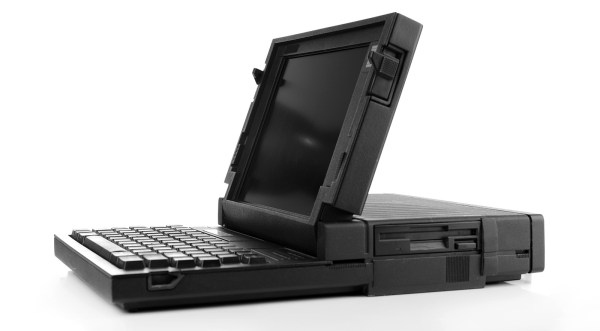
Our Right To Repair Depends On A Minimally Viable Laptop

It’s never been harder to repair your electronics. When the keyboard in your shiny new MacBook dies, you’ll have to send it to a Genius. When the battery in your iPhone dies, you’ll have to break out the pentalobe screwdrivers. Your technology does not respect your freedom, and this is true all the way down to the source code: the Library of Congress is thankfully chipping away at the DMCA in an effort that serves the Right to Repair movement, but still problems remain.

The ability — or rather, right — to repair will inevitably mean using electronics longer, and keeping them out of the garbage. That’s less e-waste, but it’s also older, potentially slower and less powerful portable workstations. This is the question: how long should you keep your electronics running? When do you start getting into the false economy of repairing something just because you can? What is the minimally viable laptop?

Continue reading “Our Right To Repair Depends On A Minimally Viable Laptop”