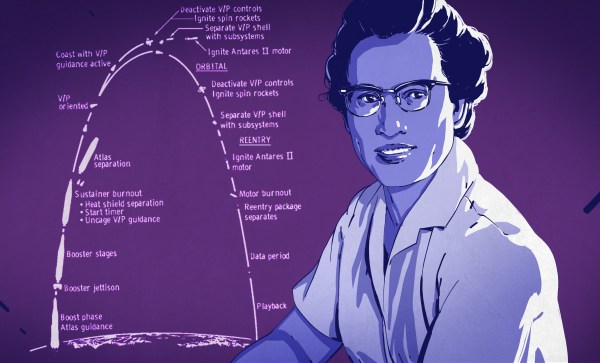
Katherine Johnson: Computer To The Stars

In 1962, John Glenn sat in his capsule waiting for his rocket engines to light-up and lift him to space. But first, he insisted that Katherine Johnson double-check the electronic computer’s trajectory calculations. While that’s the dramatic version of events given in the recent movie, Hidden Figures, the reality isn’t very far off. Glenn wasn’t sitting on the launchpad at the time, but during the weeks prior to launch, he did insist that Johnson double-check the computer’s calculations.

So who is this woman who played an important but largely unknown part of such a well-known historical event? During her long life, she was a wife, a mother, an African-American, a teacher, and a human computer, a term rarely used these days. Her calculations played a part in much of early spaceflight and in 2015, she was awarded the Presidential Medal of Freedom by President Obama. She also has a building named after her at the Langley Research Center in Hampton, Virginia.

Continue reading “Katherine Johnson: Computer To The Stars”

Building A Portable Solar Powered Spot Welder: Charging Supercapacitors

Before Lunar New Year, I had ordered two 3000 F, 2.7 V supercapacitors from China for about $4 each. I don’t actually remember why, but they arrived (unexpectedly) just before the holiday.

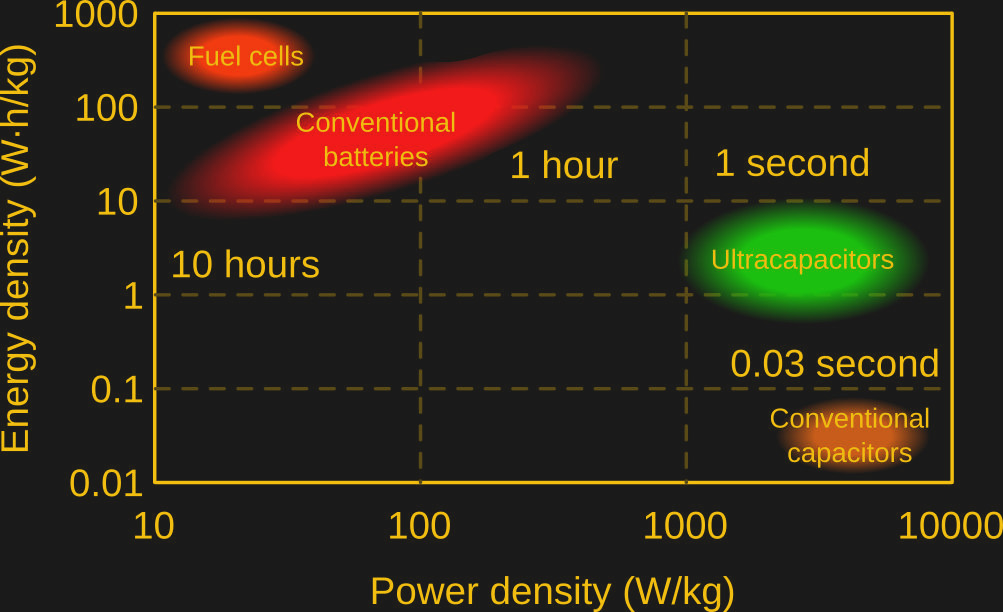
Supercapacitors (often called ultracapacitors) fill a niche somewhere between rechargeable lithium cells and ordinary capacitors. Ordinary capacitors have a low energy density, but a high power density: they can store and release energy very quickly. Lithium cells store a lot of energy, but charge and discharge at a comparatively low rate. By weight, supercapacitors store on the order of ten times less energy than lithium cells, and can deliver something like ten times lower power than capacitors.

Overall they’re an odd technology. Despite enthusiastic news coverage, they are a poor replacement for batteries or capacitors, but their long lifespan and moderate energy and power density make them suitable for some neat applications in their own right. Notably, they’re used in energy harvesting, regenerative braking, to extend the life of or replace automotive lead-acid batteries, and to retain data in some types of memory. You’re not likely to power your laptop with supercapacitors.

Anyway, I had a week-long holiday, and two large capacitors of dubious origin. Sometimes we live in the best of all possible worlds. Continue reading “Building A Portable Solar Powered Spot Welder: Charging Supercapacitors”

Can Open-source Hardware Be Like Open-source Software?

Hardware and software are certainly different beasts. Software is really just information, and the storing, modification, duplication, and transmission of information is essentially free. Hardware is expensive, or so we think, because it’s made out of physical stuff which is costly to ship or copy. So when we talk about open-source software (OSS) or open-source hardware (OSHW), we’re talking about different things — OSS is itself the end product, while OSHW is just the information to fabricate the end product, or have it fabricated.

The fabrication step makes OSHW essentially different from OSS, at least for now, but I think there’s something even more fundamentally different between the current state of OSHW and OSS: the pull request and the community. The success or failure of an OSS project depends on the community of people developing it, and for smaller projects that can hinge on the ease of a motivated individual digging in and contributing. This is the main virtue of OSS in my opinion: open-source software is most interesting when people are reading and writing that source.

With pure information, it’s essentially free to copy, modify, and push your changes upstream so that others can benefit. The open hardware world is just finding its feet in this respect, but that’s changing as we speak, and I have great hopes. Costs of fabrication are falling all around, open and useful tools are being actively developed to facilitate interchange of the design information. I think there are lessons that OSHW can learn from the OSS community’s pull-request culture, and that will help push the hardware hacker’s art forward.

What would it take to get you to build someone else’s OSHW project, improve on it, and contribute back? That’s a question worth a thoughtful deep dive.

Continue reading “Can Open-source Hardware Be Like Open-source Software?”

Successful Experiments In Multicolor Circuit Boards

Printed circuit boards have never been cheaper or easier to make. We’re not that far removed from a time where, if you wanted a printed circuit board, your best and cheapest option would be to download some proprietary software from a board house, use their terrible tool, and send your board off to be manufactured. A few copies of a 5x5cm board would cost $200. Now, anyone can use free (as in beer, if not speech) software, whip up a board, and get a beautifully printed circuit board for five dollars. It has never been easier to make a printed circuit board, and with that comes a new medium of artistic expression. Now, we can make art on PCBs.

PCB as Art

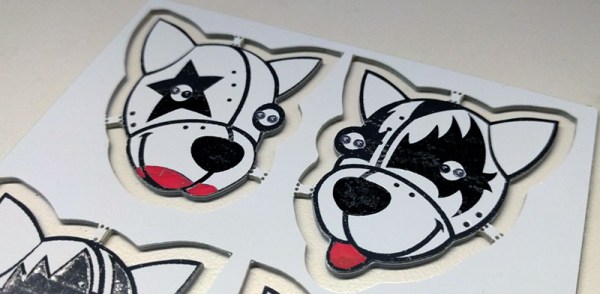
For the last year or so, Hackaday has been doing a deep-dive into the state of artistic PCBs. By far our biggest triumph is the Tindie Blinky Badge, an artistic representation of a robot dog with blinking LED eyes. [Andrew Sowa] turned some idiot into PCB coinage, and that same idiot experimented with multicolor silkscreen at last year’s DEF CON.

Others have far surpassed anything we could ever come up with ourselves; [Trammel Hudson] created an amazing blinky board using the standard OSHPark colors, and [Blake Ramsdell] is crafting full panels of PCB art. The work of Boldport and [Saar Drimer] has been featured in Marie Claire. The world of art on printed circuit boards has never been more alive, there has never been more potential, and the artistic output of the community is, simply, amazing. We are witnessing the evolution of a new artistic medium.

Printed circuit boards are a limited medium. Unless you want to shell out big bucks for more colors of silkscreen, weird colors of soldermask, or even multiple colors of soldermask, you will be limited to the standard stackup found in every board house. One color, the fiberglass substrate, will be a pale yellow. The copper layer will be silver or gold, depending on the finish. The soldermask will be green, red, yellow, blue, black, white, and of course purple if you go through OSH Park. The silkscreen will be white (or black if you go with a white soldermask). What I’m getting at is that the palette of colors available for PCB art is limited… or at least it has been.

For a few months now, Hackaday has been experimenting with a new process for adding colors to printed circuit boards. This is a manufacturing process that translates well into mass production. This is a process that could, theoretically, add dozens of colors to any small PCB. It’s just an experiment right now, but we’re happy to report some limited success. It’s now easy — and cheap — to add small amounts of color to any printed circuit board.

Continue reading “Successful Experiments In Multicolor Circuit Boards”

World Create Day Is The Hackaday Event In Your Neighborhood

Hackaday World Create Day is on March 17th and it’s happening near you. Get together with hackers in your area and create something. Sign up now to host a World Create Day gathering! These are really easy to organize, but we can only do it with your help.

The Hackaday community from around the world will meetup and spend time building together on Saturday, March 17th. Pick one of those projects you’ve been meaning to dive into and get together with some old and new friends to hack on your projects together.

You should make this day your own. As with any hands-on hacking events it’s a good idea to block out a bit of time at the end for lightning talks to show off the builds everyone has been working on. Make the memories live on past a single day by taking pictures and posting the story of your World Create Day meetup. We enjoyed getting a great look at many of last year’s meetups this way and want to expand the builds we feature on the front page this year.

Meetup Organizers Wanted

Fill out this form to let us know you want to host a meetup.

Every year we have World Create Day meetups all over the world which are set up by local organizers. Many of those will happen again this year, but we also need you to organize an event in your area. We’ll help you get things set up and put your event up on the big map so others in your area will plan to join in. Do it now, if we get your shipping info early we’ll send you stickers and other swag to hand out at your gathering.

Build Something that Matters

The core of World Create Day is to stop making excuses and just build something. Great builds start with a plan. The Hackaday Prize will begin soon, and since you’re already getting together with other people, form a team and dream up your entry.

This is your take on building something that matters to the world. Come up with a plan that solves a problem facing humanity and publish your work on Hackaday.io. You may be surprised by the support you get for your idea, but you’ll never know until you put an idea out there. Join in Hackaday’s World Create Day on March 17th and let’s show the world the kind of hope that blossoms when we decide to build something that matters.

SpaceX Joins In The Long History Of Catching Stuff From Space

On February 22nd, a Falcon 9 rocket lifted off from Vandenberg Air Force Base in California and successfully delivered into orbit an Earth-observation satellite operated by the Spanish company Hisdesat. Compared to the media coverage received by the launch of the Tesla-laden Falcon Heavy earlier in the month, this mission got very little attention. But that’s hardly surprising. With respect to Hisdesat, the payload this time around was not terribly exciting, and even the normally dramatic landing of the Falcon 9’s first stage was skipped in favor of simply allowing the booster to crash into the ocean.

As far as SpaceX launches go, this one was about as low-key as they come. It wouldn’t be a surprise if this is the first time some readers are even hearing about it. But while it didn’t invoke the same media circus as the images of a spacesuit-wearing mannequin traveling into deep space, there was still a historic “first” performed during this mission.

In an effort to increase the re-usability of the Falcon 9 booster, SpaceX attempted to catch the payload fairing (essentially a large protective nose cone) with a huge net as it fell from space. The most interesting thing about this new chapter in the quest for a fully reusable rocket system is that while SpaceX is generally considered to be pioneers in the world of bringing hardware back from space, this particular trick dates all the way back to the 1960’s.

Continue reading “SpaceX Joins In The Long History Of Catching Stuff From Space”

Rapidly Prototyping Prosthetics, Braille, And Wheelchairs

We live in an amazing time where the availability of rapid prototyping tools and expertise to use them has expanded faster than at any other time in human history. We now have an amazing ability to quickly bring together creative solutions — perfect examples of this are the designs for specialized arm prosthetics, Braille printing, and custom wheelchair builds that came together last week.

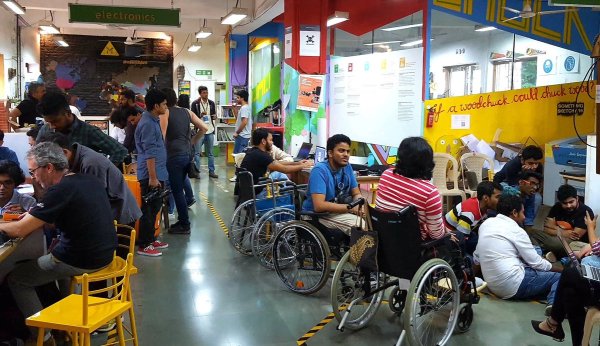
Earlier this month we published details about the S.T.E.A.M. Fabrikarium program taking place at Maker’s Asylum in Mumbai. The five-day event was designed to match up groups of makers with mentors to build assistive devices which help improve the condition of differently-abled people.

The participants were split into eight teams and they came up with some amazing results at the end of the five-day program.

Hands-On: Prosthetic Designs That Go Beyond

Three teams worked on projects based on Bionico – a myoelectric prosthesis

DIY Prosthetic Socket – a Human Machine Interface : [Mahendra Pitav aka Mahen] lost his left arm during the series of train bomb blasts in Mumbai in 2006, which killed 200 and injured over 700 commuters. He uses a prosthetic arm which is essentially a three-pronged claw that is cable activated using his other good arm. While it is useful, the limited functionality restricted him from doing many simple things. The DIY Prosthetic socket team worked with [Mahen] and [Nico Huchet] from MyHumanKit (who lost his right arm in an accident 16 years back), and fabricated a prosthetic forearm for [Mahen] with a modular, 3D printed accessory socket. Embedded within the arm is a rechargeable power source that provides 5V USB output at the socket end to power the devices that are plugged in. It also provides a second port to help recharge mobile phones. Also embedded in the arm was an IR reflective sensor that can be used to sense muscle movements and help trigger specific functions of add-on circuits, for example servos.

Continue reading “Rapidly Prototyping Prosthetics, Braille, And Wheelchairs”