Whether it’s trying to make contacts across the planet with a transmitter that would have a hard time lighting an LED, or blasting signals into space and bouncing them off the moon, amateur radio operators have always been on the forefront of communications technology. As mankind took to space in the 1950s and 1960s, hams went along for the ride with the first private satellites. But as successful as the OSCAR satellites were, they were still at best only beacons or repeaters in space. What was needed was the human touch – a real live operator making contacts with people on the ground, showing the capabilities of amateur radio while generating public interest in the space program. What was needed was a ham in space. Continue reading “Hams In Space Part 2: The Manned Spaceflights”

Featured3168 Articles
Longform articles, the best of what the Hackaday writing crew has to offer.
What’s New, ESP-32? Testing The Arduino Library
In case you missed it, the big news is that a minimal Arduino core is up and working on the ESP32. There’s still lots left to do, but the core functionality — GPIO, UART, SPI, I2C, and WiFi — are all up and ready to be tested out. Installing the library is as easy as checking out the code from GitHub into your Arduino install, so that’s exactly what I did.
I then spent a couple days playing around with it. It’s a work in progress, but it’s getting to the point of being useful, and the codebase itself contains some hidden gems. Come on along and take a sneak peek.
Continue reading “What’s New, ESP-32? Testing The Arduino Library”
Apple Sucks Now, Here’s A ThinkPad Buyer’s Guide
For the last decade, Macs have been running a UNIX-ish operating system on x86 processors. They’ve been fantastic developer’s machines, and the MacBook Pro is the de facto standard laptop issued to all developers, all hackathon attendees, and arguably, anyone who does real work with a computer.
This week, Apple unveiled the latest MacBook Pro and provided more evidence Steve Jobs actually knew what he was doing. Fifteen hundred bones will get you a MacBook Pro with a last-gen processor, an Escape key, a headphone jack, and two Thunderbolt 3 ports (with one port required for charging). The next model up costs $1800, ditches the Escape key for a dedicated emoji bar, and includes four Thunderbolt 3 ports.
In the past, I have defended people who choose MacBooks as their laptop of choice. A MacBook is a business-class laptop, and of course carries a higher price tag. However, Apple’s latest hardware release was underwhelming and overpriced. If you’re looking for a new laptop, you would do well to consider other brands. To that end, here’s a buyer’s guide to ThinkPads, currently the second most popular laptop I’ve seen with the dev/hacker/code cracker crowd.
Continue reading “Apple Sucks Now, Here’s A ThinkPad Buyer’s Guide”
Why You Should Own A Sewing Machine
![This could probably be any of our grandmothers at work. George Grantham Bain Collection [PD], via Wikimedia Commons](https://hackaday.com/wp-content/uploads/2016/10/woman-with-sewing-machine.jpg?w=362)
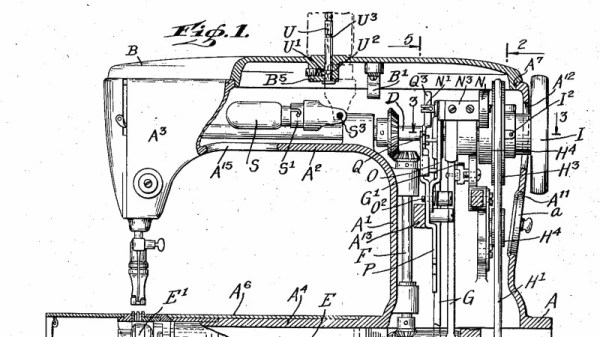
Putting it quite simply, textiles aren’t seen as very cool, in hackspace terms. You know, Women’s stuff. Your mother does it, or even maybe if you are a little younger, your grandmother. It’s just not up there with laser cutting or 3D printing, and as a result those of us for whom it’s a big part of making stuff have had to fight its corner when it comes to resources within the space.
Yet not so long ago when I brought a pair of worn-out jeans into the space on a social night and hauled out our Lervia sewing machine to fix them, I had a constant stream of fellow members passing by amazed at what I was doing. “You can repair jeans?” they asked, incredulously. For some reason this prospect had not occurred to them, I was opening up a new vista in clothing reincarnation, to the extent that before too long in our new facility I may be giving a workshop on the subject as the beloved former trousers of Oxford Hackspace denizens gain a chance of new life.
Life On Contract: How To Find Clients As An Engineering Contractor
The following is my personal advice, it probably doesn’t apply to all contractors, but it’s certainly applied to me. When you start contracting, your most pressing question is probably “how do I find clients” so here’s what little I’ve learned so far…
1. Don’t
For some, contracting is seen as a potential escape route from the hum-drum of a dull, often political office environment. But contracting isn’t always the answer. Pay, while often better, is inconsistent. I’ve had clients pay two months late (and think it’s normal), pay the wrong amount (due to misunderstanding currency conversion) and just plain forget to sign off an invoice. Chasing down these invoicing issues will all be your job. Clients will say “we’ll definitely hire you” and then a contract will never happen.
Continue reading “Life On Contract: How To Find Clients As An Engineering Contractor”
Should You Outsource Manufacturing? A Handy Guide
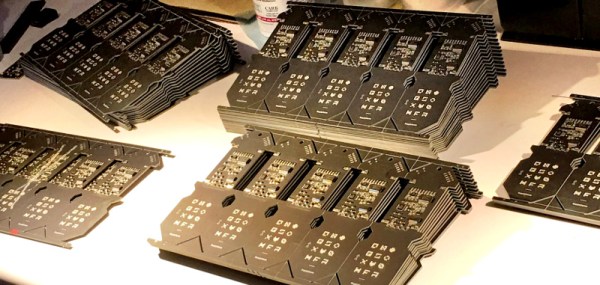
A lot of people assume that the product development cycle involves R&D, outsourcing to a Chinese manufacturer, and then selling the finished product. It’s almost ingrained in our heads that once a prototype has been developed, the next step involves a visa and airplane tickets. Here is a guide that will explore a few other options, and why outsourcing may not be appropriate for everyone.
First, let’s talk about goals. We’ll assume you’re not a large company, and that you don’t have a huge budget, and that you’re just getting started with your product and don’t have big volumes; a startup trying to sell a kit or breakout board, or a consumer electronics product. Your goals are the following:
- Validate your product in the market. Build a minimum viable product and get it in the hands of lots of users
- Get the most bang for your limited bucks. All money should go towards getting products out the door
- Reduce risk to your company so that any single failure doesn’t crater the whole operation and you can safely grow.
With that in mind, what are your options?
Continue reading “Should You Outsource Manufacturing? A Handy Guide”
Two-Stage Tentacle Mechanisms Part III: Putting It All Together
Welcome back to the final chapter in our journey exploring two-stage tentacle mechanisms. This is where we arm you with the tools and techniques to get one of these cretins alive-and-kicking in your livingroom. In this last installment, I’ll guide us through the steps of building our very own tentacle and controller identical to one we’ve been discussing in the last few weeks. As promised, this post comes with a few bonuses:

Design Files
- The Almighty Bill-o’-Materials
- Vector Drawings for laser cutting
- DXF files pre-offset (0.003″)
- DXF files original
- STL Models for 3D Printing
- Original Tentacle CAD Model Files
- Original Controller CAD Model Files
Depending on your situation, some design files may be more important than others. If you just want to get parts made, odds are good that you can simply cut the pre-offset DXFs from the right plate thicknesses and get rolling. Of course, if you need to tune the files for a laser with a slightly different beam diameter, I’ve included the original DXFs for good measure. For the heavy-hitters, I’ve also included the original files if there’s something about this design that just deserves a tweak or two. Have at it! (And, of course, let us know how you improve it!)
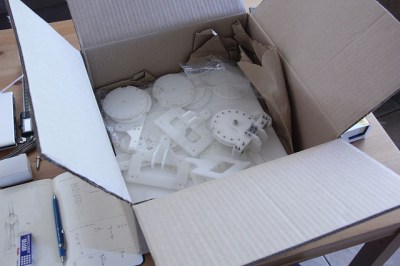
Ok, now that we’ve got the parts on-hand in a pile of pieces,let’s walk through the last-mile tweaks to making this puppet work: assembly and tuning. At this point, we’ve got a collection of parts, some laser-cut, some off the shelf. Now it’s time to string them together.
Continue reading “Two-Stage Tentacle Mechanisms Part III: Putting It All Together”