Hackaday was in Portland last weekend for the Open Hardware Summit. I did a brief recap earlier this week but this post has been on my mind the entire time. The night before the summit, OSH Park (the Purveyors of Perfect Purple PCBs which we all know and love) hosted a Bring-A-Hack at their headquarters. [Laen] knows how to throw a party — with a catered spread and open bar which all enjoyed. The place was packed with awesome hackers, and everyone had something amazing to show off.
In fact, there were far too many people showing off hardware for me to capture all in one evening. But join me after the jump for six or seven examples that really stuck out.
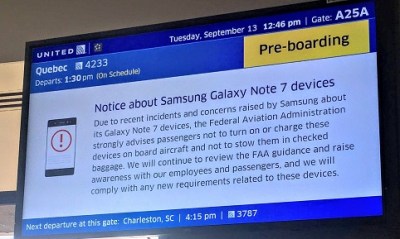
Unless you’ve been living under a high voltage transformer, you’ve heard about the potential for Samsung’s latest phone, the Note7, to turn into a little pocket grenade without warning. With over 2.5 million devices in existence, it’s creating quite a headache for the company and its consumers.
They quickly tied the problem to faulty Li-ion batteries and started replacing them, while issuing a firmware update to stop charging at 60 percent capacity. But after 5 of the replacement phones caught fire, Samsung killed the Note7 completely. There is now a Total Recall on all Note7 phones and they are no longer for sale. If you have one, you are to turn it off immediately. And don’t even think about strapping it into a VR headset — Oculus no longer supports it. If needed, Samsung will even send you a fireproof box and safety gloves to return it.
Every airline has been broadcasting warnings not to power on or charge a Note 7 on a plane. Image Source: CNET
It should be noted that the problem only affects 0.01% of the phones out there, so they’re not exactly going to set the world on fire. However, it has generated yet another discussion about the safety of Li-ion battery technology.
It was just a few months ago we all heard about those hoverboards that would catch fire. Those questionably-engineered (and poorly-named) toys used Li-ion batteries as well, and they were the source of the fire problem. In the wake of this you would think all companies manufacturing products with Li-ion batteries in them would be extra careful. And Samsung is no upstart in the electronics industry — this should be a solved problem for them.
Why has this happened? What is the deal with Li-ion batteries? Join me after the break to answer these questions.
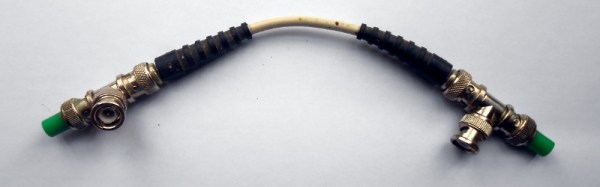
There it was, after twenty minutes of turning the place over, looking through assorted storage boxes. A Thinwire Ethernet network. About the smallest possible Thinwire Ethernet network as it happens, a crimped BNC lead about 100mm long and capped at each end by a T-piece and a 50 ohm terminator. I’d been looking for a BNC T-piece on which to hook up another terminator to a piece of test equipment, and I’d found two of them.
As I hooked up the test I wanted to run I found myself considering the absurdity of the situation. I last worked somewhere with a Thinwire network in the mid 1990s, and fortunately I am likely to never see another one in my life. If you’ve never encountered Thinwire, be thankful. A single piece of co-ax connecting all computers on the network, on which the tiniest fault causes all to fail.
So why had I held on to all the parts to make one, albeit the smallest possible variant? Some kind of memento, to remind me of the Good Old Days of running round an office with a cable tester perhaps? Or was I just returning to my past as a hoarder, like a Tolkienic dragon perched atop a mountain of electronic junk, and not the good kind of junk?
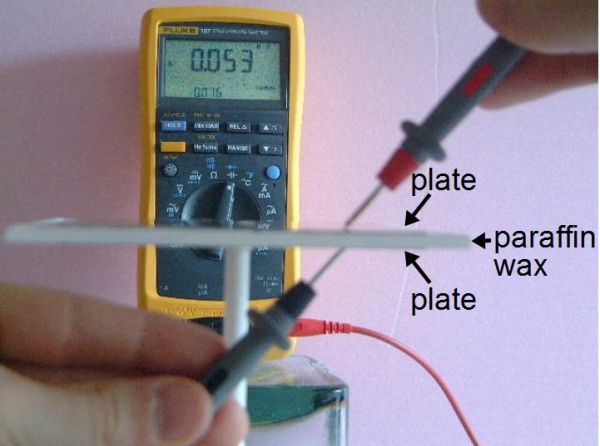
Every now and then you need to make your own capacitor. That includes choosing a dielectric for it, the insulating material that goes between the plates. One dielectric material that I use a lot is paraffin wax which can be found in art stores and is normally used for making candles. Another is resin, the easiest to find being automotive resin used for automotive body repairs.
The problem is that you sometimes need to do the calculations for the capacitor dimensions ahead of time, rather than just throwing something together. And that means you need to know the dielectric constant of the dielectric material. That’s something that the manufacturer of the paraffin wax that makes it for art stores won’t know, nor will the manufacturers of automotive body repair resin. The intended customers just don’t care.
It’s therefore left up to you to measure the dielectric constant yourself, and here I’ll talk about the method I use for doing that.
I’m not saying that the magic pocket oracle we all carry around isn’t great, but I think there is a philosophical disconnect between what it is and what it could be for us. Right now our technology is still trying to improve every tool except the one we use the most, our brain.
At first this seems like a preposterous claim. Doesn’t Google Maps let me navigate in completely foreign locations with ease? Doesn’t Evernote let me off-load complicated knowledge into a magic box somewhere and recall it with photo precision whenever I need to? Well, yes, they do, but they do it wrong. What about ordering food apps? Siri? What about all of these. Don’t they dramatically extend my ability? They do, but they do it inefficiently, and they will always do it inefficiently unless there is a philosophical change in how we design our tools.
Friday was the 2016 Open Hardware Summit, a yearly gathering of people who believe in the power of open design. The use of the term “summit” rather than “conference” is telling. This gathering brings together a critical mass of people running hardware companies that adhere to the ideal of “open”, but this isn’t at the exclusion of anyone — all are welcome to attend. Hackaday has built the world’s largest repository of Open Hardware projects. We didn’t just want to be there — We sponsored, sent a team of people, and thoroughly enjoyed ourselves in the process.
Join me after the break for a look at the talks, a walk through the swag bags, and a feel for what this wonderful day held.
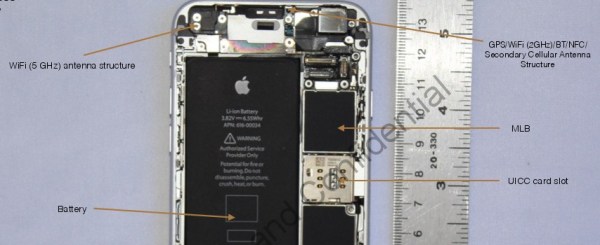
When a consumer electronics device is sold in the US, especially if it has a wireless aspect, it must be tested for compliance with FCC regulations and the test results filed with the FCC (see preparing your product for FCC testing). These documents are then made available online for all to see in the Office of Engineering and Technology (OET) Laboratory Equipment Authorization System (EAS). In fact, it’s this publishing in this and other FCC databases that has led to many leaks about new product releases, some of which we’ve covered, and others we’ve been privileged enough to know about before the filings but whose breaking was forced when the documents were filed, like the Raspberry Pi 3. It turns out that there are a lot of useful things that can be accomplished by poring over FCC filings, and we’ll explore some of them.