Meetup In Boston This Thursday

Hackaday is headed to Boston this week. Meet up with us on Thursday at 6pm to show off your projects and meet other hackers in the area. Admission is free, just tell us you’re coming.

We’re hosting a Hackaday meetup at Artisan’s Asylum hackerspace. That name should sound familiar. This is the group that decided to throw down the robot gauntlet with Japan. We can’t wait to see what that’s all about first hand!

While in town we’ll also be stopping by the MIT Media Lab, a legendary den of cutting edge research that springs forth wave after wave of awesome inspiration. If you know of any projects going on there that we just shouldn’t miss please let us know below. We’re also looking for suggestions of other places we should check out while in town.

See you Thursday!

How To Build A ProxyHam Despite A Cancelled DEFCON Talk

A few days ago, [Ben Caudill] of Rhino Security was scheduled to give a talk at DEFCON. His project, ProxyHam, is designed for those seeking complete anonymity online. Because IP addresses can be tied to physical locations, any online activities can be tracked by oppressive regimes and three letter government agencies. Sometimes, this means doors are breached, and “seditious” journalists and activists are taken into custody.

With the ProxyHam, the link between IP addresses and physical locations is severed. ProxyHam uses a 900MHz radio link to bridge a WiFi network over miles. By hiding a ProxyHam base station in a space with public WiFi, anyone can have complete anonymity online; if the government comes to take you down, they’ll first have to stop at the local library, Starbucks, or wherever else has free WiFi.

[Ben Caudill] will not be giving a talk at DEFCON. It wasn’t the choice of DEFCON organizers to cancel the talk, and it wasn’t his employers – [Ben] founded and is principal consultant at Rhino Security. The talk has been killed, and no one knows why. Speculation ranges from National Security Letters to government gag orders to a far more pedestrian explanations like, “it doesn’t work as well as intended.” Nevertheless, the details of why the ProxyHam talk was cancelled will never be known. That doesn’t mean this knowledge is lost – you can build a ProxyHam with equipment purchased from Amazon, Newegg, or any one of a number of online retailers.

Continue reading “How To Build A ProxyHam Despite A Cancelled DEFCON Talk”

Become A Mad Scientist, Build A Power Distribution Panel

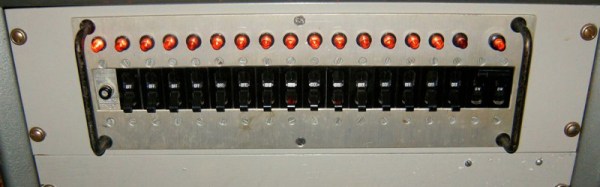
One practical use of large switches and indicator lamps is to make a power distribution panel which can be useful when you want to control and monitor the power consumption of numerous devices such as your electronics work bench or amateur radio station. Old-school in appearance and using military surplus electronics, this power distribution panel allows for control of outlet on back. Did I mention I built it when I was 16?

Building it was easy, 120 VAC line enters through a main breaker. It is fed through an AC amp meter (with built-in shunt) then to a line filter. From the line filter it goes to a line voltage meter and filament transformer to power the indicator lamps. This AC line is then bussed out to the circuit breakers. Each breaker controls one outlet on the rear panel. As devices are switched on or off the current draw can be measured. This is well demonstrated in the video overview found after the break.

Be creative. Use military surplus switches, indicators, and other unique looking hardware. Customize to give your preferred mad scientist look while also providing valuable functionality.

Continue reading “Become A Mad Scientist, Build A Power Distribution Panel”

Vintage Electronics Magazines Predicted Our Current Future

Do you remember the magazine Popular Electronics? What about Radio Electronics? These magazines were often the first exposure we had to the world of hacking. In December we learned that Americanradiohistory.com has gone to the trouble of scanning nearly every copy of both, and continues to add many many others — posting them online for us to enjoy once more. Since then we’ve been pouring through the archive pulling out some of the best in terms of nostalgia, entertainment, and fascinating engineering.

Yes much of this material is very dated; CB Radios, all-mighty computers, phasors, stun guns, levitating machines, overly complex circuits for simple tasks, and aviator eyeglasses. But found among all of this, many innovative mixed-signal circuits and other interesting ideas that have been developed into our tech-centric world. Many of those modern inventions you’ve welcomed into your life actually started long-long ago in the forward-thinking hacks shown off in these publications. The Google Glass precursor seen above is but one example. Keep reading to see the early roots of the tech we tend to think of as “new”.

Continue reading “Vintage Electronics Magazines Predicted Our Current Future”

Show Us Your Human Interface; Win Laser Cutting Time

Our newest Hot List is Human Interfaces. This is anything you’ve designed into your project to interact with people. And we want to see it all! Do you have something bristling with buttons, boasting many LCD screens, hosting controls organized with the principles of Feng Shui, or intuitively voice activated? Show us the user interface you’re proud of and you could win one of thirty $100 gift cards for Ponoko laser cutting service.

We’re in the thick of judging the Wheels, Wings, and Propellers hot list from this week. We’ll be announcing the rankings in the coming days, but for now you need to get your project onto the Your Human Interface hot list. Here’s what you need to do before Thursday, 7/16/15:

Good luck, and per usually we’d like to encourage you to Vote this week. It’s a great way to explore the entries in this year’s 2015 Hackaday Prize, and you just might win $1000 from the Hackaday Store just for voting!

The 2015 Hackaday Prize is sponsored by:

Hackaday’s Interview With Arduino CEO [Massimo Banzi]

I caught up with [Massimo Banzi] at the Shenzhen Maker Faire to talk about manufacturing in China, the current and future of Arduino, and how recent events may shape the Open Hardware landscape.

The big news from Arduino at SZMF is a new partnership with Seeed Studio to manufacture theGenuino. This is an official Arduino board manufactured in China for the Chinese market. Knowing that the board is official and connected to the founders is key point to get makers to adopt this hardware. [Massimo] makes a good point about the ideal of “Proudly Made in China” which I could see as a selling point for the burgeoning maker market there. This may be a growing principle in China, but in an ocean of clone boards it sounds like a tough path forward. On the other hand, their booth was mobbed with people putting in new orders.

[Massimo] belives the current Arduino strife has actually served to move the project forward. He cites the schism between arduino.cc and arduino.org for catalyzing manufacturing partnerships with both Adafruit Industries and Seeed Studios. This has resulted in official Arduino hardware that is not made only in Italy, but made in the region the hardware will be used; NYC for US orders, Shenzhen for China orders.

Our discussion wraps up with a plea from [Massimo] for the Hackaday community to be a little less fickle about projects using Arduino. That one makes me chuckle a bit!

Stenography (Yes, With Arduinos)

What’s the fastest keyboard? Few subjects are as divisive in the geek community. Clicky or squishy? QWERTY or Dvorak? Old-school IBM or Microsoft Natural? The answer: none of the above.

danger-court-reporter-tyingThe fastest normal-keyboard typists (Dvorak or Qwerty) can get around 220 words per minute (wpm) in bursts. That sounds fast, and it’s a lot faster than we type, but that’s still below the minimum speed allowable for certified court reporters or closed captioners. The fastest court reporters clock in around 350 to 375 wpm for testimony. But they do this by cheating — using a stenotype machine. We’ll talk more about stenography in a minute, but first a hack.

The Hack

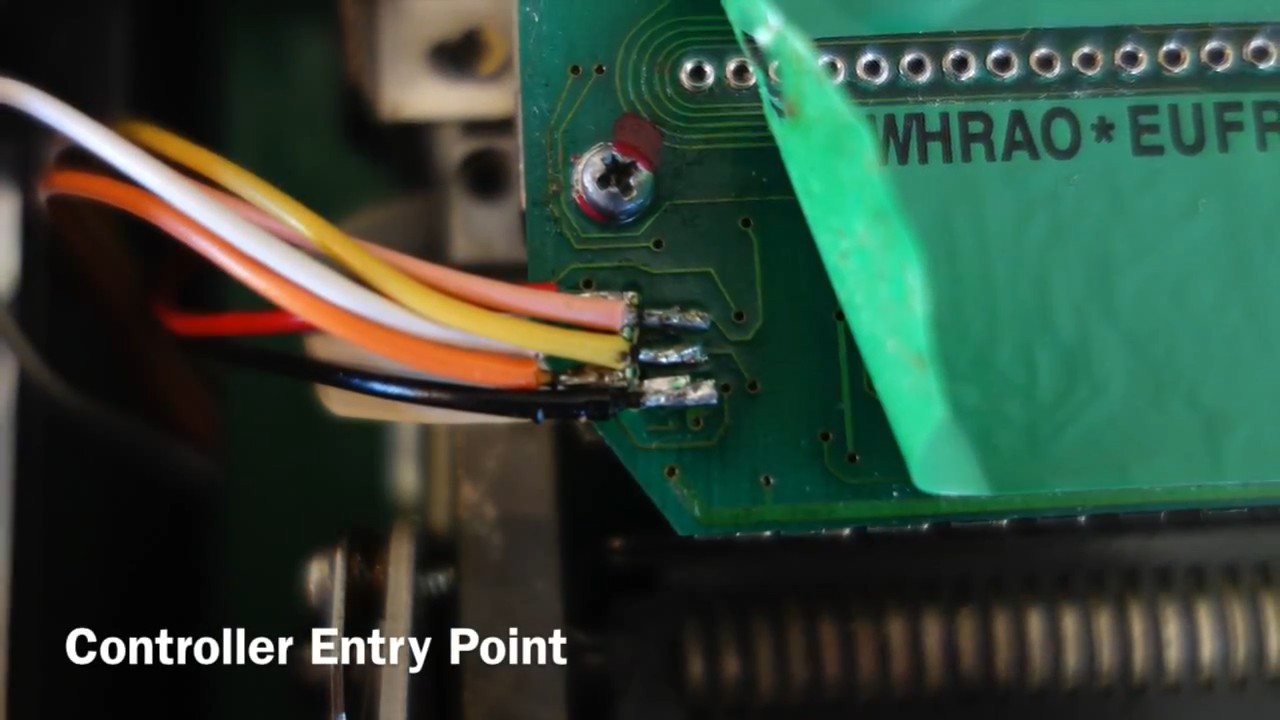
[Kevin Nygaard] bought a used Stentura 200 stenotype machine off Ebay and it wasn’t working right, so naturally he opened it up to see if he could fix it. A normal stenotype operates stand-alone and prints out on paper tape, but many can also be connected to an external computer. [Kevin]’s machine had a serial output board installed, but it wasn’t outputting serial, so naturally he opened it up to see if he could fix it. In the end, he bypassed the serial output by soldering on an Arduino and writing a few lines of code.
shot0001The serial interface board in [Kevin]’s machine was basically a set of switches that made contact with the keys as they get pressed, and a few shift registers to read the state of these switches out over a serial connection. [Kevin] tapped into this line, read the switch state out into his Arduino, and then transmitted the correct characters to his computer via the Arduino’s serial over USB. (Video demo) As hardware types like to say, the rest is a simple matter of software.

Continue reading “Stenography (Yes, With Arduinos)”