Glove80 Keyboard Sure Fits Like One

If you’re what one might call unlucky, there comes a point in your life when you need to switch to a keyboard that’s more ergonomic than your average rectangle. A little prevention goes a long way, though, and there’s no time like the present to go ergo. Why not? You have everything to gain, from long-lasting comfort to satisfying key presses.

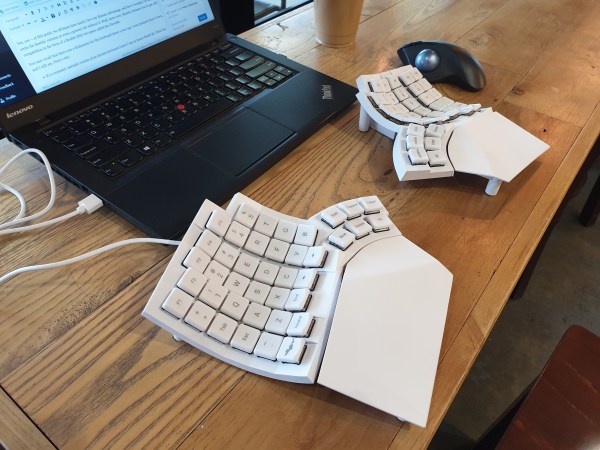
The only problem is that most severely ergonomic keyboards just aren’t portable. At this point, we all know how much I love my Kinesis Advantage, and how I wouldn’t be able to write the Keebin’ column or even a grocery list without it. I have two now, and I take the ugly, yellowed, sticker-bombed one with me out into the world. But as much as I love it, I would really dig a a slimmed-down version that’s just as comfortable, perhaps more so. Well, move over, Kinesis, because you’ve got stiff competition in the form of a flexible little two-piece called the Glove80.

You may recall that there was a Kickstarter for this keyboard about a year ago. I was pumped about it then, and I still am. Here’s why:

Continue reading “Glove80 Keyboard Sure Fits Like One”

Why LLaMa Is A Big Deal

You might have heard about LLaMa or maybe you haven’t. Either way, what’s the big deal? It’s just some AI thing. In a nutshell, LLaMa is important because it allows you to run large language models (LLM) like GPT-3 on commodity hardware. In many ways, this is a bit like Stable Diffusion, which similarly allowed normal folks to run image generation models on their own hardware with access to the underlying source code. We’ve discussed why Stable Diffusion matters and even talked about how it works.

LLaMa is a transformer language model from Facebook/Meta research, which is a collection of large models from 7 billion to 65 billion parameters trained on publicly available datasets. Their research paper showed that the 13B version outperformed GPT-3 in most benchmarks and LLama-65B is right up there with the best of them. LLaMa was unique as inference could be run on a single GPU due to some optimizations made to the transformer itself and the model being about 10x smaller. While Meta recommended that users have at least 10 GB of VRAM to run inference on the larger models, that’s a huge step from the 80 GB A100 cards that often run these models.

While this was an important step forward for the research community, it became a huge one for the hacker community when [Georgi Gerganov] rolled in. He released llama.cpp on GitHub, which runs the inference of a LLaMa model with 4-bit quantization. His code was focused on running LLaMa-7B on your Macbook, but we’ve seen versions running on smartphones and Raspberry Pis. There’s even a version written in Rust! A rough rule of thumb is anything with more than 4 GB of RAM can run LLaMa. Model weights are available through Meta with some rather strict terms, but they’ve been leaked online and can be found even in a pull request on the GitHub repo itself. Continue reading “Why LLaMa Is A Big Deal”

Hands-On: NVIDIA Jetson Orin Nano Developer Kit

NVIDIA’s Jetson line of single-board computers are doing something different in a vast sea of relatively similar Linux SBCs. Designed for edge computing applications, such as a robot that needs to perform high-speed computer vision while out in the field, they provide exceptional performance in a board that’s of comparable size and weight to other SBCs on the market. The only difference, as you might expect, is that they tend to cost a lot more: the current top of the line Jetson AGX Orin Developer Kit is $1999 USD

Luckily for hackers and makers like us, NVIDIA realized they needed an affordable gateway into their ecosystem, so they introduced the $99 Jetson Nano in 2019. The product proved so popular that just a year later the company refreshed it with a streamlined carrier board that dropped the cost of the kit down to an incredible $59. Looking to expand on that success even further, today NVIDIA announced a new upmarket entry into the Nano family that lies somewhere in the middle.

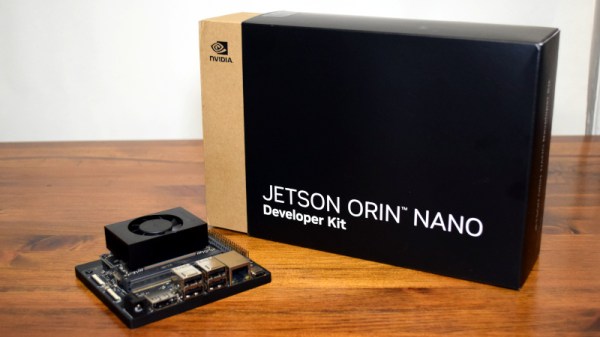
While the $499 price tag of the Jetson Orin Nano Developer Kit may be a bit steep for hobbyists, there’s no question that you get a lot for your money. Capable of performing 40 trillion operations per second (TOPS), NVIDIA estimates the Orin Nano is a staggering 80X as powerful as the previous Nano. It’s a level of performance that, admittedly, not every Hackaday reader needs on their workbench. But the allure of a palm-sized supercomputer is very real, and anyone with an interest in experimenting with machine learning would do well to weigh (literally, and figuratively) the Orin Nano against a desktop computer with a comparable NVIDIA graphics card.

We were provided with one of the very first Jetson Orin Nano Developer Kits before their official unveiling during NVIDIA GTC (GPU Technology Conference), and I’ve spent the last few days getting up close and personal with the hardware and software. After coming to terms with the fact that this tiny board is considerably more powerful than the computer I’m currently writing this on, I’m left excited to see what the community can accomplish with the incredible performance offered by this pint-sized system.

Continue reading “Hands-On: NVIDIA Jetson Orin Nano Developer Kit”

Vinyl Sales Ran Circles Around CDs In 2022

How do you take your music these days? For those in Camp Tangible, it seems our ranks are certainly growing, and in the analog direction. For the first time since 1987, vinyl record sales have outperformed CD sales in the US, according to a new report. The CD, which saved us all from the cassette, was a digital revolution in music. But for some, the love was lost somewhere among the ones and zeroes.

Those who prefer pure analog troughs of sound cut into wax have never given up on vinyl, and the real ones probably gobbled up a bunch of it in the 90s when everybody was CD-crazy. But mind you these aren’t used vinyl sales we’re talking about, which means that enough new vinyl has to have been readily available for purchase for quite some time now. Although it doesn’t really seem like that long, new vinyl’s been back for almost 20 years — and according to the report, 2022 was the 16th consecutive year of growth for record sales.

So Why Vinyl?

Nostalgia ain’t what it used to be, but there was a time in my 1980s childhood when vinyl was all this scribe had to listen to. I have historically been a bit slow to adopt new music formats — I didn’t have a CD player until 1998, and it was given to me for my birthday. I was excited to get the thing, mind you, especially since it had 10 seconds of anti-skip protection (which of course was a huge concern with portable CD players).

But CDs are way different from records. Sure, they’re both round, but the similarities sort of end there. For one thing, the artwork is disappointingly small compared to vinyl. And the whole gatefold album cover thing isn’t really possible with a CD, unless you forego the jewel case and release it in a chintzy little cardboard jacket. But then people will have this one disc that’s four times thinner than the rest and it throws everything off in the collection.

Continue reading “Vinyl Sales Ran Circles Around CDs In 2022”

Another Room-Temperature Superconductivity Claim And Questions Of Scientific Integrity

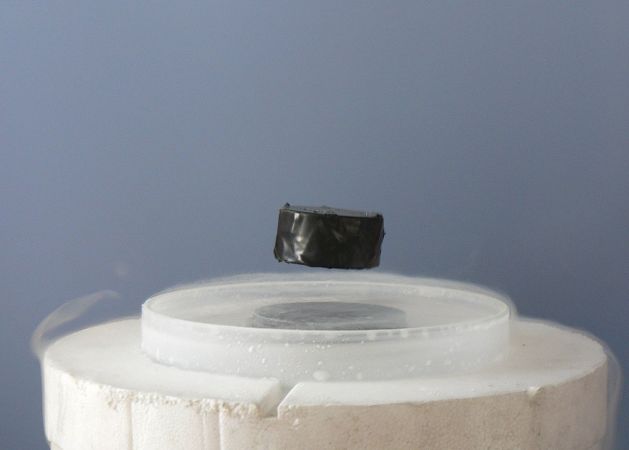
In early March of 2023, a paper was published in Nature, with the researchers claiming that they had observed superconductivity at room temperature in a conductive alloy, at near-ambient pressure. While normally this would be cause for excitement, what mars this occasion is that this is not the first time that such claims have been made by these same researchers. Last year their previous paper in Nature on the topic was retracted after numerous issues were raised by other researchers regarding their data and the interpretation of this that led them to conclude that they had observed superconductivity.

According to an interview with one of the lead authors at the University of Rochester – Ranga Dias – the retracted paper has since been revised to incorporate the received feedback, with the research team purportedly having invited colleagues to vet their data and experimental setup. Of note, the newly released paper reports improvements over the previous results by requiring even lower pressures.

Depending on one’s perspective, this may either seem incredibly suspicious, or merely a sign that the scientific peer review system is working as it should. For the lay person this does however make it rather hard to answer the simple question of whether room-temperature superconductors are right around the corner. What does this effectively mean?

Continue reading “Another Room-Temperature Superconductivity Claim And Questions Of Scientific Integrity”

The Rise And (Eventual) Fall Of The SIM Card

There are few devices that better exemplify the breakneck pace of modern technical advancement than the mobile phone. In the span of just a decade, we went from flip phones and polyphonic ringtones to full-fledged mobile computers with quad-core processors and gigabytes of memory.

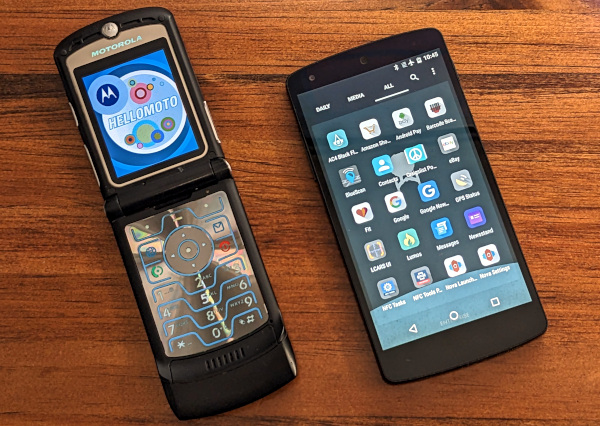
While rapid advancements in computational power are of course nothing new, the evolution of mobile devices is something altogether different. The Razr V3 of 2003 and the Nexus 5 of 2013 are so vastly different that it’s hard to reconcile the fact they were (at least ostensibly) designed to serve the same purpose — with everything from their basic physical layout to the way the user interacts with them having undergone dramatic changes in the intervening years. Even the network technology they use to facilitate voice and data communication are different.

Two phones, a decade apart.

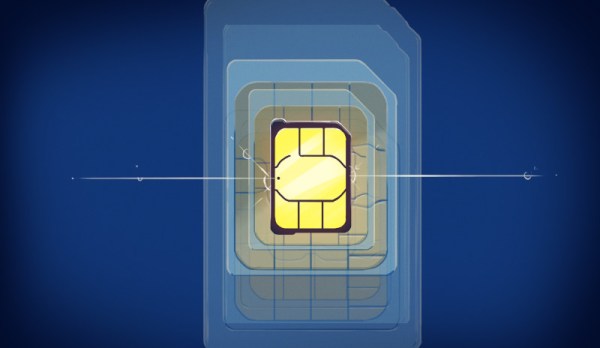
Yet, there’s at least one component they share: the lowly SIM card. In fact, if you don’t mind trimming a bit of unnecessary plastic away, you could pull the SIM out of the Razr and slap it into the Nexus 5 without a problem. It doesn’t matter that the latter phone wasn’t even a twinkling in Google’s eye when the card was made, the nature of the SIM card means compatibility is a given.

Indeed there’s every reason to believe that very same card, now 20 years old, could be installed in any number of phones on the market today. Although, once again, some minor surgery would be required to pare it down to size.

Such is the beauty of the SIM, or Subscriber Identity Module. It allows you to easily transfer your cellular service from one phone to another, with little regard to the age or manufacturer of the device, and generally without even having to inform your carrier of the swap. It’s a simple concept that has served us well for almost as long as cellular telephones have existed, and separates the phone from the phone contract.

So naturally, there’s mounting pressure in the industry to screw it up.

Continue reading “The Rise And (Eventual) Fall Of The SIM Card”

Hackaday Links Column Banner

Hackaday Links: March 19, 2023

We get results! Well, sort of. You may recall that in this space last week we discussed Ford’s plans to exclude AM reception on the infotainment systems of certain of their cars starting in 2024. We decried the decision, not for the loss of the sweet, sweet content that AM stations tend to carry — although we always enjoyed “Traffic on the 8s” back in our dismal days of daily commuting — but rather as a safety concern, because AM radio can reach almost the entire US population with emergency information using just 75 stations. To our way of thinking, this makes AM radio critical infrastructure, and eliminating it from motor vehicles is likely to have unintended consequences. Now it seems like there’s some agreement with that position, as former administrators of FEMA (Federal Emergency Management Administration; and no, not FEDRA) have gotten together to warn about the dangers of deleting AM from cars. Manufacturers seem to be leaning into the excuse that EVs emit a lot of radio frequency interference, rendering static-sensitive AM receivers less useful than other, more profitable less susceptible modes, like digital satellite radio. That seems like a red herring to us, but then again, the most advanced infotainment option in any car we’ve ever owned is a CD player, so it’s hard for us to judge.

Continue reading “Hackaday Links: March 19, 2023”