In Praise Of “Just Because” Hacks

Sometimes you pick a project because the world needs it to be done. Or maybe you or a friend need it. Or maybe you don’t really need it, but it fulfills a longstanding dream. In my mind, the last stop before you reach “why am I doing this” is the “just because” hack.

The ideal “just because” hack is limited in scope. You don’t want to spend years on a whimsical project, and because of this a “just because” hack isn’t usually motivating enough to keep you going that long anyway, except for the tenacious few. A “just because” doesn’t necessarily have to be an easy win, but it makes sense for you to see your way out before you get in too deep.

I’m not sure if it’s the Baader-Meinhof phenomenon or not, but in the last week or so in the Hackaday universe, a lot of people have been singing the praises of “just because” hacks. (Check out this one discussion, for instance.) Mostly, it’s a combination of them turning out better than initially thought, or it’s about the learning that came along for the ride. Of course, many of them spin off into longer, serious projects even if they didn’t start that way.

Not everything in life can be frivolous, of course. But that makes the “just because” hack that much sweeter, and you should try to make mental room for them if you can. When the stakes are low, creativity can be high. You might still want to impose a deadline, lest you fall into eternal yak shaving, but take it easy. You don’t need a justification all the time: the journey can be the destination.


Hackaday Podcast 199: Ferrofluid Follies, Decentralized Chaos, And NTSC For You And Me

This week, Editor-in-Chief Elliot Williams and Assignments Editor Kristina Panos decided against using one of Kristina’s tin can microphones to record the podcast, though that might be a cool optional thing to do once (and then probably never again).

After a brief foray into the news that the Chaos Communications Congress will be decentralized once again this year, as COVID restrictions make planning this huge event a complete headache (among other notable symptoms), we discuss the news that the EU is demanding replaceable batteries in phones going forward.

After that, it’s time for another What’s That Sound results show, and despite repeated listens, Kristina fails to guess the thing. Even if she’d had an inkling as to what it was, she probably would have said ‘split-flap display’ instead of the proper answer, which is ‘flip-dot display’, as a few people responded. Finally, it’s on to the hacks, where we talk about uses for ferrofluid and decide that it’s one of those things that’s just for fun and should not be applied to the world as some sort of all-purpose whacking device.

Check out the links below if you want to follow along, and as always, tell us what you think about this episode in the comments!

And/or download it and listen offline.

Continue reading “Hackaday Podcast 199: Ferrofluid Follies, Decentralized Chaos, And NTSC For You And Me”

This Week In Security: Adblock For Security, ProxyNotShell Lives, And CVSS 10 To Not Worry About

The ubiquity of ransomware continues, this time with The Guardian announcing they were partially shut down from an attack. Staff are working from home as the incident is being investigated and data is recovered. Publishing seems to be continuing, and the print paper ran as expected.

There have been a couple reports published recently on how ransomware and other malware is distributed, the first being a public service announcement from the FBI, detailing what might be a blindly obvious attack vector — search engine advertising. A bad actor picks a company or common search term, pays for placement on a search engine, and then builds a fake web site that looks legitimate. For bonus points, this uses a typosquatted domain, like adobe[dot]cm or a punycode domain that looks even closer to the real thing.

The FBI has a trio of recommendations, one of which I whole-heartedly agree with. Their first suggestion is to inspect links before clicking them, which is great, except for the punycode attack. In fact, there are enough lookalike glyphs to make this essentially useless. Second is to type in URLs directly rather than using a search engine to find a company’s site. This is great so long as you know the URL and don’t make a typo. But honestly, haven’t we all accidentally ended up at website[dot]co by doing this? Their last recommendation is the good one, and that is to run a high-quality ad-blocker for security. Just remember to selectively disable blocking for websites you want to support. (Like Hackaday!) Continue reading “This Week In Security: Adblock For Security, ProxyNotShell Lives, And CVSS 10 To Not Worry About”

Wear Your Fave Cassette Tapes As A Necklace With This 3D Printed Adapter

While packing merch for a recent gig, I realised I had the opportunity to do something a little fun. I’d released an album on tape, and spent a little extra to ensure the cassette itself was a thing of beauty. It deserved to be seen, rather than hidden away in a case on a shelf. I wanted to turn this piece of musical media into a necklace.

Of course, cassette tapes aren’t meant to be used in this way. Simply throwing a chain through the cassette would lead to tape reeling out everywhere. Thus, I fired up some CAD software and engineered a solution to do the job! Here’s how I built an adapter to turn any cassette tape into a cool necklace.

Find the design on Thingiverse, and more details below!

Continue reading “Wear Your Fave Cassette Tapes As A Necklace With This 3D Printed Adapter”

Supercon 2022: Mooneer Salem Goes Ham With An ESP32

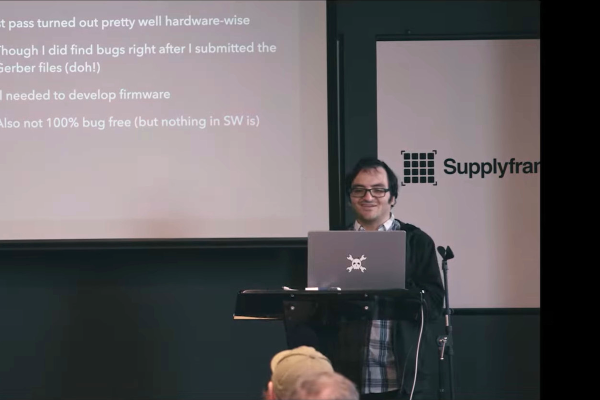
After being licensed as a ham radio operator since the early 2000s, you tend to start thinking about combining your love for the radio with other talents. In a 20-minute talk at Hackaday Supercon 2022, [Mooneer Salem] tells the story of one such passion project that combined software and radio to miniaturize a digital ham radio modulator.

[Mooneer] works as a software developer and contributes to a project called FreeDV (free digital voice), a digital voice mode for HF radio. FreeDV first compresses the digital audio stream, then converts it into a modulation scheme sent out over a radio. The appeal is that this can be understandable down to very low signal-to-noise ratios and includes metadata and all the other niceties that digital signals bring.

Traditionally, this has required a computer to compress the audio and modulate the signal in addition to two sound cards. One card processes the audio in and out of your headset, and another for the audio coming in and out of the radio. [David Rowe] and [Rick Barnich] developed the SM1000, a portable FreeDV adapter based around the STM32F4 microcontroller. However, flash space was running low, and the cost was more than they wanted. Continue reading “Supercon 2022: Mooneer Salem Goes Ham With An ESP32”

Linux Fu: Miller The Killer Makes CSV No Pest

Historically, one of the nice things about Unix and Linux is that everything is a file, and files are just sequences of characters. Of course, modern practice is that everything is not a file, and there is a proliferation of files with some imposed structure. However, if you’ve ever worked on old systems where your file access was by the block, you’ll appreciate the Unix-like files. Classic tools like awk, sed, and grep work with this idea. Files are just characters. But this sometimes has its problems. That’s the motivation behind a tool called Miller, and I think it deserves more attention because, for certain tasks, it is a lifesaver.

The Problem

Consider trying to process a comma-delimited file, known as a CSV file. There are a lot of variations to this type of file. Here’s one that defines two “columns.” I’ve deliberately used different line formats as a test, but most often, you get one format for the entire file:

Slot,String 
A,"Hello" 
"B",Howdy 
"C","Hello Hackaday" 
"D","""Madam, I'm Adam,"" he said." 
E 100,With some spaces!
X,"With a comma, or two, even"

Continue reading “Linux Fu: Miller The Killer Makes CSV No Pest”

Lo-Fi Fun: Beer Can Microphones

Sometimes, you just need an easy win, right? This is one of those projects. A couple months back, I was looking at my guitars and guitar accessories and thought, it is finally time to do something with the neck I’ve had lying around for years. In trying to decide a suitable body for the slapdash guitar I was about to build, I found myself at a tractor supply store for LEGO-related reasons. (Where else are you going to get a bunch of egg cartons without eating a bunch of eggs?) I  noticed that they happened to also stock ammo boxes. Bam! It’s sturdy, it opens easily, and it’s (very) roughly guitar body shaped. I happily picked one up and started scheming on the way home.

Having never built a cigar box guitar before and being of a certain vintage, I’m inclined to turn to books instead of the Internet, so I stocked up from the library. Among my early choices was Making Poor Man’s Guitars by Shane Speal, who is widely considered to be the guru on the subject. In flipping through the book, I noticed the beer can microphone project and was immediately taken by the aesthetic of some cool old 70s beer can with a 1/4″ instrument jack on the bottom, just asking for some dirty blues to be belted into it. I had to build one. Or twelve.

Continue reading “Lo-Fi Fun: Beer Can Microphones”