All About USB-C: Connector Mechanics

There’s two cases when hackers have to think about USB-C connector mechanics. The first is when a USB-C connector physically breaks, and the second is when we need to put a connector on our own board. Let’s go through both of them.

Clean That Connector

What if a socket on your phone or laptop fails? First off, it could be due to dust or debris. There’s swabs you can buy to clean a USB-C connector; perhaps adding some isopropyl alcohol or other cleaning-suitable liquids, you can get to a “good enough” state. You can also reflow pins on your connector, equipped with hot air or a sharp soldering iron tip, as well as some flux – when it comes to mechanical failures, this tends to remedy them, even for a short period of time.

How could a connector fail, exactly? Well, one of the pins could break off inside the plastic, or just get too dirty to make contact. Consider a device with a USB-C charging and data socket, with USB 2.0 but without high-speed pairs – which is to say, sadly, the majority of the phones out there. Try plugging it into a USB-A charger using a USB-A to USB-C cable. Does it charge, even if slowly? Then, your VBUS pins are okay.

Plug it into a Type-C charger using a Type-C cable, and now the CC pins are involved. Does it charge in both orientations? Then both of your CC pins are okay. Does it charge in only one orientation? One of the CC pins has to be busted. Then, you can check USB 2.0 pins, used for data transfer and legacy charging. Plug the phone into a computer using a USB-A to USB-C cable. Does it enumerate as a device? Does it enumerate in both orientations? If not, you might want to clean D- and D+ pins specifically, maybe even both sets. Continue reading “All About USB-C: Connector Mechanics”


A Love Letter To My Lost Amiga

My first love was a black wedge. It was 1982, and I had saved up to buy a Sinclair ZX81. That little computer remains the only one of the huge number that I have owned over the years about which I can truly say that I understood its workings completely; while I know how the i7 laptop on which this is being written works I can only say so in a loose way as it is an immensely complex device.

Computing allegiance is fickle, and while I never lost an affection for the little Sinclair I would meet my true electronic soulmate around eight years later as an electronic engineering student. It no longer graces my bench, but this was the computer against which all subsequent machines I have owned would be measured, the one which I wish had not been taken from me before its time, and with which I wish I could have grown old together. That machine was a Commodore Amiga, and this is part love letter, part wistful musing about what could have been, and part rant about what went wrong for the best desktop computer platform ever made. Continue reading “A Love Letter To My Lost Amiga”

Hackaday Links Column Banner

Hackaday Links: December 18, 2022

By now everyone has probably seen the devastation wrought by the structural failure of what was once the world’s largest free-standing cylindrical aquarium. The scale of the tank, which until about 5:50 AM Berlin time on Friday graced the lobby of the Raddison Blu hotel, was amazing — 16 meters tall, 12 meters in diameter, holding a million liters of saltwater and some 1,500 tropical fish. The tank sat atop a bar in the hotel lobby and was so big that it even had an elevator passing up through the middle of it.

But for some reason, the tank failed catastrophically, emptying its contents into the hotel lobby and spilling the hapless fish out into the freezing streets of Berlin. No humans were killed by the flood, which is miraculous when you consider the forces that were unleashed here. Given the level of destruction, the displaced hotel guests, and the fact that a €13 million structure just up and failed, we’re pretty sure there will be a thorough analysis of the incident. We’re pretty interested in why structures fail, so we’ll be looking forward to finding out the story here.

Continue reading “Hackaday Links: December 18, 2022”

Battery Engineering Hack Chat Gets Charged Up

Turn the clock back a couple of decades, and the only time the average person would have given much thought to batteries was when the power would go out, and they suddenly needed to juice up their flashlight or portable radio.  But today, high-capacity batteries have become part and parcel to our increasingly digital lifestyle. In fact, there’s an excellent chance the device your reading this on is currently running on battery power, or at least, is capable of it.

So let’s get to know batteries better. What’s the chemical process that allows them to work? For that matter, what even is a battery in the first place?

It’s these questions, and more, that made up this week’s Battery Engineering Hack Chat with Dave Sopchak. Our last Hack Chat of 2022 ended up being one of the longest in recent memory, with the conversation starting over an hour before the scheduled kickoff and running another half hour beyond when emcee Dan Maloney officially made his closing remarks. Not bad for a topic that so often gets taken for granted.

Continue reading “Battery Engineering Hack Chat Gets Charged Up”

This Week In Security: Scamming The FBI, In The Wild, And AI Security

If you’re part of a government alphabet agency, particularly running a program to share information to fight cybercrime, make sure to properly verify the identity of new members before admission. Oh, and make sure the API is rate-limited so a malicious member can’t scrape the entire user database and sell it on a dark web forum.

Putting snark aside, this is exactly what has happened to the FBI’s InfraGuard program. A clever user applied to the program using a CEO’s name and phone number, and a convincing-looking email address. The program administrators didn’t do much due diligence, and approved the application. Awkward.

BSD Ping

First off, the good folks at FreeBSD have published some errata about the ping problem we talked about last week. First off, note that while ping does elevate to root privileges via setuid, those privileges are dropped before any data handling occurs. And ping on FreeBSD runs inside a Capsicum sandbox, a huge obstacle to system compromise from within ping. And finally, further examination of the bug in a real-world context casts doubt on the idea that Remote Code Execution (RCE) is actually possible due to stack layouts.

If someone messes up somewhere, go look if you messed up in the same or similar way somewhere else.

Sage advice from [Florian Obser], OpenBSD developer. So seeing the ping problem in FreeBSD, he set about checking the OpenBSD ping implementation for identical or similar problems. The vulnerable code isn’t shared between the versions, so he reached for afl++, a fuzzing tool with an impressive list of finds. Connect afl++ to the function in ping that handles incoming data, and see what shakes out. The conclusion? No crashes found in this particular effort, but several hangs were identified and fixed. And that is a win. Continue reading “This Week In Security: Scamming The FBI, In The Wild, And AI Security”

Supercon 2022: Sam Mulvey Shows You How To FM Radio

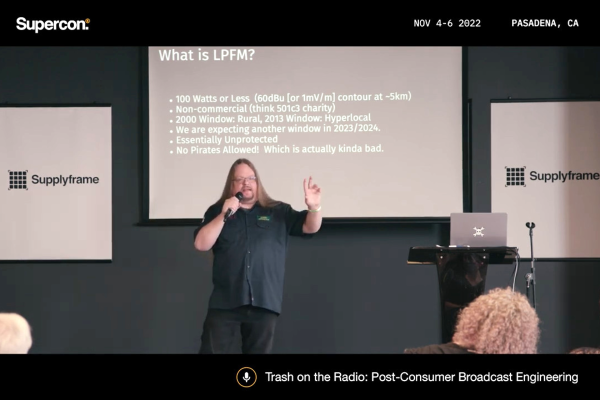
Sam Mulvey built his own radio station in Tacoma, WA. Is there a better way to meld ham radio practice with a colossal number of DIY electrical and computer projects? Sam would say there isn’t one! This 45-minute talk is basically the lessons-learned review of setting up KTQA 95.3 – the radio station on the hill.

Sam starts out the talk by introducing you to LPFM. And maybe you didn’t know that there’s a special type of license issued by the US FCC allowing non-profit community radio stations up to 100 W, covering an radius of around 5 km. It’s like running a pirate radio station, but by jumping through a few legal hoops, made legal.

Trash on the Radio

Putting a radio station together on a budget requires a ton of clever choices, flexibility, and above all, luck. But if you’re willing to repair a busted CD player or turntable, scrounge up some used computers, and work on your own amplifiers, the budget doesn’t have to be the limiting factor.

Being cheap means a lot of DIY. For instance, Sam and friends made a custom console to support all the gear and hide all the wiring. Some hot tips from the physical build-out: painted cinderblocks make great studio monitor stands, and Cat-5 can carry two channels of balanced audio along with power, with sufficient isolation that it all sounds clean. Continue reading “Supercon 2022: Sam Mulvey Shows You How To FM Radio”

Australia’s Soft Plastic Recycling Debacle

We’ve all been told to cut back on waste to help prevent environmental crisis on Earth. Reducing waste helps reduce the need to spend time and energy digging up fresh materials, and helps reduce the amount of trash we have to go out and bury in the ground in landfills. Recycling is a big part of this drive, allowing us to divert waste by reprocessing it into fresh new materials.

Sadly, though, recycling isn’t always as magical as it seems. As Australia has just found out, it’s harder than it sounds, and often smoke and mirrors prevent the public from understanding what’s really going on. Here’s how soft plastic recycling went wrong Down Under.

Continue reading “Australia’s Soft Plastic Recycling Debacle”