Printed It: Collet Drill Stop

You’d think that being quarantined in your home would be perfect for hackers and makers like us, as we all have a project or two that’s been sitting on the back burner because we didn’t have the time to tackle it. Unfortunately, some are finding that the problem now is actually getting the parts and tools needed to do the job. When there’s a bouncer and a line outside the Home Depot like it’s a nightclub on Saturday night, even the simplest of things can be difficult to source when making in the time of COVID.

Which is exactly the situation I found myself in recently when I needed to drill a bunch of holes to the same depth. The piece was too big to put in the drill press, and while I contemplated just wrapping the bit in some tape to serve as a makeshift stop, I wasn’t convinced it would be accurate or repeatable enough. It occurred to me that a set of drill stop collars would be easy enough to design and 3D print, but before I fired up OpenSCAD, I decided to see what was already available online.

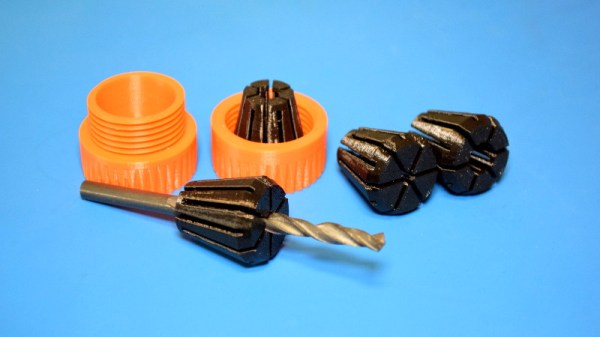
Which is how I found the “Collet Drill Stop” from Adam Harrison. Rather than the traditional ring and setscrew arrangement, his design uses a printable collet that will clamp down on the bit at an arbitrary position without tools. So not only could I avoid a trip to the store by printing this design out, it looked like it would potentially be an upgrade over what I would have bought.

Of course, it’s wise not to take anything for granted when dealing with 3D printing. The only way I could be sure that Adam’s design would work for me was to commit it to plastic and try it out.

Continue reading “Printed It: Collet Drill Stop”

Limiting Factor Submersible Is In A League Of Its Own

Space may be the final frontier, but there are still Earthly frontiers that a select few have visited — the deepest depths of the high seas. Victor Vescovo, a Texas businessman and former Naval officer, is one of those few. Last spring, Vescovo realized his dream of becoming the first person to scrape the bottoms of all five oceans.

Vescovo descended alone in Limiting Factor, a $37 million two-seater submersible he commissioned from Triton, a private manufacturer who made this feat of engineering come to life. Vescovo and the crew discovered over 40 new species of aquatic lifeforms throughout the course of their Five Deeps expedition. But the attention-getting takeaway came when Vescovo visited the absolute lowest point on Earth. In the Challenger Deep portion of the Marianas Trench, seven miles below sea level, he saw a plastic bag drift by in the abyss.

One normal-sounding quirk sets this sub apart from others: it’s made to be reusable. You read that right, most super-deep divers never manage to dive over and over again.

Continue reading “Limiting Factor Submersible Is In A League Of Its Own”

Searching For Alien Life With The Sun As Gravitational Telescope

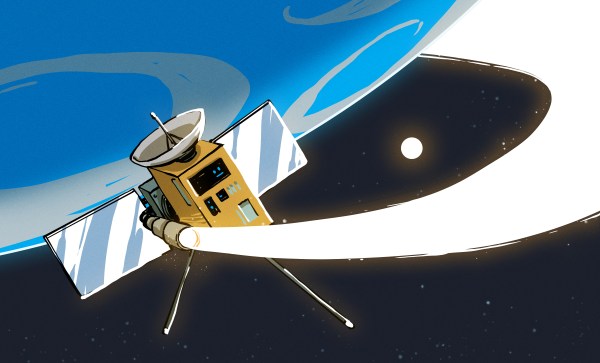
Astronomy is undoubtedly one of the most exciting subjects in physics. Especially the search for exoplanets has been a thriving field in the last decades. While the first exoplanet was only discovered in 1992, there are now 4,144 confirmed exoplanets (as of 2nd April 2020). Naturally, we Sci-Fi lovers are most interested in the 55 potentially habitable exoplanets. Unfortunately, taking an image of an Earth 2.0 with enough detail to identify potential features of life is impossible with conventional telescopes.

The solar gravitational lens mission, which has recently been selected for phase III funding by the NASA Innovative Advanced Concepts (NIAC) program, is aiming to change that by taking advantage of the Sun’s gravitational lensing effect. Continue reading “Searching For Alien Life With The Sun As Gravitational Telescope”

COBOL Isn’t The Issue: A Misinterpreted Crisis

Is history doomed to repeat itself? Or rather, is there really any doubt that it isn’t, considering recent events that made the news? I am of course talking about New Jersey’s call for COBOL programmers to fix their ancient unemployment system, collapsing under the application spikes caused by the COVID-19 lockdown. Soon after, other states joined in, and it becomes painfully apparent that we have learned absolutely nothing from Y2K: we still rely on the same old antiques running our infrastructure, and we still think people want to voluntarily write COBOL.

Or maybe they do? Following the calls for aid, things went strangely intense. IBM announced to offer free COBOL trainings and launched a forum where programmers can plug their skills and availability. The Open Mainframe Project’s COBOL programming course suddenly tops the list of trending GitHub projects, and Google Trends shows a massive peak for COBOL as well. COBOL is seemingly on its way to be one of the hottest languages of 2020, and it feels like it’s only a matter of time until we see some MicroCOBOL running on a Teensy.

However, the unemployment systems in question are unfortunately only a tiny selection of systems relying on decades old software, written in a language that went out of fashion a long time ago, which makes it difficult to find programmers in today’s times. Why is that?

Continue reading “COBOL Isn’t The Issue: A Misinterpreted Crisis”

Inputs Of Interest: The Differently Dexterous DataHand Directionalizes Digits

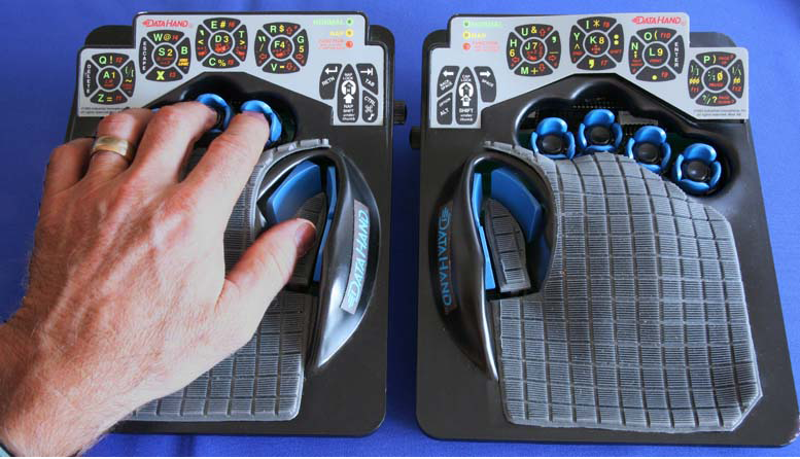
If you had debilitating pain from repetitive stress injury in the 1990s, there were a lot of alternative keyboard options out there. One of the more eye-catching offerings was the DataHand keyboard made by DataHand Systems out of Phoenix, AZ. The DataHand debuted in 1993 with a price tag around $2,000. While this is admittedly pretty steep for the average consumer, it was well within the IT budgets of companies that wanted to avoid workman’s comp claims and keep their employees typing away.

In theory, this is holy grail territory for anti-RSI keyboards. The DataHand was designed to eliminate wrist motion altogether by essentially assigning a d-pad plus a regular push-down button to each finger. The layout resembles QWERTY as closely as possible and uses layers to access numbers, symbols, and other functions, like a rudimentary mouse.

Although if you put them this close together, you’re kind of missing the point. Image via Bill Buxton

Ergonomic to the Max

Typing on the DataHand is supposed to be next to effortless. The directional switches are all optical, which probably has a lot to do with the eye-popping price point. But instead of being spring-loaded, these switches use magnets to return to the neutral position.

Continue reading “Inputs Of Interest: The Differently Dexterous DataHand Directionalizes Digits”

Google And Apple Reveal Their Coronavirus Contact Tracing Plans: We Kick The Tires

Google and Apple have joined forces to issue a common API that will run on their mobile phone operating systems, enabling applications to track people who you come “into contact” with in order to slow the spread of the COVID-19 pandemic. It’s an extremely tall order to do so in a way that is voluntary, respects personal privacy as much as possible, doesn’t rely on potentially vulnerable centralized services, and doesn’t produce so many false positives that the results are either ignored or create a mass panic. And perhaps much more importantly, it’s got to work.

Slowing the Spread

As I write this, the COVID-19 pandemic seems to be just turning the corner from uncontrolled exponential growth to something that’s potentially more manageable, but it’s not clear that we yet see an end in sight. So far, this has required hundreds of millions of people to go into essentially voluntary quarantine. But that’s a blunt tool. In an ideal world, you could stop the disease globally in a couple weeks if you could somehow test everyone and isolate those who have been exposed to the virus. In the real world, truly comprehensive testing is impossible, and figuring out whom to isolate is extraordinarily difficult due to two factors: COVID-19 has a long incubation period during which it is nonetheless transmissible, and some or even most people don’t know they have it. How can you stop what you can’t see, and even when you can detect it, it’s a week too late?

One promising approach is to isolate those people who’ve been in contact with known cases during the stealth contagion period. To do this is essentially to keep a diary of everyone you’ve been in contact with for the last week or two, and then if you eventually test positive for COVID-19, alert them all so that they can keep from infecting others even before they test positive: track and trace. Doctors can do this by interviewing patients who test positive (this is the “contact tracing” we’ve been hearing so much about), but memory is imperfect. Enter a technological solution. Continue reading “Google And Apple Reveal Their Coronavirus Contact Tracing Plans: We Kick The Tires”

SpaceX Offers NASA A Custom Moon Freighter

Under the current Administration, NASA has been tasked with returning American astronauts to the Moon as quickly as possible. The Artemis program would launch a crewed mission to our nearest celestial neighbor as soon as 2024, and establish a system for sustainable exploration and habitation by 2028. It’s an extremely aggressive timeline, to put it mildly.

To have any chance of meeting these goals, NASA will have to enlist the help of not only its international partners, but private industry. There simply isn’t enough time for the agency to design, build, and test all of the hardware that will eventually be required for any sort of sustained presence on or around the Moon. By awarding a series of contracts, NASA plans to offload some of the logistical components of the Artemis program to qualified companies and agencies.

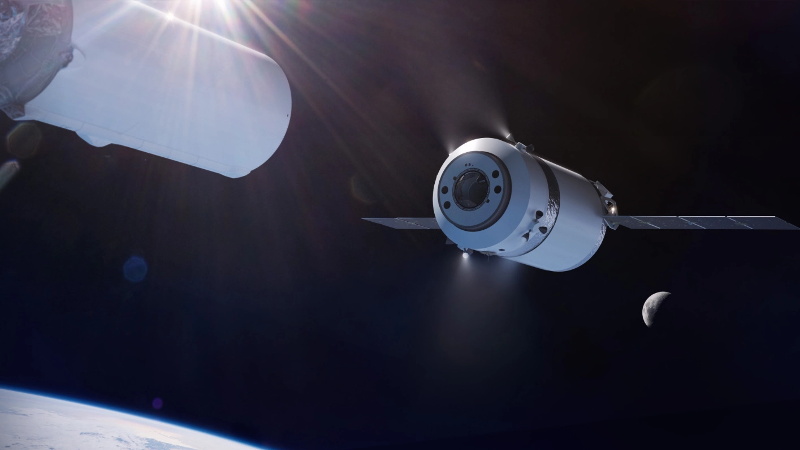
Artist’s Rendering of the Dragon XL

For anyone who’s been following the New Space race these last few years, it should come as no surprise to hear that SpaceX has already been awarded one of these lucrative logistics contracts. They’ve been selected as the first commercial provider for cargo deliveries to Gateway, a small space station that NASA intendeds to operate in lunar orbit. Considering SpaceX already has a contract to resupply the International Space Station, they were the ideal candidate to offer similar services for a future lunar outpost.

But that certainly doesn’t mean it will be easy. The so-called “Gateway Logistics Services” contract stipulates that providers must be able to deliver at least 3,400 kilograms (7,500 pounds) of pressurized cargo and 1,000 kilograms (2,200 pounds) of unpressurized cargo to lunar orbit. That’s beyond the capabilities of SpaceX’s Dragon spacecraft, which was only designed to service low Earth orbit.

To complete this new mission, the company is proposing a new vehicle they’re calling the Dragon XL that would ride to orbit on the Falcon Heavy booster. But even for this New Space darling, there’s not a lot of time to design, test, and build a brand-new spacecraft. To get the Dragon XL flying as quickly as possible, SpaceX is going to need to strip the craft down to the bare minimum.

Continue reading “SpaceX Offers NASA A Custom Moon Freighter”