Most of us perceive time as an arrow, a one-way trip into the future. And while that’s true, nature has a way of interpolating circular patterns onto that linear model — day follows night, the seasons progress through the year, and generations are born, live, and die after creating the next generation to do experience the same cycles in the future.
Our star, too, follows this cyclical model, and goes through observable, periodic changes that are of keen interest to solar scientists. So it was with some fanfare that they recently announced that the sun had transitioned into Solar Cycle 25. But what exactly does that mean? Does the Sun’s changing face make much difference to the average person’s daily life? History shows that it can, so it pays to know what we’re in store for over the next couple of decades. Welcome to your primer on Solar Cycle 25.
Telsa are one of the world’s biggest purchasers of batteries through their partnerships with manufacturers like Panasonic, LG and CATL. Their endless hunger for more cells is unlikely to be satiated anytime soon, as demand for electric cars and power storage continues to rise.
As announced at their Battery Day keynote, Tesla has been working hard on a broad spectrum of projects to take battery technology to the next level in order to reach their goal of 3 TWh annual production by 2030. One of the most interesting aspects of this was the announcement of Tesla’s new tabless 4680 battery, which will be manufactured by the company itself. Let’s take a look at what makes the 4680 so exciting, and why going tabless is such a big deal. Continue reading “Tesla’s New Tabless Batteries Unlock New Levels Of Performance”→
NVIDIA kicked off their line of GPU-accelerated single board computers back in 2014 with the Jetson TK1, a $200 USD development system for those looking to get involved with the burgeoning world of so-called “edge computing”. It was designed to put high performance computing in a small and energy efficient enough package that it could be integrated directly into products, rather than connecting to a data center half-way across the world.
The TK1 was an impressive piece of hardware, but not something the hacker and maker community was necessarily interested in. For one thing, it was fairly expensive. But perhaps more importantly, it was clearly geared more towards industry types than consumers. We did see the occasional project using the TK1 and the subsequent TX1 and TX2 boards, but they were few and far between.
Then came the Jetson Nano. Its 128 core Maxwell CPU still packed plenty of power and was fully compatible with NVIDIA’s CUDA architecture, but its smaller size and $99 price tag made it far more attractive for hobbyists. According to the company’s own figures, the number of active Jetson developers has more than tripled since the Nano’s introduction in March of 2019. With the platform accessible to a larger and more diverse group of users, new and innovative applications for machine learning started pouring in.
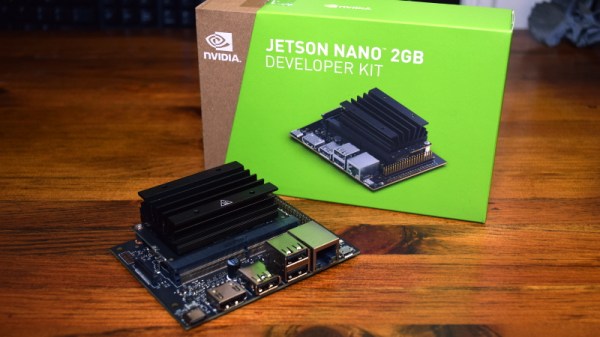
Cutting the price of the entry level Jetson hardware in half was clearly a step in the right direction, but NVIDIA wanted to bring even more developers into the fray. So why not see if lightning can strike twice? Today they’ve officially announced that the new Jetson Nano 2GB will go on sale later this month for just $59. Let’s take a close look at this new iteration of the Nano to see what’s changed (and what hasn’t) from last year’s model.
While we’re currently in an era of comparatively low gas prices, the last few decades have seen much volatility in the oil market. This can hit the hip pocket hard, particularly for those driving thirstier vehicles. Thankfully, modifications can help squeeze a few extra miles out of each gallon of dinosaur juice if you know what you’re doing.
The art of striving for the best fuel economy is known as hypermiling, and involves a broad spectrum of tricks and techniques to get the most out of a drop of fuel. Let’s dive in to how you can build a more efficient cruiser for getting around town.
Step 1: Know Thine Enemy
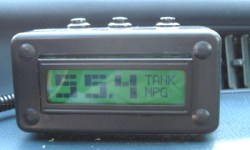
The MPGuino is a great solution for monitoring fuel consumption in older cars without a trip computer.
If you want to improve your fuel economy, the first step is to measure it. Without accurate measurement, it’s impossible to quantify any gains made or optimise for the best performance. For those with modern cars, it’s likely that there’s already a trip computer built into the dash. Using this to track your fuel economy is the easiest solution. Instantaneous modes are useful to help improve driving habits, while average modes are great for determining the car’s economy over time.
However, many older vehicles don’t have such features installed as stock. Thankfully, there’s a few ways to work around this. For those driving post-1996 vehicles outfitted with an OBD-II port, tools like Kiwi or Scangauge can often track fuel economy. Failing this, most fuel injected cars can be fitted with a device like the MPGuino that monitors fuel injection to calculate consumption. Fundamentally, all of these tools involve tracking the amount of fuel used per distance travelled. Factory tools and OBD-II gauges do it by using the car’s standard hardware, while the MPGuino splices in to speedometer signals and injector triggers to do the same thing with an Arduino. If you do decide to install a custom device, make sure you calibrate it properly, else your figures won’t bear much resemblance to what’s going on in reality.
Of course, as long as your car has a working odometer and a fuel tank that doesn’t leak, there’s always the pen-and-paper method. Simply reset the trip odometer to zero after filling the tank to the brim. Then, when refilling the tank, fill all the way to the top, and divide the miles driven by the gallons of fuel added back to the tank. This isn’t the most accurate method, as the nature of gas station pumps and automotive fuel tanks mean that tanks aren’t always accurately filled to the brim, due to air pockets and devices used to prevent overfilling. Despite this, it’s a handy way of getting some ballpark figures of your car’s performance over time.
Ah, the ever-present PDF, and our love-hate relationship with the format. We’ve lost count of how many vulnerabilities have been fixed in PDF software, but it’s been a bunch over the years. This week, we’re reminded that Adobe isn’t the only player in PDF-land, as Foxit released a round of updates, and there were a couple serious problems fixed. Among the vulnerabilities, a handful could lead to RCE, so if you use or support Foxit users, be sure to go get them updated.
PunkBuster
Remember PunkBuster? It’s one of the original anti-cheat solutions, from way back in 2000. The now-classic Return to Castle Wolfenstein was the first game to support PunkBuster to prevent cheating. It’s not the latest or greatest, but PunkBuster is still running on a bunch of game servers even today. [Daniel Prizmant] and [Mauricio Sandt] decided to do a deep dive project on PunkBuster, and happened to find an arbitrary file-write vulnerability, that could easily compromise a PB enabled server.
One of the functions of PunkBuster is a remote screenshot capture. If a server admin thinks a player is behaving strangely, a screenshot request is sent. I assume this targets so-called wallhack cheats — making textures transparent, so the player can see through walls. The problem is that the server logic that handles the incoming image has a loophole. If the filename ends in .png as expected, some traversal attack checks are done, and the png file is saved to the server. However, if the incoming file isn’t a png, no transversal detection is done, and the file is naively written to disk. This weakness, combined with the stateless nature of screenshot requests, means that any connected client can write any file to any location on the server at any time. To their credit, even Balance, the creators of PunkBuster, quickly acknowledged the issue, and have released an update to fix it.
There are many ways to update an embedded system in the field. Images can fly through the air one a time, travel by sneaker or hitch a ride on other passing data. OK, maybe that’s a stretch, but there are certainly a plethora of ways to get those sweet update bytes into a target system. How are those bytes assembled, and what are the tools that do the assembly? This is the problem I needed to solve.
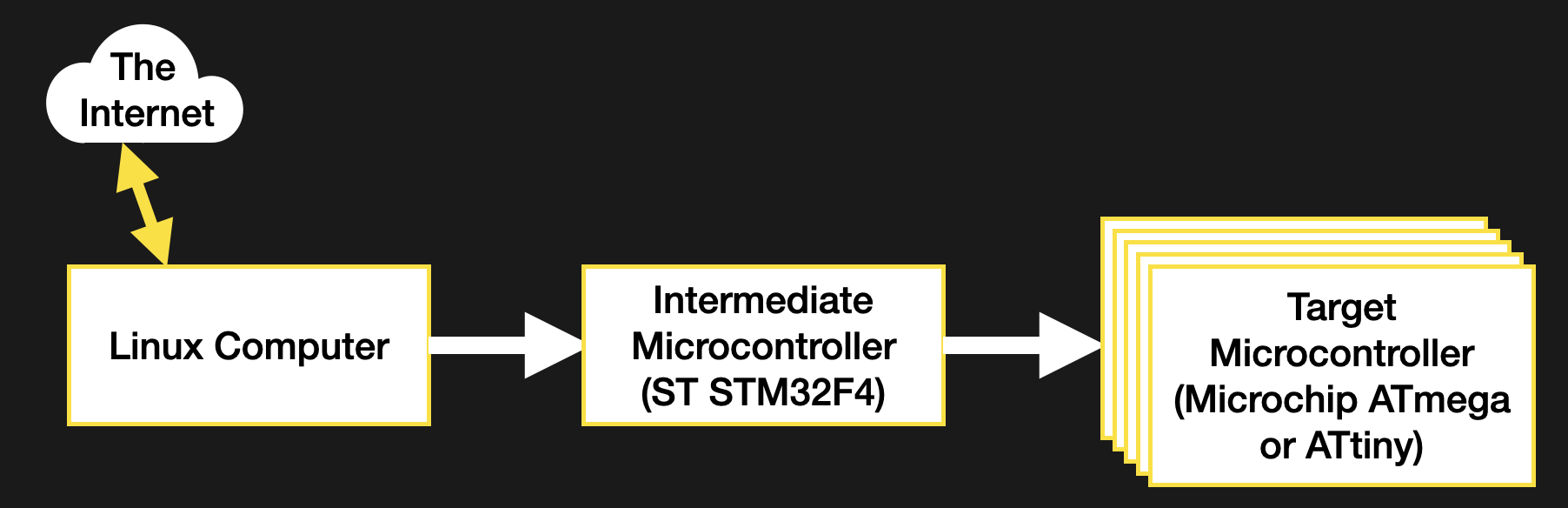
Recall, my system wasn’t a particularly novel one (see the block diagram below). Just a few computers asking each other for an update over some serial busses. I had chosen to bundle the payload firmware images into the binary for the intermediate microcontroller which was to carry out the update process. The additional constraint was that the blending of the three firmware images (one carrier and two payload) needed to happen long after compile time, on a different system with a separate toolchain. There were ultimately two options that fit the bill.
The US Nuclear Regulatory Commission (NRC) recently announced that it had approved certification of NuScale’s SMR (small modular reactor) design, completing its Phase 6 review of NuScale’s Design Certification Application (DCA). What this means is that SMRs using NuScale’s reactor design can legally be constructed within the US as soon as the rulemaking process completes. An NRC certification would also mean that certification of the design in other countries should pose no significant hurdles.
A question that remains unanswered at this point for most is how this certification process at the NRC actually works. Are there departments full of engineers at the NRC who have been twiddling their thumbs for the past decades while the US nuclear industry has been languishing? What was in the literally millions of documents that NuScale had to send to the NRC as part of the certification process, and what exactly are these six phases?
Stay tuned for a crash course in nuclear reactor certification, after a bit of SMR history.