The Smallest Large Display Is Projected Straight Onto Your Retina

For most of human history, the way to get custom shapes and colors onto one’s retinas was to draw it on a cave wall, or a piece of parchment, or on paper. Later on, we invented electronic displays and used them for everything from televisions to computers, even toying with displays that gave the illusion of a 3D shape existing in front of us. Yet what if one could just skip this surface and draw directly onto our retinas?

Admittedly, the thought of aiming lasers directly at the layer of cells at the back of our eyeballs — the delicate organs which allow us to see — likely does not give one the same response as you’d have when thinking of sitting in front of a 4K, 27″ gaming display to look at the same content. Yet effectively we’d have the same photons painting the same image on our retinas. And what if it could be an 8K display, cinema-sized. Or maybe have a HUD overlay instead, like in video games?

In many ways, this concept of virtual retinal displays as they are called is almost too much like science-fiction, and yet it’s been the subject of decades of research, with increasingly more sophisticated technologies making it closer to an every day reality. Will we be ditching our displays and TVs for this technology any time soon?

Continue reading “The Smallest Large Display Is Projected Straight Onto Your Retina”

Pluto Might Not Be A Planet, But It Is An SDR Transceiver

Many of the SDR projects we see use a cheap USB dongle. They are great, but sometimes you want more and — especially — sometimes you want to transmit. The Analog Devices ADALM-Pluto SDR is easily available for $200 and sometimes as low as $100 and it both transmits and receives using an Analog AD9363 and a Zynq FPGA. Although you normally use the device to pipe IQ signals to a host computer, you can run SDR applications on the device itself. That requires you to dig into the Zynq tools, which is fun but a topic for another time. In this post, I’m going to show you how you can use GNU Radio to make a simple Morse code beacon in the 2m ham band.

I’ve had one on my bench for quite a while and I’ve played with it a bit. There are several ways to use it with GNU Radio and it seems to work very well. You have to hack it to get the frequency range down a bit. Sure, it might not be “to spec” once you broaden the frequency range, but it seems to work fine. Instead of working from 325 MHz to 3,800 MHz with a 20 MHz bandwidth, the hacked device transceives 70 MHz to 6,000 MHz with 56 MHz bandwidth. It is a simple hack you only have to do once. It tells the device that it has a slightly better chip onboard and our guess is the chips are the same but sorted by performance. So while the specs might be a little off, you probably won’t notice.

Continue reading “Pluto Might Not Be A Planet, But It Is An SDR Transceiver”

So What Is Protein Folding, Anyway?

The current COVID-19 pandemic is rife with problems that hackers have attacked with gusto. From 3D printed face shields and homebrew face masks to replacements for full-fledged mechanical ventilators, the outpouring of ideas has been inspirational and heartwarming. At the same time there have been many efforts in a different area: research aimed at fighting the virus itself.

Getting to the root of the problem seems to have the most potential for ending this pandemic and getting ahead of future ones, and that’s the “know your enemy” problem that the distributed computing effort known as Folding@Home aims to address. Millions of people have signed up to donate cycles from spare PCs and GPUs, and in the process have created the largest supercomputer in history.

But what exactly are all these exaFLOPS being used for? Why is protein folding something to direct so much computational might toward? What’s the biochemistry behind this, and why do proteins need to fold in the first place? Here’s a brief look at protein folding: what it is, how it happens, and why it’s important.

Continue reading “So What Is Protein Folding, Anyway?”

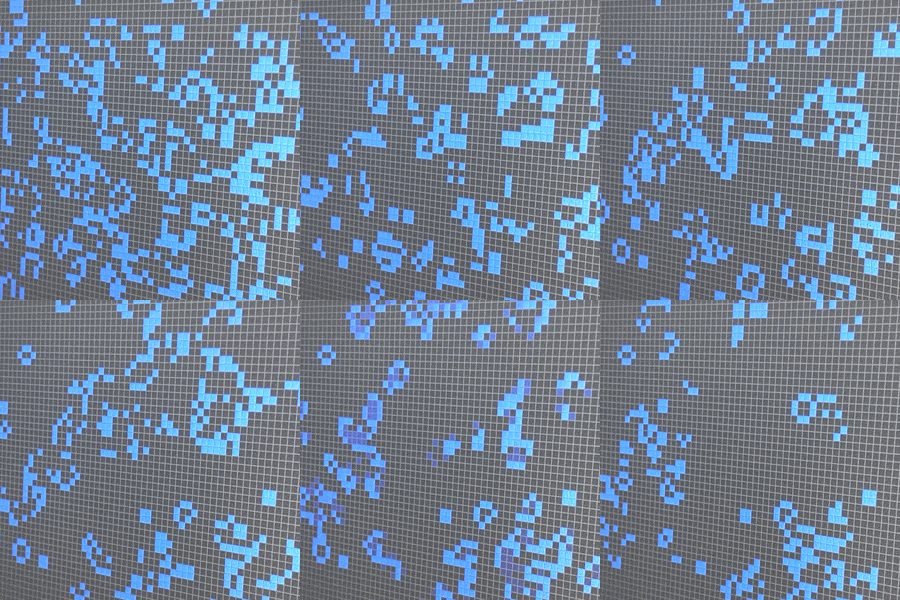
John Horton Conway, Creator Of Conway’s Game Of Life, Has Died

Programmers everywhere are familiar with Conway’s Game of Life: whether they’ve written a version themselves or simply seen the mesmerizing action resulting from the cellular automata, it’s a household name in all homes where code is spoken. On Saturday April 11th, 2020 its inventor and namesake, John Horton Conway passed away from COVID-19 at the age of 82.

Born in Liverpool, Conway received his PhD in mathematics in 1964 from Gonville and Caius College, Cambridge. He accepted a position at Sidney Sussex College, Cambridge which he held until joining the faculty of Princeton University in 1987. A brilliant mathematician, he received numerous awards and was well known for his work in combinatorial game theory, group theory, and theoretical physics.

Many readers will be familiar with his Doomsday algorithm which can be used to deduce the day of the week for any given date in your head. But by far the rockstar mathematics moment of developing Conway’s Game of Life in 1970 cements him a perpetual place of legend in computing lore. His original work on the concept used pencil and paper as the computing revolution had yet to make digital resources easily available, even to mathematics researchers like Conway.

The game uses an infinite grid of squares where all of the edges of the grid wrap around. Four simple rules (which can be boiled down to three if you’re clever) determine which cells live and which cells die during each frame of the “game”. The only parameters that are needed are the number and position of living cells at the start of the game, and the delay between each game frame. But the effect of this simplicity is not to be understated. The game can be coded by a novice — and it’s become a common challenge in University course work. Small errors, or intentional tweaks, in the implementation have profound effects on behavior of the game. And the effect on the person programming it for the first time can be long lasting. You could call it a mathematics gateway drug, grabbing the curiosity of the unsuspecting mind and pulling it down the rabbit hole of advanced mathematics discovery.

We’d love to celebrate his life by hearing your own stories of programming the Game of Life in the comments below. If you haven’t yet had the pleasure, now’s a great time to take on the challenge.

[Game of Life example shown in this article is John Conway’s Game of Life – 1.0 written in Python by Nick Jarvis and Nick Wayne]

Will 2020 (Finally) Be The Year Of Electronic Paper?

These days paper is being phased out whenever possible, and while we’re still far from being a completely digital society, the last decade or two has seen a huge reduction in the amount of paper the average person deals with on a daily basis. At the very least, we seem a lot closer to a future without the printed page than we are flying cars or any of the other concepts we generally associate with the far-flung future.

That said, there’s still something undeniably appealing about reading on paper. The idea of squirting ink on a piece of thin wood might seem increasingly archaic to us, but it sure does look nice when you hold it in your hand. Which is exactly why so much effort has been put into recreating the look of printed paper in electronic form; we all love the experience of paper, but the traditional execution doesn’t align itself particularly well with modern sensibilities.

Of course electronic “eReaders”, most notably the Kindle line from Amazon, have gone a long way towards making this a reality. At least for reading books, anyway. But what about magazines, newspapers, or even the lowly notebook we keep by the bench to jot down measurements or ideas? A PDF datasheet, with graphics where the grey tones matter? Being able to carry a whole bookshelf worth of novels in your bag is incredible, but despite what science fiction has promised us since 2001: A Space Odyssey, we’re still consuming plenty of media off of dead trees.

But that might be changing soon. This year will see the release of two tablets that promise to deliver an experience much closer to reading and writing on traditional paper than anything we’ve seen previously. They certainly aren’t cheap, and it’s too early to tell how much is just hype, but these devices could end up being an important step towards the paperless future we’ve been dreaming of.

Continue reading “Will 2020 (Finally) Be The Year Of Electronic Paper?”

Three Years Of HardwareX: Where Are They Now?

After three years of online publications, HardwareX may have solidified itself as an academic journal for open-source hardware. We originally wrote about HardwareX back in 2016. At the time, HardwareX hadn’t even published its first issue and only begun soliciting manuscripts. Now after three years of publishing, six issues as of October 2019 (with the seventh scheduled for April 2020), and an impact factor of 4.33, it’s fair to say that Elsevier’s push into open-access publications is on a path to success.

To give you a bit of background, HardwareX aims to promote the reproducibility of scientific work by giving researchers an avenue to publish all the hardware and software hacks that often get buried in traditional manuscripts. The format of HardwareX articles is a bit different than most academic journals. HardwareX articles look more like project pages similar to Hackaday.io. (Maybe we inspired them a bit? Who knows.)

It’s a bold attempt on Elsevier’s part because although open-access is held as an ideal scenario for scientific work, such efforts often come under quite a bit of scrutiny in the academic community. Don’t ask us. We can’t relate.

Either way, we genuinely wish Elsevier all the best and will keep our eyes on HardwareX. Maybe some of our readers should consider publishing their projects in HardwareX.

COVID-19 And The State Of The Climate

The novel coronavirus sweeping the globe has led governments to institute widespread quarantines to stem the spread. Many industries have slowed production or shutdown entirely, and economic activity has slowed to a crawl. This has naturally led to a sudden reduction in greenhouse gas emissions. But how great will the effect be, and will it buy us any real time?

On The Ground

Nitrogen dioxide levels in China have dropped sharply with the reduction in industrial activity due to COVID-19. Image source: NASA

In the wake of COVID-19, good news stories have sprung up as people look for a silver lining. Unfortunately, these stories aren’t always true. There aren’t dolphins in the waters of Venice, though the water has cleared due to reduced boat activity. And drunken elephants did not begin roaming the mountains of China.

Despite this, there have been notable reductions in emissions in several areas due to government-mandated lockdowns. Northern Italy is seeing a much lower concentration of nitrogen dioxide, likely due to reduced industrial and vehicular activity. Carbon monoxide levels have similarly dropped in New York, while China has seen its carbon emissions temporarily drop by a full 25%.

On the surface of it, these are all promising numbers. Many are cautiously optimistic that this could be a major development to help stave off the worst of climate change for a little longer. Nonetheless, it’s early days yet, and what happens after the crisis passes is just as important as what’s happening now.

Continue reading “COVID-19 And The State Of The Climate”