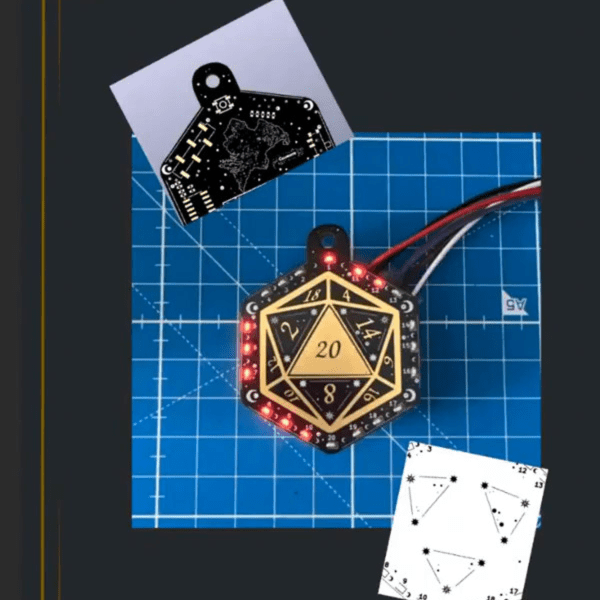
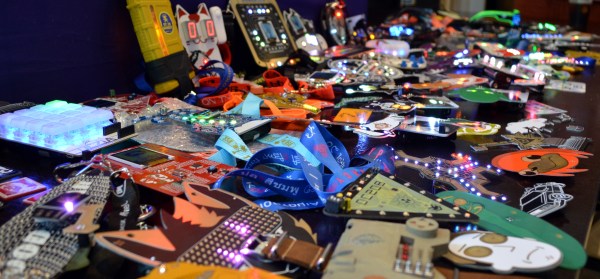
From a cockroach filled with LEDs, to an impressively dense 576 RGB LED display, and even a hunk of carpet, our final installment of the unofficial hardware badges at DEF CON 26 are beyond impressive. I tried to see every badge and speak to every badge maker this year. So far we’ve covered a ton of badges in volume 1, volume 2, and volume 3 of this series, and now it’s time to finish up!
If I didn’t get a chance to cover your badge in these articles, we still want to hear about it. What everyone wants is to dig into the details of these gorgeous examples of unique hardware. So post a project page for you badge on Hackaday.io, and make sure you get on the Conference Badges list that has been growing by leaps and bounds.
If you have your ear even slightly to the ground of the software community, you’ll have heard of Docker. Having recently enjoyed a tremendous rise in popularity, it continues to attract users at a rapid pace, including many global firms whose infrastructure depends on it. Part of Docker’s rise to fame can be attributed to its users becoming instant fans with evangelical tendencies.
But what’s behind the popularity, and how does it work? Let’s go through a conceptual introduction and then explore Docker with a bit of hands-on playing around.
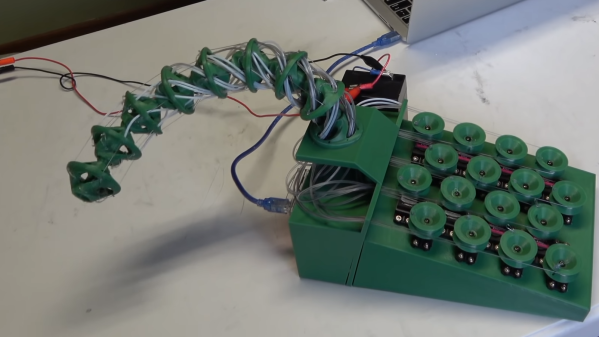
We’ve written about a lot of DIY robotic arms. Some of them are high-performance, some are inexpensive, and some are just uniquely fun. This one certainly falls into the last category; whilst watching an episode of Black Mirror, [Gear Down For What] was struck by inspiration for a thin robotic limb. After some iterations he has a final prototype, and it’s quite something to see in action.
To make a robotic arm as slender as possible, the actuators can’t be mounted on the arm itself but must instead drive the arm remotely. There are a number of ways of doing this, and though [Gear Down For What] considered using pneumatics or hydraulics, he opted to keep it simple with RC servos which produced a nifty solution that we really like.
The arm is made out of a series of 3D printed ball joints, allowing rotation in any direction. The tricky bit is transferring the force from the servos to each joint. Initially bare fishing line was considered, but this made the remote joints difficult to control when lower joints were moving. The solution was to use the fishing line inside of tubing, similar to the way that bike brakes operate. This allows the force to be carried to the appropriate joint regardless of lower movement. Each joint needs an x and y tension to allow it to rotate in any direction, which means an army of sixteen servos is needed to operate the eight segment arm.
What does post-apocalyptic technology look like? Well, that kind of depends on the apocalypse. Regardless of the cause, we’ll need to be clever and resourceful and re-learn ancient crafts like weaving and pottery-making. After all, the only real apocalyptic constants are the needs of the survivors. Humans need clothing and other textiles. Fortunately, weaving doesn’t require electricity—just simple mechanics, patience, and craftsmanship.
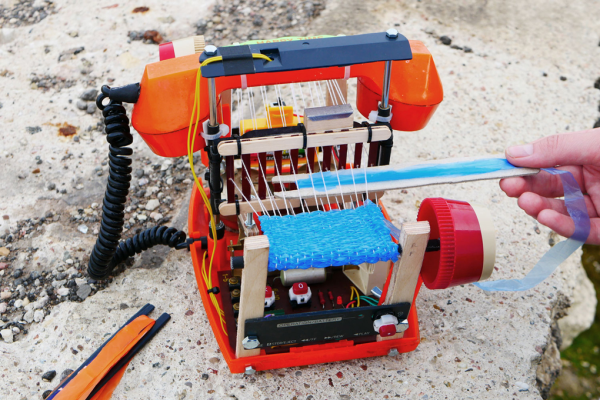
If it turns out the apocalypse is scheduled for tomorrow, we’ll have piles and piles of e-waste as fodder for new-old looms. This adorable loom is a mashup of old and new technologies that [Kati Hyyppä] built at an artist residency in Latvia, a country with a rich historical tapestry of textile-making. It combines a cheerful orange telephone with an old cassette player and some telescoping rods from a radio antenna. [Kati] reused the phone’s hang-up switch to trigger tunes from a deconstructed toddler toy every time the receiver is lifted. Check it out after the beep break.
And yeah, you’re right, it does use batteries. But the looming part doesn’t require power, only the music. In case of apocalypse, just scrounge up a solar panel.
If you’d rather be prepared to have to make your own clothes someday, print this loom beforehand.
Batteries placed in harm’s way need to be protected. A battery placed where a breakdown could endanger a life needs to be protected. Lithium-ion batteries on the bottoms of electric cars are subject to accidental damage and they are bathed in flame-retardant epoxy inside a metal sled. Phone batteries are hidden behind something that will shatter or snap before the battery suffers and warrant inspection. Hoverboard batteries are placed behind cheap plastic, and we have all seen how well that works. Batteries contain chemicals with a high density of energy, so the less exploding they do, the better.
Researchers at Oak Ridge National Laboratory have added a new ingredient to batteries that makes them armored but from the inside. The ingredient is silica spheres so fine it is safe to call it powder. The effect of this dust is that the electrolyte in every battery will harden like cornstarch/water then go right back to being a liquid. This non-Newtonian fluid works on the principal principle of shear-thickening which, in this case, says that the suspension will become harder as shear force is applied. So, batteries get rock hard when struck, then go back to being batteries when it is safe.
Non-Newtonian fluids are much fun, but we’re also happy to see them put to use. The same principle works in special speed bumps to allow safe drivers to continue driving but jolts speeders. Micromachines can swim in non-Newtonian fluids better than water in some cases.
Last summer was an exercise in developing a completely different kind of product from my normal wheelhouse; a costume. My Halloween costume had been so popular that I decided to have a go at commercializing it, and that took me on a path into manufacturing that I hadn’t yet taken; shipping by boat from China. The short version is it’s a ridiculously difficult mess. Continue reading “The Challenges Of Shipping From China – Life Of A Flailing Tube Man”→
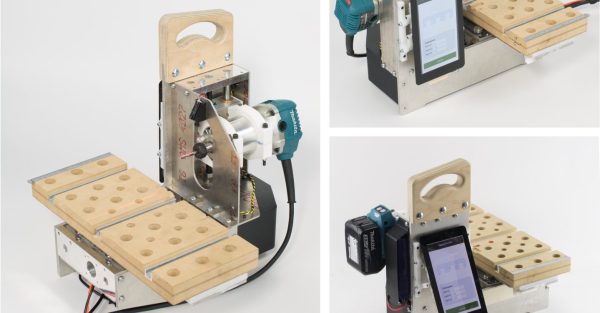
Drawn along in the wake of the 3d printing/home shop revolution has been the accessibility of traditional subtractive CNC equipment, especially routers and mills. Speaking of, want a desktop mill? Try a Bantam Tools (née Othermachine) Desktop Milling Machine or a Carvey or a Carbide 3D Nomad. Tiny but many-axis general purpose mill? Maybe a Pocket NC. Router for the shop? Perhaps a Shapeoko, or an X-Carve, or a ShopBot, or a… you get the picture. [Rundong]’s MatchSticks deviceis a CNC tool for the shop and it might be classified as a milling machine, but it doesn’t quite work the way a more traditional machine tool does. It computer controls the woodworker too.
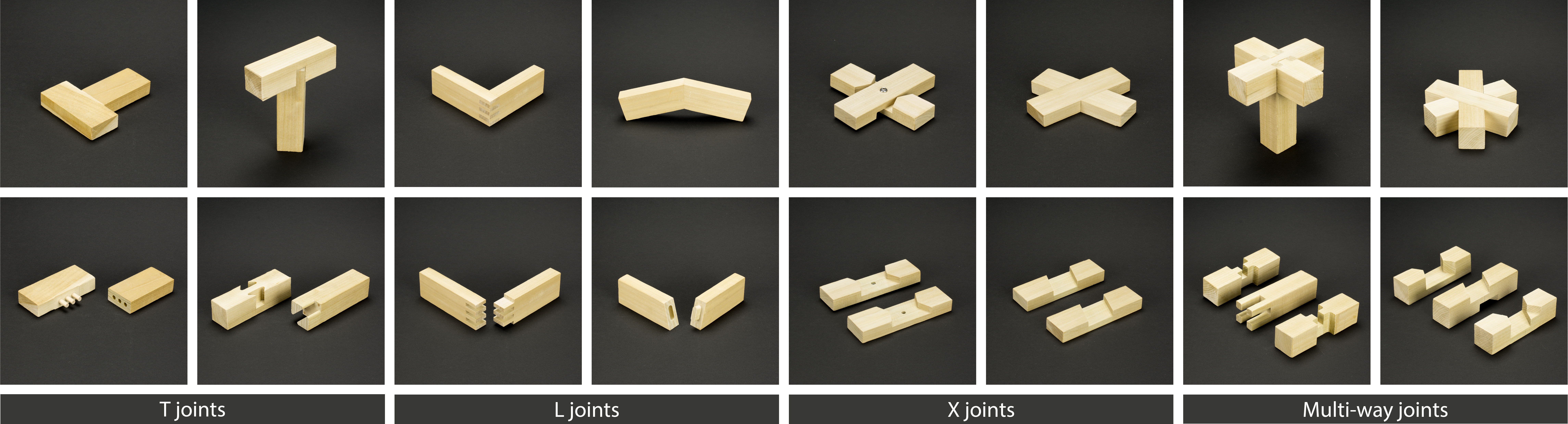
Sample joints the MatchSticks can cut
At a glance MatchSticks probably looks most similar to a Pocket NC with a big Makita router sticking out the side. There’s an obvious X-axis spoilboard with holes for fixturing material, mounted to a gantry for Z-axis travel. Below the big friendly handle on top is the router attached to its own Y-axis carriage. The only oddity might be the tablet bolted to the other side. And come to think of it the surprisingly small size for such an overbuilt machine. What would it be useful for? MatchSticks doesn’t work by processing an entire piece of stock at once (that what you’re for, adaptable human woodworker) it’s really a tool for doing the complex part of the job – joinery – and explaining to the human how to do the rest.
The full MatchSticks creation flow goes like this:
Choose a design to make on the included interface and specify the parameters you want (size, etc).
The MatchSticks tool will suggest what material stocks you need, and then ask you to cut them to size and prepare them using other tools.
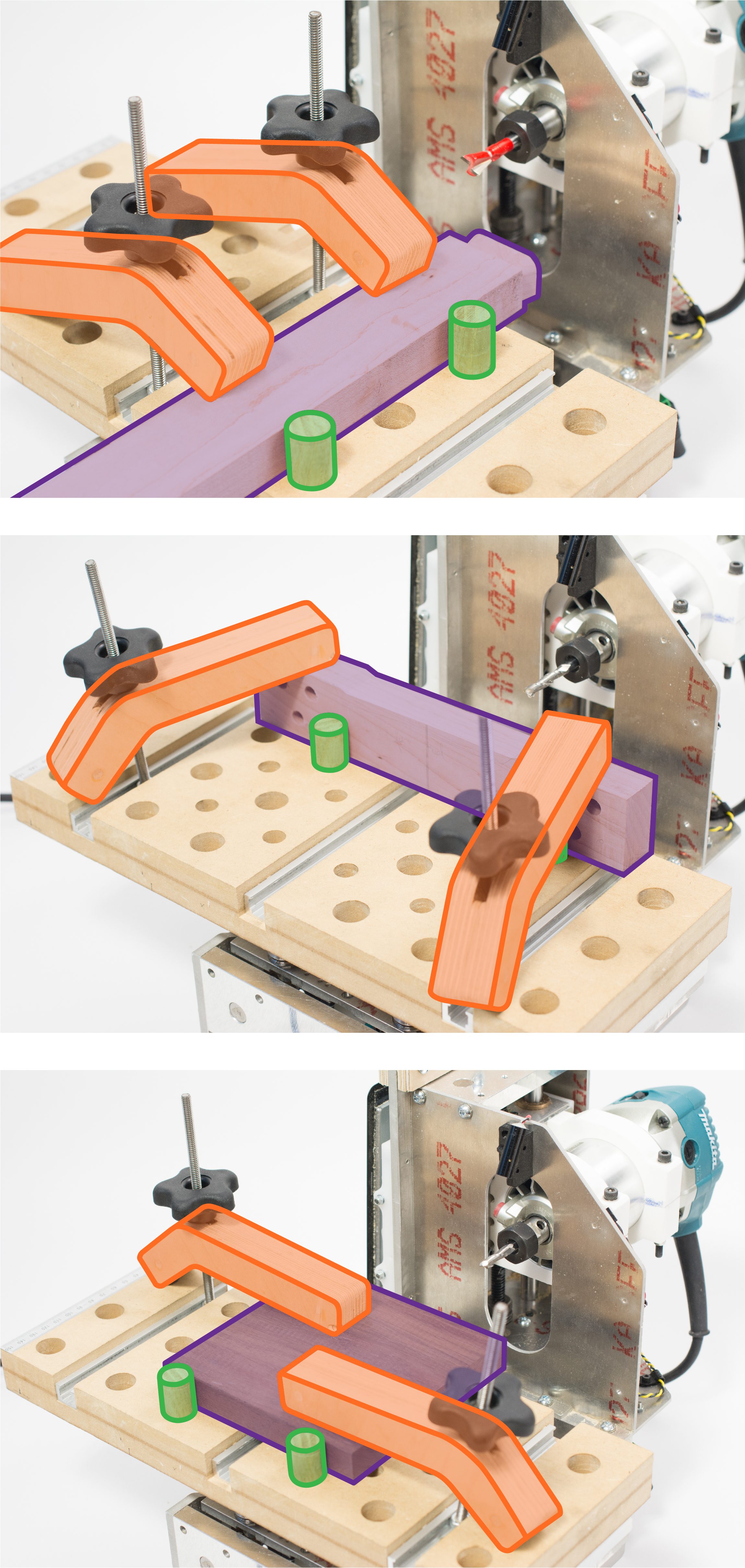
For any parts which require CNC work the tool will help guide the user to fixture the stock to its bed, then do the cutting itself.
Once everything is ready for final assembly the MatchSticks will once again provide friendly instructions for where to pound the mallet.
In this way [rundong], [sarah], [jeremy], [ethan], and [eric] were able to build a much smaller machine tool without sacrificing much practical functionality. It’s almost software-like in it’s focus on a singular purpose. Why reinvent what the table saw can do when the user probably already has access to a table saw that will cut stock better? MatchSticks is an entire machine bent around one goal, making the hard stuff easier.
It’s worth noting that MatchSticks was designed as an exploration into computer/human interaction for the ACM Conference on Human Factors in Computing Systems so it’s not a commercial product quite yet (we’re eagerly waiting!). For a much more in depth look at the project and its goals and learnings the full research paper is available here. Their intro video is down after the break.




 The full MatchSticks creation flow goes like this: