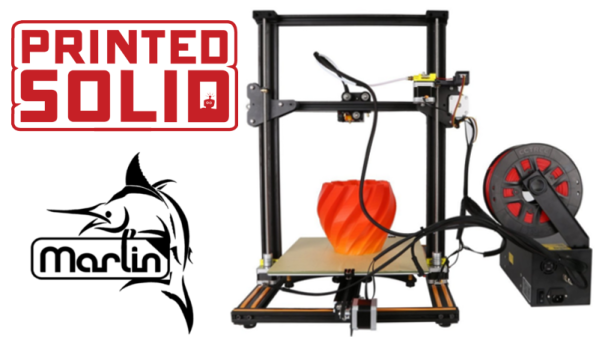
GPL Violations Cost Creality A US Distributor

One of the core tenets of free and open source software licenses is that you’re being provided source code for a project with the hope that you’ll “pay it forward” if and when you utilize that code. In fact some licenses, such as the GNU Public License (GPL), require that you keep the source code for subsequent spin-offs or forks open. These are known as viral licenses, and the hope is that they will help spread the use of open source as derivative works can’t turn around and refuse to release their source code.

Unfortunately, not everyone plays by the rules. In a recent post on their blog, Printed Solid has announced they are ending their relationship with Chinese manufacturer Creality, best known for their popular CR-10 printer. Creality produces a number of printers which make use of Marlin, a GPLv3 licensed firmware that runs (in some form or another) a large majority of desktop 3D printers. But as explained in the blog post, Printed Solid has grown tired with the manufacturer’s back and forth promises to comply with the viral aspects of the GPL license.

Rather than helping to support a company they believe is violating the trust of the open source community, they have decided to mark down their existing stock of Creality printers to the point they will be selling them at a loss until they run out. In addition, for each Creality printer that is sold Printed Solid has promised to make a $50 USD donation to the development of Marlin saying: “if Creality won’t support Marlin development then we will.”

As is often the case when tempers are high and agreements break down, Printed Solid has also pulled back the curtain a bit as to the relationship they have had thus far with the manufacturer. According to the blog post, Printed Solid claims that some models of Creality printers have had a 100% fault rate, and that the company needed to repair and tweak the machines before sending them out to customers. The not so subtle implication being that Creality printers have been benefiting from the work Printed Solid has been doing on their hardware, and that purchasing a unit direct from the manufacturer could be a dicey proposition.

We’ve previously covered an issue with Creality’s CR-10S printer that required the end-user to replace an SMD capacitor just to get reliable results out of the machine, and of course we’ve talked of the extra work that’s often required when wrangling a low-end Chinese printer. It’s even more disheartening when you realize cheap machines sold by shady manufacturers are pushing open source manufacturers out of business.


FOSSCON 2018: Hacking The Indego Bike Sharing API

It’s often said that necessity of the mother of invention, but as a large portion of the projects we cover here at Hackaday can attest, curiosity has to at least be its step-mother. Not every project starts with a need, sometimes it’s just about understanding how something works. That desire we’ve all felt from time to time, when we’ve looked at some obscure piece of hardware or technology and decided that the world would be a slightly better place if we cracked it open and looked at what spilled out.

That’s precisely the feeling Eric O’Callaghan had when he looked out the window of his Philadelphia apartment a few years back and saw something unusual. Seemingly overnight, they had built an automated Indego bike sharing station right across the street. Seeing the row of light blue bicycles sitting in their electronic docks, he wondered how the system worked, and what kind of data they might be collecting. He didn’t need to rent a bike, he hadn’t even ridden one in years, but he suddenly had a strong urge to go across the street and learn as much as he could about this system.

He recently presented those findings during FOSSCON 2018 at the International House in Philadelphia, in the hopes that others might be interested in getting involved. Currently Eric is one of the only people who’s investigating the public data Indego offers, and as his personal MySQL database has now surpassed 15 million rows of data, he’s hoping to get some developers with big data experience into the fray. His approach to making this data useful is an interesting one which I’ll dive into after the break.

Continue reading “FOSSCON 2018: Hacking The Indego Bike Sharing API”

Selling Everything, Moving To Asia, And Setting Up A Company

Today I don’t have a hack for you. I have a story, one that I hope will prove useful to a few of you who are considering a move to Asia to chase opportunities here.

Seven years ago, I was a pretty stereotypical starving hacker. I had five jobs: A full-time dead-end job in biotech, and four part-time or contract gigs that were either electronic hardware design or programming. I worked perhaps 50 hours a week, and was barely past the poverty line – I was starting to wonder why I spent so much time in school. I saw the economic growth in Asia as an attractive but risky opportunity.

Check out that image above…France? No, this is Shenzhen and let’s face it: many exciting things are made there (even the copies). After a short visit to the region, I decided to take that risk but not in Shenzhen. I sold everything I owned and moved from Canada to Vietnam and started a company. Over the last seven years things have worked out well, although I certainly wish I had known more about the process before I got on a plane. This article is about the general path I took to get where I am. Obviously I don’t know the legal framework of every country in Asia, but speaking in generalities I hope that I can cover some interesting points for the curious and adventurous.

Continue reading “Selling Everything, Moving To Asia, And Setting Up A Company”

2018 Electromagnetic Field Badge: It’s An Entire Phone!

As is always the case with a significant hacker camp, we’ve been awaiting the official badge announcement for the upcoming Electromagnetic Field 2018 hacker camp with huge interest. These badges, for readers who may have been on Mars for the past few years, are part of a lively scene of wearable electronics at hacker conferences and camps, and can usually be expected to sport a fully-fledged computer in their own right along with other special functionality.

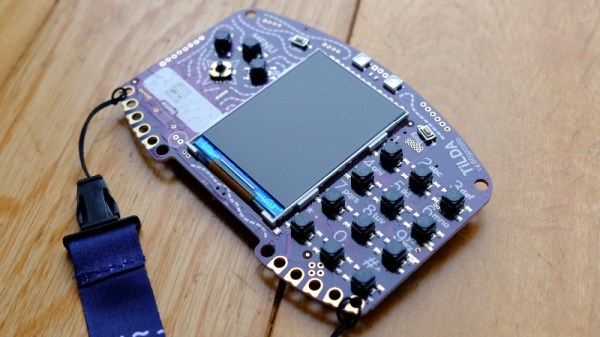
The announcement of the 2018 badge, dubbed the TiLDA Mk4, does not disappoint. We’d been told that there would be an on-site GSM network for which the welcome packs would contain a SIM, and the well-prepared among us had accordingly dusted off our old Nokia handsets alongside our DECT phones. What we hadn’t expected was that the SIM would be for the badge, because the Mk4 is a fully-fledged hackable mobile phone in its own right. The network will be fully functional for  calls and texts within the camp, though since it does not explicitly say so we expect that external calls may be an impossibility. Afterwards though it will remain a usable device on any GSM network, giving it a lease of post-camp life that may see more of them staying in use rather than joining the hacker’s dusty collection in a drawer.

Beyond the party-piece phone it appears to follow the lead of its 2016 predecessor, with the same Python environment atop a TI chipset including an MSP432E4 ARM Cortex M4F microcontroller running at 120MHz with 256kB of internal and 8MB of external RAM, a CC3210 WiFi processor, and the usual battery of sensors, LEDs and GPIOs. Importantly, it also has a Shitty Add-on connector. The 2016 badge was remarkably easy to develop for, and we expect that there will soon be an impressive array of apps for this badge too. If any reader would like to put together a Hackaday feed reader app, we can’t offer you fortune but fame such as we can bestow awaits.

We’ll bring you more information as we have it about the TiLDA Mk4, as well as a hands-on report when one lands in front of us. Meanwhile you’d like to see a retrospective of past EMF badges as a demonstration of where this one has come from, have a read of our coverage of the 2016 and 2014 badges.

Arduino Gets Command Line Interface Tools That Let You Skip The IDE

Arduino now has an officially supported command-line interface. The project, called arduino-cli, is the first time that the official toolchain has departed from the Java-based editor known as the Arduino IDE. You can see the official announcement video below.

Obviously this isn’t a new idea. Platform IO and other command-line driven tools exist. But official support means even if you don’t want to use the command line yourself, this should open up a path to integrate the Arduino build process to other IDEs more easily.

The code is open source, but they do mention in their official announcement that you can license it for commercial use. We assume that would mean if you wanted to build it into a product, not just provide an interface to it. This seems like something Arduino expects, because a lot of the command line tools can produce json which is a fair way to send information to another application for parsing.

The command line interface doesn’t just build a sketch. You can do things like install and manage libraries. For example, to create a new sketch:

Continue reading “Arduino Gets Command Line Interface Tools That Let You Skip The IDE”

Electric Shower Head Teardown Makes Us Wince

We have bought some really amazing stuff from the Chinese online shops. We’ve also bought stuff that was… less than satisfactory, let’s say. At the prices you pay, you usually just chalk up the bad stuff as a cost of doing business. But [DiodeGoneWild] has a teardown of something that could be very dangerous if it wasn’t up to snuff: an electrically heated shower head. He says they are common in Latin America and have the nickname “suicide showers.”

We’ve seen the cute showerheads that change color, but those take batteries. What we are talking about here connects to the 220V main and draws 30A to instantly heat your shower water. Environmentally, that’s great since you don’t have a tank of water you keep heating and reheating just in case you need hot water. But you wouldn’t throw an AC radio in the tub, so you have to wonder just how safely this thing’s built. Well, you don’t have to wonder, because the videos below are going to show us.

Continue reading “Electric Shower Head Teardown Makes Us Wince”

A Peek At The Mesmerizing Action Of A Cycloidal Drive

Cycloidal drives are fascinating pieces of hardware, and we’ve seen them showing up in part due to their suitability for 3D printing. The open source robot arm makers [Haddington Dynamics] are among those playing with a cycloidal drive concept, and tucked away in their August 2018 newsletter was a link they shared to a short but mesmerizing video of a prototype, which we’ve embedded below.

A 10:1 Cycloidal Drive [Source: Wikipedia, image public domain]
A cycloidal drive has some similarities to both planetary gearing and strain-wave gears. In the image shown, the green shaft is the input and its rotation causes an eccentric motion in the yellow cycloidal disk. The cycloidal disk is geared to a stationary outer ring, represented in the animation by the outer ring of grey segments. Its motion is transferred to the purple output shaft via rollers or pins that interface to the holes in the disk. Like planetary gearing, the output shaft rotates in the opposite direction to the input shaft. Because the individual parts are well-suited to 3D printing, this opens the door to easily prototyping custom designs and gearing ratios.

[Haddington Dynamics] are the folks responsible for the open source robot arm Dexter (which will be competing in the Hackaday Prize finals this year), and their interest in a cycloidal drive design sounds extremely forward-thinking. Their prototype consists of 3D printed parts plus some added hardware, but the real magic is in the manufacturing concept of the design. The idea is for the whole assembly to be 3D printed, stopping the printer at five different times to insert hardware. With a robot working in tandem with the printer, coordinating the print pauses with automated insertion of the appropriate hardware, the result will be a finished transmission unit right off the print bed. It’s a lofty goal, and really interesting advancement for small-scale fabrication.

Continue reading “A Peek At The Mesmerizing Action Of A Cycloidal Drive”