The Pre-CRT Oscilloscope

Oscilloscopes are especially magical because they translate the abstract world of electronics into something you can visualize. These days, a scope is likely to use an LCD or another kind of flat electronic display, but the gold standard for many years was the ubiquitous CRT (cathode ray tube). Historically, though, CRTs were not very common in the early days of electronics and radio. What we think of as a CRT didn’t really show up until 1931, although if you could draw a high vacuum and provide 30 kV, there were tubes as early as 1919. But there was a lot of electronics work done well before that, so how did early scientists visualize electric current? You might think the answer is “they didn’t,” but that’s not true. We are spoiled today with high-resolution electronic displays, but our grandfathers were clever and used what they had to visualize electronics.

Keep in mind, you couldn’t even get an electronic amplifier until the early 1900s (something we’ve talked about before). The earliest way to get a visual idea of what was happening in a circuit was purely a manual process. You would make measurements and draw your readings on a piece of graph paper.

Continue reading “The Pre-CRT Oscilloscope”

Do Space Probes Fail Because Of Space Weather?

Over the past few decades, numerous space probes sent to the far-flung reaches of the Solar System have fallen silent. These failures weren’t due to communications problems, probes flying into scientifically implausible anomalies, or little green men snatching up the robotic scouts we’ve sent out into the Solar System. No, these space probes have failed simply because engineers on Earth can’t point them. If you lose attitude control, you lose the ability to point a transmitter at Earth. If you’re managing a space telescope, losing the ability to point a spacecraft turns a valuable piece of scientific equipment into a worthless, spinning pile of junk.

The reasons for these failures is difficult to pin down, but now a few people have an idea. Failures of the Kepler, Dawn, Hayabusa, and FUSE space probes were due to failures of the reaction wheels in the spacecraft. These failures, in turn, were caused by space weather. Specifically, coronal mass ejections from the Sun. How did this research come about, and what does it mean for future missions to deep space?

Continue reading “Do Space Probes Fail Because Of Space Weather?”

Shoelace-Tying Robot With Only Two Motors

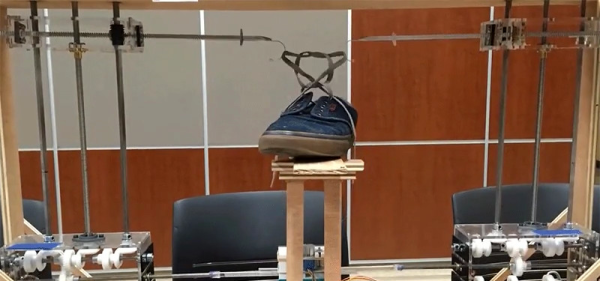
Many things that humans do are very difficult for machines. Case in point: tying shoelaces. Think of the intricate dance of fingers crossing over fingers that it takes to pass off a lace from one hand to the other. So when a team of five students from UC Davis got together and built a machine that got the job done with two hooks, some very clever gears, and two motors, we have to say that we’re impressed. Watch it in action on Youtube (also embedded below).

The two-motor constraint would seem at first to be a show-stopper, but now that we’ve watched the video about a hundred times, we’re pretty convinced that a sufficiently clever mechanical engineer could do virtually anything with two motors and enough gears. You see, the secret is that one motor is dedicated to moving a drive gear back and forth to multiple destinations, and the other motor provides the power.

This being Hackaday, I’m sure that some of you are saying “I could do that with one motor!” Consider that a challenge.

Meanwhile, if you need to see more gear-porn, check out this hummingbird automaton. Or for the miracles of cam-driven machines, check out [Fran Blanche]’s work with the Maillardet Automaton.

Continue reading “Shoelace-Tying Robot With Only Two Motors”

You Can’t Build A Roland TR-808 Because You Don’t Have Faulty Transistors

That headline sounds suspect, but it is the most succinct way to explain why the Roland TR-808 drum machine has a very distinct, and difficult to replicate noise circuit. The drum machine was borne of a hack. As the Secret Life of Synthesizers explains, it was a rejected part picked up and characterized by Roland which delivers this unique auditory thumbprint.

Pictured above is the 2SC828-R, and you can still get this part. But it won’t function the same as the parts found in the original 808. The little dab of paint on the top of the transistor indicates that it was a very special subset of those rejected parts (the 2SC828-RNZ). A big batch of rejects were sold to Roland back in the 1970’s — which they then thinned out in a mysterious testing process. What was left went into the noise circuit that gave the 808 its magical sizzle. When the parts ran out, production ended as newer processes didn’t produce the same superbly flawed parts.

This is an incredible story that was highlighted in 808, a documentary premiered at SXSW back in 2015. The film is currently streaming on Amazon Prime (and to rent everywhere else) and is certainly worth your time just to grasp how seminal this drum machine has been in hip hop and several other music genres.

For modern product developers, betting your production on a batch of reject parts is just batty. But it was a very different time with a lot fewer components on the market. What worked, worked. You do have to wonder how you stumble upon the correct trait in an obscure batch of reject parts? Looks like we’ll be adding Ikutar Kakehashi’s book I Believe in Music: Life Experiences and Thoughts on the Future of Electronic Music by the Founder of the Roland Corporation to our reading list.

[via EMSL]

Save Fingers, Save Lives With A No-Voltage Release For The Shop

Imagine the scenario: you’re spending some quality time in the shop with your daughter, teaching her the basics while trying to get some actual work done. You’re ripping some stock on your cheap table saw when your padiwan accidentally hooks the power cord with her foot and pulls out the plug. You have a brief chat about shop safety and ask her to plug it back in. She stoops to pick up the cord and plugs it back in while her hand is on the table! Before you can stop the unfolding tragedy, the saw roars to life, scaring the hell out of everyone but thankfully doing no damage.

If that seems strangely specific it’s because it really happened, and my daughter was scared out of the shop for months by it. I’ll leave it to your imagination what was scared out of me by the event. Had I only known about no-voltage release switches, or NVRs, I might have been able to avoid that near-tragedy. [Gosforth Handyman] has a video explaining NVRs that’s worth watching by anyone who plugs in anything that can spin, cut, slice, dice, and potentially mutilate. NVRs, sometimes also called magnetic contactors, do exactly what the name implies: they switch a supply current on and off, but automatically switch to an open condition if the supply voltage fails.

Big power tools like table saws and mills should have them built in to prevent a dangerous restart condition if the supply drops, but little tools like routers and drills can still do a lot of damage if they power back up while switched on. [Gosforth] built a fail-safe power strip for his shop from a commercial NVR, and I’d say it’s a great idea that’s worth considering. Amazon has a variety of NVRs that don’t cost much, at least compared to the cost of losing a hand.

True, an NVR power strip wouldn’t have helped me with that cheap table saw of yore, but it’s still a good idea to put some NVR circuits in your shop. Trust me, it only takes a second’s inattention to turn a fun day in the shop into a well-deserved dressing down by an angry mother. Or worse.

Continue reading “Save Fingers, Save Lives With A No-Voltage Release For The Shop”

Ask Hackaday: Managing Inspiration

For most of us, hacking is a hobby, something to pass a few idle hours and satisfy our need to create. Precious few of us get to live the dream of being paid to tinker; most of us need some kind of day job to pay the bills and support our hacking habits. This necessarily creates an essential conflict, rooted in the fact that we all only have 24 hours to spread around every day: I need to spend my time working so I can afford to hack, but the time I spend working to earn money eats away at my hacking time. That’s some catch, that Catch-22.

From that primary conflict emerges another one. Hacking is a hugely creative process, and while the artist or the author might not see it that way, it’s true nonetheless. Unless we’re straight-up copying someone else’s work, either because they’ve already solved the same problem we’re working on and we just need to get it done, or perhaps we’re just learning a new skill and want to stick to the script, chances are pretty good that we’re hitting the creative juices hard when we build something new. And that requires something perhaps even more limiting than time: inspiration. How you manage inspiration in large part dictates how productive you are in your creative pursuits.

Continue reading “Ask Hackaday: Managing Inspiration”

Electromagnetic Field: A Hacked Knitting Machine, Knitting The Universe

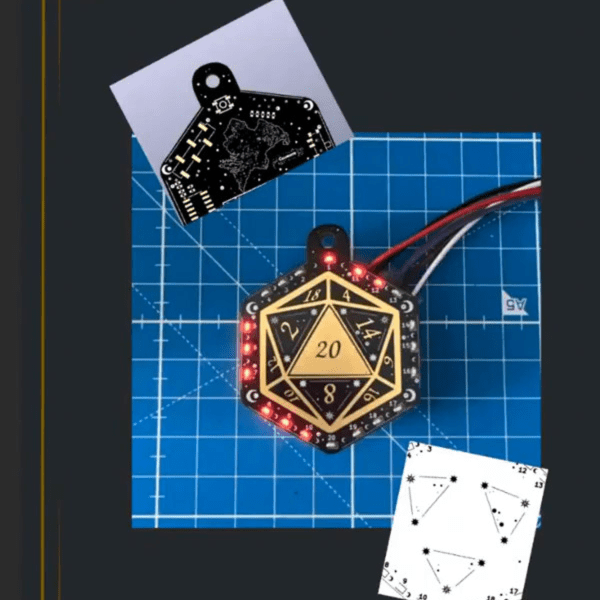
A large hacker camp attracts attendees from all over the world, and at the recent Electromagnetic Field in the UK there were certainly plenty of international visitors. Probably one of those with the longest journey was [Sarah Spencer] from Australia, and she deserves our admiration not just for her work but also for devoting much of her meagre luggage space to the installation she’d brought over for the event. In the lounge tent you could find the Knitted Universe, a map of the night sky with light-up Neopixel constellations covering an entire wall, and among the talks you could find her in-depth description of how  she created it by hacking a 1980s Brother knitting machine into a network printer.

She starts with a potted history of knitting machine hacking, leading to the use of an emulated floppy drive replacing the mechanical item used to store scanned designs on the original hardware. She took an existing hack for a 16-bit Brother knitting machine and re-wrote it for her later 32-bit model, and then created a web interface for it called Octoknit which runs upon a Raspberry Pi. We’re then taken through the operation of a knitting machine and her further adventures in reverse engineering the file format. She ends up with a dithered 4-colour image, but there remains a problem. On the Brother, colour changes are performed by pressing a button, so something to automate the process was required. This task was taken on by her husband, who created an Arduino-driven mechanical button-presser in what had become a team effort. With this in place her only manual task became a periodic adjustment of the weight that preserves the tension in the finished knit.

Finally she moves on to the Knitted Universe itself, which at that point had become something of a viral sensation.  Those of us who have created hacker camp installations will appreciate the volume of work that went into the piece, and she truly deserves the applause at the end of the talk. Watch it below the break, it’s a fascinating half-hour.

Continue reading “Electromagnetic Field: A Hacked Knitting Machine, Knitting The Universe”