Hackaday Belgrade: Luka Mustafa On Exploiting IoT Niches

Ecology is a strange discipline. At its most basic, it’s the study of how living things interact with their environment. It doesn’t so much seek to explain how life works, but rather how lives work together. A guiding principle of ecology is that life finds a way to exploit niches, subregions within the larger world with a particular mix of resources and challenges. It’s actually all quite fascinating.

But what does ecology have to do with Luka Mustafa’s talk at the 2018 Hackaday Belgrade Conference? Everything, as it turns out, and not just because Luka and his colleagues put IoT tools on animals and in their environments to measure and monitor them. It’s also that Luka has found a fascinating niche of his own to exploit, one on the edge of technology and ecology. As CEO of Institute IRNAS, a non-profit technology development group in Slovenia, Luka has leveraged his MEng degree, background in ham radio, and interest in LoRaWAN and other wide-area radio networks to explore ecological niches in ways that would have been unthinkable even 10 years ago, let alone in the days when animal tracking was limited by bulky radio collars.

Continue reading “Hackaday Belgrade: Luka Mustafa On Exploiting IoT Niches”

Radar In Space: The Gemini Rendezvous Radar

In families with three kids, the middle child always seems to get the short end of the stick. The first child gets all the attention for reaching every milestone first, and the third child will forever be the baby of the family, and the middle child gets lost in-between. Something similar happened with the U.S. manned space program in the 60s. The Mercury program got massive attention when America finally got their efforts safely off the ground, and Apollo naturally seized all the attention by making good on President Kennedy’s promise to land a man on the moon.

In between Mercury and Apollo was NASA’s middle child, Project Gemini. Underappreciated at the time and even still today, Gemini was the necessary link between learning to get into orbit and figuring out how to fly to the Moon. Gemini was the program that taught NASA how to work in space, and where vital questions would be answered before the big dance of Apollo.

Chief among these questions were tackling the problems surrounding rendezvous between spacecraft. There were those who thought that flying two spacecraft whizzing around the Earth at 18,000 miles per hour wouldn’t work, and Gemini sought to prove them wrong. To achieve this, Gemini needed something no other spacecraft before had been equipped with: a space radar.

Continue reading “Radar In Space: The Gemini Rendezvous Radar”

HOPE XII: A FOSS Operating System For E-Readers

Free and open source software (FOSS) was a recurring theme during many of the talks during the HOPE XII conference, which should probably come as no surprise. Hackers aren’t big fans of being monitored by faceless corporate overlords or being told what they can and cannot do on the hardware they purchased. Replacing proprietary software with FOSS alternatives is a way to put control back into the hands of the user, so naturally many of the talks pushed the idea.

In most cases that took the form of advising you to move your Windows or Mac OS computer over to a more open operating system such as GNU/Linux. Sound advice if you’re looking for software freedom, but it’s a bit quaint to limit such thinking to the desktop in 2018. We increasingly depend on mobile computing devices, and more often than not those are locked down hard with not only a closed proprietary operating system but also a “Walled Garden” style content delivery system. What’s the point of running all FOSS software at home on your desktop if you’re carrying a proprietary mobile device around?

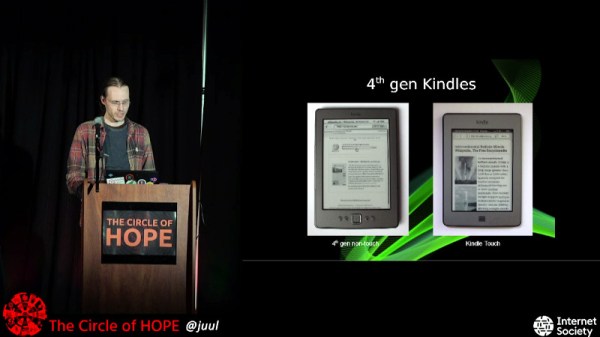
That’s precisely the thinking that got Marc Juul interested in the possibility of bringing a FOSS operating system to e-reader devices. During his talk “Liberate Your E-book Reader with fread.ink!”, he gave examples such as Amazon’s infamous remote deletion of 1984 off of users’ Kindles as a perfect example of the sort of control these companies exert on our personal devices. Marc believes the goal should be to completely replace the operating system on these devices with a free software alternative that still retains the ability to open electronic book formats. Not only would this keep the likes of Amazon or Barnes and Noble out of our reading habits, but turn these cheap readers into more capable devices in the bargain.

Continue reading “HOPE XII: A FOSS Operating System For E-Readers”

Was The Self Driving Car Invented In The 1980s?

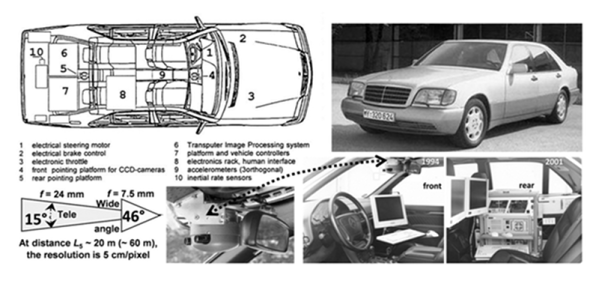
The news is full of self-driving cars and while there is some bad news, most of it is pretty positive. It seems a foregone conclusion that it is just a matter of time before calling for an Uber doesn’t involve another person. But according to a recent article, [Ernst Dickmanns] — a German aerospace engineer —  built three autonomous vehicles starting in 1986 and culminating with on-the-road demonstrations in 1994 for Daimler.

It is hard to imagine what had to take place to get a self-driving car in 1986. The article asserts that you need computer analysis of video at 10 frames a second minimum. In the 1980s doing a single frame in 10 minutes was considered an accomplishment. [Dickmanns’] vehicles borrowed tricks from how humans drive. They focused on a small area at any one moment and tried to ignore things that were not relevant.

Continue reading “Was The Self Driving Car Invented In The 1980s?”

Twenty Power Harvesting Projects Headed To The Hackaday Prize Finals

The Academy Awards of hardware creation is going on right now! The Hackaday Prize is a challenge to you — yes, you — to create the next great piece of Open Hardware. It is simply incomparable to anything else, and we have the projects to show for it.

Last week, we wrapped up the Power Harvesting Challenge portion of The Hackaday Prize. Now we’re happy to announce twenty of those projects have been selected to move onto the final round and have been awarded a $1000 cash prize. Congratulations to the winners of the Power Harvesting Challenge portion of the Hackaday Prize. Here are the winners, in no particular order:

Continue reading “Twenty Power Harvesting Projects Headed To The Hackaday Prize Finals”

Hands On With Python 3.7: What’s New In The Latest Release

Used for general purpose programming, data science, website backends, GUIs, and pretty much everything else; the first programming language for many, and claimed to be the fastest growing in the world, is of course Python. The newest version 3.7.0 has just recently been released.
Naturally any release of Python, no matter how small, undergoes meticulous planning and design before any development is started at all. In fact, you can read the PEP (Python Enhancement Proposal) for Python 3.7, which was created back in 2016.

What’s new in 3.7? Why should you upgrade? Is there anything new that’s actually useful? I’ll answer these questions for you by walking through some examples of the new features. Whilst there’s not much in this release that will make a difference to the Python beginner, there’s plenty of small changes for seasoned coders and a few headline features you’ll want to know about.

Continue reading “Hands On With Python 3.7: What’s New In The Latest Release”

The Return Of RadioShack?

We’ve been following the ups and downs of Radio Shack for a while now, and it looks like another chapter is about to be penned in the storied retailer’s biography – and not Chapter 11 bankruptcy this time.

According to the ARRL website and major media reports, up to 50 of the 147 US locations of HobbyTown, the brick-and-mortar retailer of RC and other hobby supplies, will soon host a “RadioShack Express” outlet. Each outlet will be up to 500 square feet of retail space devoted to electronic components that would be of use to HobbyTown’s core customer base, as well as other merchandise and services.

HobbyTown locations in Mooresville, North Carolina, and Ontario, Ohio, will be among the first stores to get the RadioShack Express treatment. Current employees of the franchisees will staff the store-within-a-store, which will be stocked with RadioShack merchandise purchased by the store. Stores with Express outlets will have special RadioShack branding inside and out to attract customers. There’s talk of the deal being extended chain-wide if the pilot program goes well.

Back from the Ashes?

This is obviously great news for the beleaguered electronics retailer that was once a neighborhood fixture. True, its parts selection was often less than complete, more so in recent years than in the chain’s heyday in the mid-1970s and early 1980s. And it’s true that prices were often astronomical compared to buying online. But on a Sunday afternoon, The Shack was a lifesaver for that last minute part needed to finish a project, and the premium was well worth the convenience. Watching the decline of the chain and seeing stores disappear one by one was a slow, sad process, so that makes this seems like an unqualified positive development.

But is it? On the face of it, there’s a lot of synergy between the HobbyTown offerings and what could be stocked in a RadioShack Express. I’ve never actually visited a HobbyTown myself — I plan to fix that now that I know I’ve got an outlet nearby, even if it doesn’t appear to be on the list of 50 early Express locations — so I can only go by what I see listed online for merchandise. But a store that sells every conceivable part for RC cars and planes, drones, model rockets, and STEM-related toys and kits seems a likely place to find customers for RadioShack’s offerings.

It won’t be clear until someone sees one of these Express kiosks first hand and reports back, but it seems like we might see something like the old “cabinet o’ components” that was found in the back of the most recent incarnation of RadioShack retail stores, along with a few shelves full of things like solder, wire, and tools. There may also be some items in the Arduino-Pi space, which would be really exciting, although that might run afoul of existing HobbyTown offerings. Still, one-stop shopping of everything from servos to MOSFETs would be a huge win for electronics hobbyists.

Not the Cell Phones Again!

But there may be cause for concern. Reports are that RadioShack Express locations will also offer services such as cell phone repairs. Dipping a toe into the cell phone market seemed to be the beginning of the end for RadioShack the first time through, and by the time it was clear to everyone that the chain was on death’s door, it was hard to go into a RadioShack store without being bombarded by cell phone sales pitches. To be brutally frank, I don’t take the early inclusion of cell phone repairs as an encouraging sign of the long-term viability of the RadioShack Express concept. Do we really need another place that fixes cell phones? The areas that HobbyTown stores tend to locate are rife with places that fix phones already, so I just don’t see the point. And it just smacks of the bad old days of RadioShack.

Still, I’m cautiously optimistic that this is a positive development for RadioShack, and I think it’s a win for electronics hobbyists overall. I’ll be keeping my eye on my local HobbyTown for the return of that iconic RadioShack logo, and looking forward to the day that I can pay a buck for a resistor again. Until then, if any readers happen to be near one of the combined locations when they open next week, we’d love a boots-on-the-ground report. Post your observations in the comments below, and pix or it didn’t happen.

[via r/amateurradio]