Hacking The Digital And Social System

When you live in a totalitarian, controlled and “happy” society, and you want to be a hacker, you have to hack the social system first. Being just an engineer doesn’t cut it, you have to be a hypocrite, dissident and a smuggler at the same time. That’s the motto of my personal story, which starts in Yugoslavia, and ends in Serbia. No, I didn’t move, I’m still in Belgrade, only the political borders have changed.

Half a century ago, when I was in elementary school, I discovered the magical world of HAM radio. I became a member of two amateur radio clubs, passed all exams and got my licence and callsign, which was YU1OPC. I was delighted, but after five years, the party was over. What happened? Well, one day the police paid a visit to all registered owners of CB Band equipment and simply took that equipment away. No one knows why they did it, but it was probably off the books, as we never got any written confirmation, and no one ever saw their equipment again.

Continue reading “Hacking The Digital And Social System” →

Downloading Satellite Images Via FM Radio

Did you know weather satellites transmit their weather images over an FM frequency? And now that you know… You can intercept them yourself with a $10 FM radio dongle!

American NOAA weather satellites are in a polar orbit around earth, and each one will pass the same point approximately every 12 hours. When it is overhead, the signal is strong enough to receive. After [Matt] found out this tidbit of knowledge, he had to learn how to intercept the images himself.

The satellites transmit the images over the 137MHz band, and using a radio tuner USB dongle, you can record the transmission and then decode it into a picture. He used CubicSDR to tune and record the signal, and then Soundflower to pull out interference, and finally WXtoIMG — which starts recording when the satellite is above, and decodes the image.

[Thanks for the tip Amirgon!]

Build Your Own CPU? That’s The Easy Part!

You want to build your own CPU? That’s great fun, but you might find it isn’t as hard as you think. I’ve done several CPUs over the years, and there’s no shortage of other custom CPUs out there ranging from pretty serious attempts to computers made out of discrete chips to computers made with relays. Not to trivialize the attempt, but the real problem isn’t the CPU. It is the infrastructure.

What Kind of Infrastructure?

I suppose the holy grail would be to bootstrap your custom CPU into a full-blown Linux system. That’s a big enough job that I haven’t done it. Although you might be more productive than I am, you probably need a certain amount of sleep, and so you may want to consider if you can really get it all done in a reasonable time. Many custom CPUs, for example, don’t run interactive operating systems (or any operating system, for that matter). In extreme cases, custom CPUs don’t have any infrastructure and you program them in straight machine code.

Machine code is error prone so, you really need an assembler. If you are working on a big machine, you might even want a linker. Assembly language coding gets tedious after a while, so maybe you want a C compiler (or some other language). A debugger? What about an operating system?

Each one of those things is a pretty serious project all by itself (on top of the project of making a fairly capable CPU). Unless you have a lot of free time on your hands or a big team, you are going to have to consider how to hack some shortcuts.

Continue reading “Build Your Own CPU? That’s The Easy Part!” →

One Way To Recharge Alkaline Batteries

It says it right on the side of every alkaline battery – do not attempt to recharge. By which of course the manufacturer means don’t try to force electrons back into the cell. But [Cody] figured he could work around that safety warning chemically, by replacing the guts of an alkaline dry cell.

The batteries in question were certainly old, gnarly looking, and pretty dead – [Cody] barely got a reading on his multimeter. As you can see after the break, he cleaned off the exterior corrosion and did a quick teardown of the dry cells, removing the remains of the zinc anode, now in the form of zinc oxide paste looking very much like what you’d slather on your nose before a day at the beach. He filled the resulting cavity with a putty of zinc dust, freshened up the electrolyte charge with a squirt of 20% potassium hydroxide, sealed up the cell with a little silicone caulking, and put the recycled cell to the test. Result: 1.27 volts. Not too shabby.

Continue reading “One Way To Recharge Alkaline Batteries” →

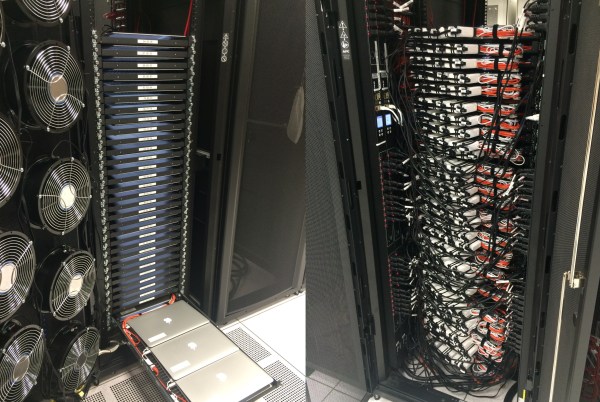
There are 96 macbooks in this rack

96 MacBook Pros: Most Expensive Server Rack We’ve Ever Seen

Ever see a standard server rack stuffed full with 8-dozen MacBook Pros? Well now you have.

Now before the torrential downpour of anti-Mac comments come, this actually has a purpose. No seriously. Besides, what company in their right mind would spend that much money on a rack full of paperweights? Kidding.

[Steve] works for a company that designs electronics, and for a particular launch they needed to perform a lot of testing — using MacBook Pros. There are ways he could have emulated OS X on a much cheaper hardware setup, but the whole point was to test the product with Apple hardware. So he took a stroll down to the local Apple store and picked up two pallets worth. Continue reading “96 MacBook Pros: Most Expensive Server Rack We’ve Ever Seen” →

Find And Repair A 230kV 800Amp Oil-Filled Power Cable Feels Like Mission Impossible

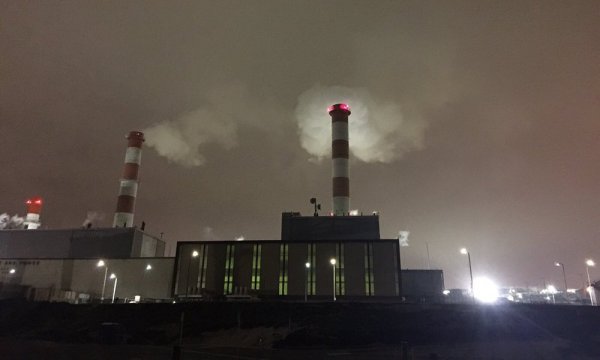
How do you fix a shorted cable ? Not just any cable. An underground, 3-phase, 230kV, 800 amp per phase, 10 mile long one, carrying power from a power station to a distribution centre. It costs $13,000 per hour in downtime, counting 1989 money, and takes 8 months to fix. That’s almost $75 million. The Los Angeles Department of Water and Power did this fix about 26 years ago on the cable going from the Scattergood Steam Plant in El Segundo to a distribution center near Bundy and S.M. Blvd. [Jamie Zawinski] posted details on his blog in 2002. [Jamie] a.k.a [jwz] may be familiar to many as one of the founders of Netscape and Mozilla.

To begin with, you need Liquid Nitrogen. Lots of it. As in truckloads. The cable is 16 inch diameter co-axial, filled with 100,000 gallons of oil dielectric pressurised to 200 psi. You can’t drain out all the oil for lots of very good reasons – time and cost being on top of the list. That’s where the LN2 comes in. They dig holes on both sides (20-30 feet each way) of the fault, wrap the pipe with giant blankets filled with all kind of tubes and wires, feed LN2 through the tubes, and *freeze* the oil. With the frozen oil acting as a plug, the faulty section is cut open, drained, the bad stuff removed, replaced, welded back together, topped off, and the plugs are thawed. To make sure the frozen plugs don’t blow out, the oil pressure is reduced to 80 psi during the repair process. They can’t lower it any further, again due to several compelling reasons. The cable was laid in 1972 and was designed to have a MTBF of 60 years.

Continue reading “Find And Repair A 230kV 800Amp Oil-Filled Power Cable Feels Like Mission Impossible” →

The Factory Of The World – Hackaday Documentary On The Shenzhen Ecosystem

When it comes to manufacturing, no place in the world has the same kind of allure as the Pearl River Delta region of China. Within just an hour-long train ride, two vastly different cultures co-exist, each with its unique appeal that keeps attracting engineers, entrepreneurs, and hustlers alike. On the mainland side, cities like Shenzhen and Guangzhou bring the promise of cheap components, low-cost contract work, and the street cred of “having done the Shenzhen thing.” And on the island, the capitalist utopia called Hong Kong glows with all of its high finance and stories of lavish expat lifestyles.

As the “new” China evolves, it seems like it’s exactly the convergence of these two cultures that will bring the biggest change—and not just to the area but to the whole world. Still, understanding what exactly is going on and what the place is really all about remains a mystery to many. So, this June, we jumped on the bandwagon and headed east, trying to get our own feel for the whole thing.

Here’s what we came back with…

Continue reading “The Factory Of The World – Hackaday Documentary On The Shenzhen Ecosystem” →