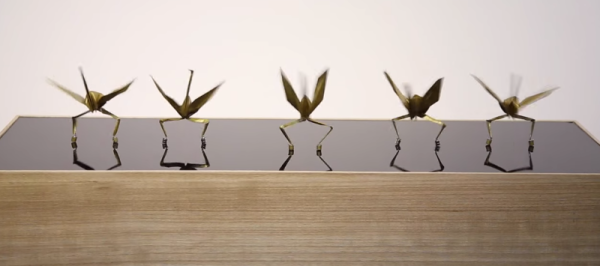
Origami Busts A Move With Dancing Paper

Origami cranes are cool, but do you know what’s cooler? Origami cranes dancing to the beat. That’s the challenge [Basami Sentaku] took on when he created Dancing Paper (YouTube link). You might remember [Basami] from his 8 bit harmonica hack. In Dancing Paper, paper cranes seem to dance all on their own – even performing some crazy spinning moves. Of course, the “magic” is due to some carefully written code, and magnets, lots of magnets.

Using magnets to move objects from below isn’t a new concept. Many of us have seen the “ice skating pond” Christmas decoration which uses the same effect. Unlike the skating pond,Dancing Paper has moving parts (other than the cranes themselves). Under the plastic surface are a series of individually controlled electromagnets. Each of the supporting dancers has a line of four magnets, while the featured dancer in the center has a 5×5 matrix. The 41 electromagnets were wound around bolts with the help of a Tamiya motor and gearbox.

The actual dance moves are controlled by C code which appears to be running on an Atmel microcontroller. Of course a microcontroller wouldn’t be able to drive those big coils, so some beefy TO-220 case transistors were employed to switch the loads. The cranes themselves needed a bit of modification as well. Thin pieces of wire travel from the neodymium magnets on their feet up to the body of the crane. The wire provides just enough support to keep the paper from collapsing, while still being flexible enough to boogie down.

Click past the break to see Dancing Paper in action!

Continue reading “Origami Busts A Move With Dancing Paper” →

Retro Edition: VCF East, April 17 – 19

Around this time last year we were planning our trip to the Vintage Computer Festival East in Wall, NJ. This year we’re doing it all over again, and according to the announcements coming out of the planning committee, it’s going to be a very, very cool event.

This year marks fifty years since the release of the PDP-8, regarded as the first commercially successful computer ever. The historic Straight-8 from the infamous RESISTORS has been restored over the past few months, and it’s going to be turned on again for the festival. There will also be a half a dozen other PDP-8s at the event, but these are 8/M, 8/E, and 8/L models and not constructed completely out of discrete diode transistor logic.

Keynote speakers include [Wesley Clark], designer of the LINC computer and [Bob Frankston], co-creator of Visicalc. There will, of course, be a ton of educational and historical sessions on Friday. Our own [Bil Herd] will be there talking about vintage microcomputer architectures along with a dozen other fascinating people talking about really interesting stuff

As far as exhibits go, there’s literally everything you could imagine when it comes to retro computers. There will of course be a fully restored and functional PDP Straight 8, along with PDP-11s, Apple Newtons, Ataris, Network gaming on C64s. Hollerith cards, VisiCalc, mainframes, teletypes, video toasters, an RTTY amateur radio station (KC1CKV), a flea market/consignment thing, and all sorts of retro goodies. Oh, a Fairlight CMI will also be there. I don’t know how they got that one.

More info for VCF East at the official site, Facebook, and Twitter. If you’re in the area and want to exhibit something really, really cool, there’s still room for more. If you want a better feel for what will be going down at VCF East, check out our megapost wrapup from last year.

Of course if New Jersey isn’t your thing and you live a few blocks down from Peachtree Avenue, Lane, or Street, VCF Southeast 3.0 will be held in Roswell, Georgia the first weekend in May.

Cardboard CNC Machine Boxes Up Both A Tool And A Framework

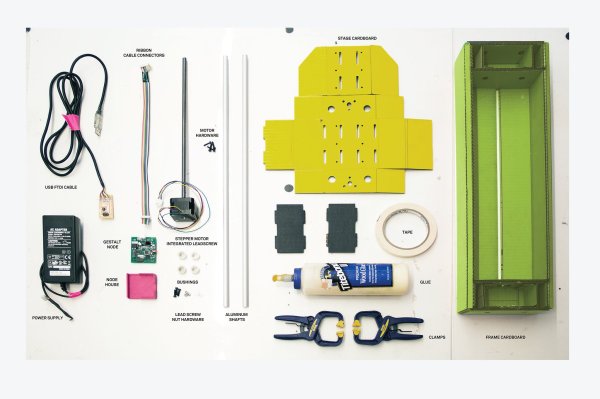
Want to build up a desktop CNC machine without breaking your pocketbook? [James Coleman], [Nadya Peek], and [Ilan Moyer] of MIT Media Labs have cooked up a modular cardboard CNC that gives you the backbone from which you can design your own machine.

The CNC build comprises of design instructions for a single axis linear stage and single axis rotary stage with several ideas on how to combine multiple of these axes together to construct a particular machine. Whether your milling wood, laser-engraving your desk, or pipetting your bacteria samples, the designs [Dropbox] and physical components can be adopted for your end-application.

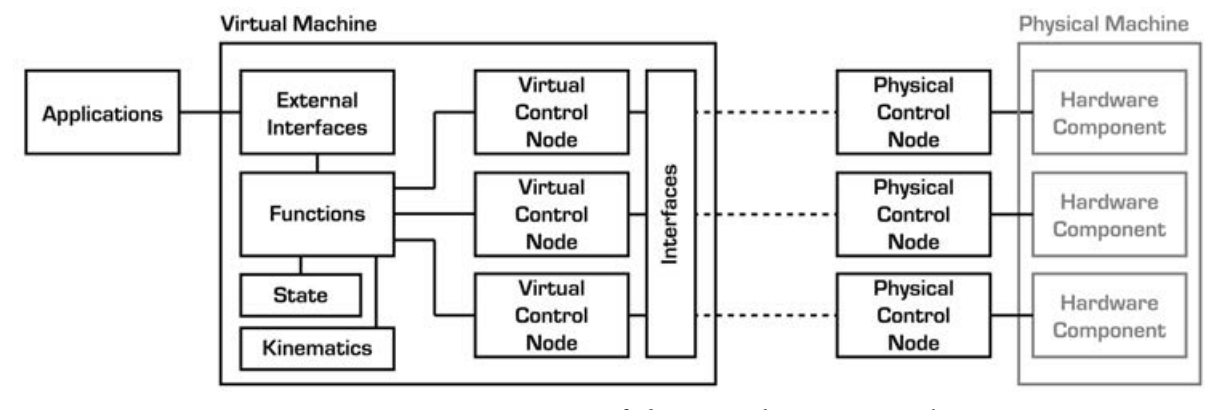
Perhaps the most interesting aspect of this project is that, at the high level, it is not just a cnc, but a framework known as Gestalt. This architecture enables users to develop their own machine configuration consisting of multiple software nodes linked together with high-level Python Code. Most of the high level computation is organized by a Python library that calls compiled C-code. This high-level framework processes instructions through the desired machine’s kinematics to output commands to the motor controllers. Finally, the top-level interface does away with the archaic GCode with two alternatives: a Python interface consisting of function calls to procedures and a remote interface to make procedure calls through http requests. While the downside of a motion control language is that commands have no standardization; they are, however, far more human-readable, a benefit that plays into the Gestalt Framework’s aim “to be accessible to individuals for personal use.”

gestaltFramework

In the paper [PDF], [Ilan] expresses the notion of a tool as an impedance-matching device, an instrument that extends the reach of our creativity to bend and morph a broader range of shapes into forms from our imagination. Where our hands fail in their imprecision and weakness, tools bridge this gap. Gestalt and the Cardboard CNC are first steps to creating a framework so that anyone can design and realize their own impedance-matching device, whether they’re weaving steel cables or carving wood.

The folks at MIT Media Labs a familiar heavy-hitters in this field of low-cost machinery, especially the kind that fit in a suitcase. We’re thrilled to see a build that reaches out directly to the community.

via [CreativeApplications.net]

Arduino V. Arduino

Arduino LLC is suing Arduino Srl (the Italian version of an LLC). Sounds confusing? It gets juicier. What follows is a summary of the situation as we learned it from this article at MakeMagazin.de (google translatrix)

Arduino LLC is the company founded by [Massimo Banzi], [David Cuartielles], [David Mellis], [Tom Igoe] and [Gianluca Martino] in 2009 and is the owner of the Arduino trademark and gave us the designs, software, and community support that’s gotten the Arduino where it is. The boards were manufactured by a spinoff company, Smart Projects Srl, founded by the same [Gianluca Martino]. So far, so good.

Things got ugly in November when [Martino] and new CEO [Federico Musto] renamed Smart Projects to Arduino Srl and registered arduino.org (which is arguably a better domain name than the old arduino.cc). Whether or not this is a trademark infringement is waiting to be heard in the Massachussetts District Court.

According to this Italian Wired article, the cause of the split is that [Banzi] and the other three wanted to internationalize the brand and license production to other firms freely, while [Martino] and [Musto] at the company formerly known as Smart Projects want to list on the stock market and keep all production strictly in the Italian factory.

Naturally, a lot of the original Arduino’s Open Source Hardware credentials and ethos are hanging in the balance, not to mention its supply chain and dealer relationships. However the trademark suit comes out, we’re guessing it’s only going to be the first in a series of struggles. Get ready for the Arduino wars.

We’re not sure if this schism is at all related to the not-quite-open-source hardware design of the Yun, but it’s surely the case that the company is / the companies are going through some growing pains right now.

Thanks [Philip Steffan] for the pointer to the MakeMagazin.DE article. (And for writing it.)

Controlling Analog with SPI

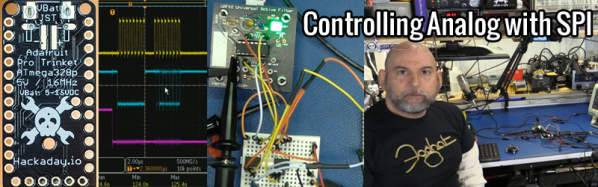
We Assume Control: SPI And A Digital Potentiometer

In the last video I demonstrated a Universal Active Filter that I could adjust with a dual-gang potentiometer, here I replace the potentiometer with a processor controlled solid-state potentiometer. For those that are too young to remember, we used to say “solid-state” to differentiate between that and something that used vacuum tubes… mostly we meant you could drop it without it breakage.

The most common way to control the everyday peripheral chips available is through use of one of the common Serial Protocols such as I2C and SPI.  In the before-time back when we had only 8 bits and were lucky if 7 of them worked, we used to have to memory map a peripheral or Input/Output (I/O) controller which means we had to take many control and data lines from the microprocessor such as Data, Address, Read/Write, system clocks and several other signals just to write to a couple of control registers buried in a chip.

Nowadays there is a proliferation of microcontrollers that tend to have built-in serial interface capability it is pretty straightforward to control a full range of peripheral functions; digital and analog alike.  Rather than map each peripheral using said data and address lines,which is a very parallel approach,  the controller communicates with peripherals serially using but a handful of signal lines such as serial data and clock. A major task of old system design, mapping of I/O and peripherals, is no longer needed.

Continue reading “We Assume Control: SPI And A Digital Potentiometer” →

Logic Noise: The Switching Sequencer Has The Beat

Logic Noise is all about using logic circuits to make sounds. Preferably sound that will be enjoyable to hear and useful for making music. This week, we’ll be scratching the surface of one of my favorite chips to use and abuse for, well, nearly anything: the 4051 8-way analog switch. As the name suggests, you can hook up eight inputs and select one from among them to be connected up to the output. (Alternatively, you can send a single input to one of eight destinations, but we won’t be doing that here.)

Why is this cool? Well, imagine that you wanted to make our oscillator play eight notes. If you worked through our first installment, you built an abrasive-sounding but versatile oscillator. I had you tapping manually on eight different resistors or turning a potentiometer to eight different positions. This week, we’ll be letting the 4051 take over some of the controls, leaving us to do the more advanced knob twiddling.

Continue reading “Logic Noise: The Switching Sequencer Has The Beat” →

Ground Stations Are Just The Beginning: The SatNOGS Story

When you think of satellites, you may think of the Space Shuttle extending its robot arm with a huge piece of high-tech equipment waiting to pirouette into orbit. This misconception is similar to picturing huge mainframes when thinking about computers. The future (and arguably even the present) reality of satellites is smaller, cheaper, and more prolific. This future is also an “open” one if the Libre Space Foundation has anything to say about it.

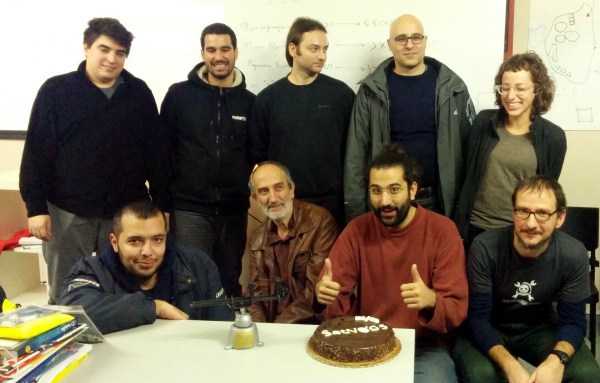
This group that plans to make satellite communications available to anyone started out as a build at a hackerspace. One good idea, a shared set of skills and experience, and a little bit of time led them to accomplish amazing things. We are, of course, talking about the Grand Prize winners of the 2014 Hackaday Prize. The SatNOGS team built a working satellite ground station and laid the foundation for a data-sharing network to connect to it. But even this description can be a bit daunting, so come with me to learn what this is all about, and how it matters to you.

Continue reading “Ground Stations Are Just The Beginning: The SatNOGS Story” →