This excellent content from the Hackaday writing crew highlights recurring topics and popular series like Linux-Fu, 3D-Printering, Hackaday Links, This Week in Security, Inputs of Interest, Profiles in Science, Retrotechtacular, Ask Hackaday, Teardowns, Reviews, and many more.
[Dan Royer] is hard at work building his own personal robot army. Robots mean motors, and motors mean gearboxes. In [Dan]’s case, gearboxes mean $3000 wasted on a prototype that doesn’t work. Why doesn’t it work? He doesn’t know, and we don’t either.
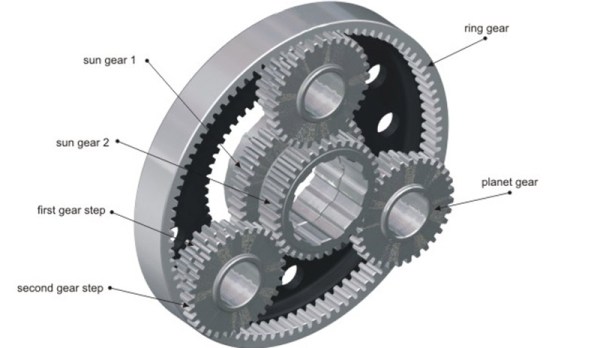
[Dan] would like to use small but fast DC motors for his robots coupled to a gearbox to step down the speed and increase the torque. The most common way of doing this is with a planetary gear set, but there’s a problem with the design of planetary gears – there is inherent backlash and play between the gears. This makes programming challenging, and the robot imprecise.
A much better way to gear down a small DC motor is a hypocycloid gear. If you’ve ever seen the inside of a Wankel engine, this sort of gearing will look very familiar: a single gear is placed slightly off-axis inside a ring gear. On paper, it works. In reality, not so much.
[Dan] spent $3000 on a prototype hypocycloid gearbox that doesn’t turn without binding or jamming. The gear was made with incredible tolerances and top quality machining, but [Dan] has a very expensive paper weight sitting on his desk right now.
If anyone out there has ever designed or machined a hypocycloid gearbox that works, your input is needed. The brightest minds [Dan] met at the Bring A Hack event at Maker Faire last weekend could only come up with. ‘add more lasers’, but we know there’s a genius machinist out there that knows exactly how to make this work.
Hackaday Fail is a column which runs every now and again. Help keep the fun rolling by writing about your past failures and sending us a link to the story — or sending in links to fail write ups you find in your Internet travels.
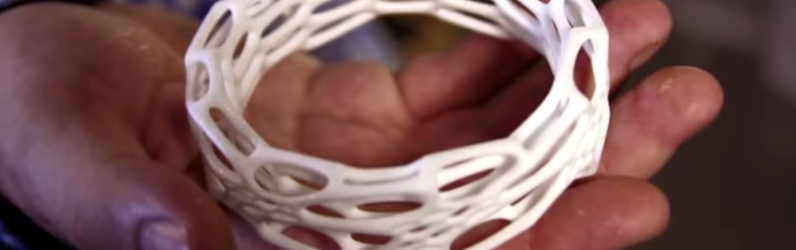
Of course Maker Faire was loaded up with 3D printers, but we’re no longer in the era of a 3D printer in every single booth. Filament-based printers are passé, but that doesn’t mean there’s no new technology to demonstrate. This year, it was stereolithography and other resin-based printers. Here’s the roundup of each and every one displayed at the faire, and the reason it’s still not prime time for resin-based printers.
Formlabs
Of course the Formlabs Form 1+ was presented at the Bay Area Maker Faire. They were one of the first SLA printers on the market, and they’ve jumped through enough legal hoops to be able to call themselves the current kings of low-cost laser and resin printing. There were a few new companies and products at the Faire vying for the top spot, and this is where things get interesting.
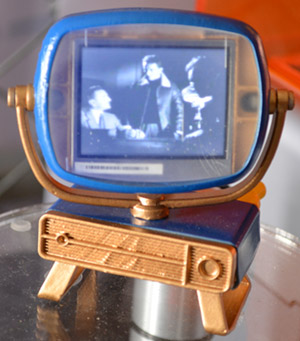
The folks at Formlabs displayed the only functional print of all the resin-based 3D printing companies – a tiny, tiny Philco Predicta stuffed with an LCD displaying composite video. The display is covered by a 3D printed lens/window. That’s the closest you’re going to get to an optically clear 3D printed part at the Faire.
XYZPrinting Nobel
The Eiffel tower, an architectural model, and a Bratz doll, all printed on the XYZPrinting Nobel
XYZPrinting, the company famous for the $500 printer that follows the Gillette model: sell the printer cheap, sell expensive replacement filament cartridges, and laugh all the way to the bank. Resetting the DRM on the XYZPrinting Da Vinci printer is easy, the proprietary host software is done away with, and bricked devices are not. Time for a new market, huh?
Enter the XYZPrinting Nobel, a resin printer that uses lasers to solidify parts 25 microns at a time. The build volume is 125x125x200mm (5x5x7.9″), with an X and Y resolution of 300 microns. Everything prints out just as you would expect. As far as laser resin printers go, it’s incredibly cheap: $1500. It does, however, use XYZware, the proprietary toolchain forced upon Da Vinci users, although the Nobel is a stand-alone printer that can pull a .STL file from a USB drive and turn it into an object without a computer. There was no mention of how – or if – this printer is locked down.
DWS Lab XFAB
This Shrek is the highest resolution 3D printed object I’ve ever seen.
You’ve seen the cheapest, now check out the most expensive. It’s the DWS Lab XFAB, an enormous and impressive machine that has incredible resolution, a huge build area, and when you take into account other resin printers, a price approaching insanity.
First, the price: $5000 officially, although I heard rumors of $6500 around the 3D printing tent. No, it’s not for sale yet – they’re still in beta testing. Compare that to the Formlabs Form 1+ at $3300, or the XYZPrinting Nobel at $1500, and you would expect this printer to be incredible. You would be right.
The minimum feature size of the XFAB is 80 microns, and can slice down to 10 microns. Compare that to the 300 micron feature size of the Form 1+ and Nobel, and even on paper, you can tell they really have something here. Looking at the sample prints, they do. These are simply the highest resolution 3D printed objects I’ve ever seen. The quality of the prints compares to the finest resin cast objects, machined plastic, or any other manufacturing process. If you’re looking for a printer for very, very high quality work, this is what you need.
Sharebot Voyager
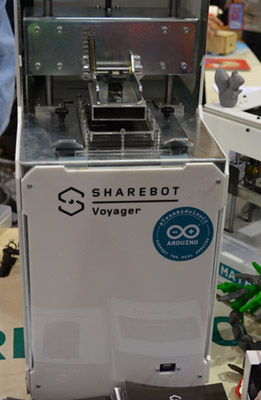
Also on display – but not in the 3D printing booth, for some reason – was the Sharebot Voyager. Unlike all the printers described above, this is a DLP printer; instead of lasers and galvos, the Voyager uses an off-the-shelf 3D DLP projector to harden layers of resin.
Strangely, the Sharebot Voyager was stuck in either the Atmel or the Arduino.cc (the [Massimo] one) booth. The printing area is a bit small – 56x96x100mm, but the resolution – on paper, mind you – goes beyond what the most expensive laser and galvo printers can manage: 50 microns in the X and Y axes, 20 to 100 microns in the Z. Compare that figure to the XFAB’s 80 micron minimum feature size, and you begin to see the genius of using a DLP projector.
The Sharebot Voyager is fully controllable over the web thanks to a 1.5GHz quad core, 1GB RAM computer that I believe is running 32 bit Windows. Yes, the spec sheet said OS: 32 bit Windows.
There were no sample prints, no price, and no expected release date. It is, for all intents and purposes, vaporware. I’ve seen it, I’ve taken pictures of it, but I’ve done that for a lot of products that never made it to market.
The Problem With Resin Printers
Taking a gander over all the resin-based 3D printers, you start to pick up on a few common themes. All the software is proprietary, and there is no open source solution for either moving galvos, lasers, or displaying images on a DLP projector correctly to run a resin-based machine. Yes, you heard it here first: it’s the first time in history Open Source hardware folk are ahead of the Open Source software folk. Honestly, open source resin printer hosts is something that should have been done years ago.
This will change in just a few months. A scary, tattooed little bird told me there will soon be an open source solution to printing in resin by the Detroit Maker Faire. Then, finally, the deluge of resin.
For this week we’re veering away from our habit of giving away things to help with your build and giving away something fun. 20 Hackaday Prize entries will receive a Bulbdial Clock kit. Getting into the running is easy, start your project on Hackaday.io and make sure you officially submit it to the Hackaday Prize. Get it in by next Wednesday to be considered for this week’s prizes, and you’ll also be in the running each week after that as we work our way through $50,000 in prizes this summer before giving away the big stuff like a Trip into Space and $100,000 in cash.
The Bulbdial Clock has been a favorite of ours for years. Developed by Hackaday Prize Judges [Windell] and [Lenore] at Evil Mad Scientist Labs, it uses three rings of colored LEDs to cast shadows as clock hands. It’s a fun solder kit that will take time to assemble. In keeping with that ideal, your best bet at scoring one this week is to post a new project log showing off the solder work you’ve done on your prototype. If you don’t have one soldered yet, that’s okay too. Just post a new project log that talks about the component assembly you’ll be working on. This would be a great time to finally draw up a basic schematic, right?
Last Week’s 40 Winners of $50 Shapeways Gift Cards
Congratulations to these 40 projects who were selected as winners from last week. You will receive a $50 gift card from Shapeways so that you can get your custom parts 3D printed. We were on the lookout for projects that we thought would benefit most from custom parts. Some of these are far along in their development, some have just started, but all of them are awesome so browse the list and make sure to skull and follow the ones you like!
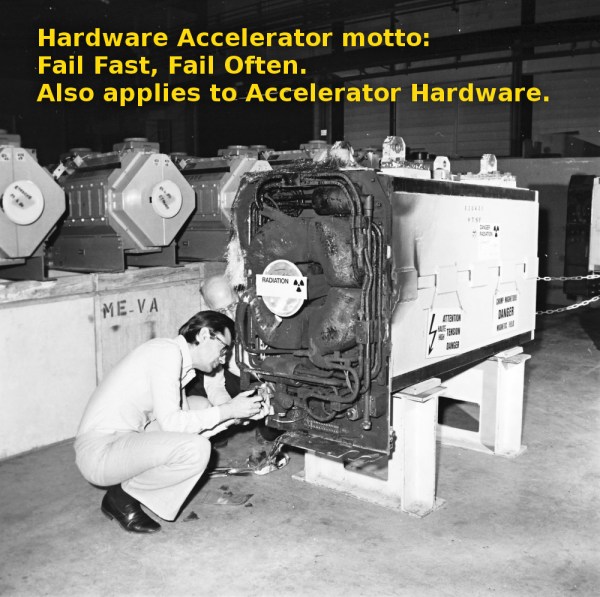
Accidents happen – but the awesome quotes you all sent in for Week 15 of the Caption CERN Contest were no accident. A huge thank you for our biggest week yet! The scientists in this week’s image are definitely cleaning up after some type of nasty accident. At first blush it looks like an electrical problem in the coils of what appears to be part of a beam line. With all that soot and radiation dangers to boot, only the photographer and the people in the image know for sure!
The Funnies:
“This is the second server these idiots have fried! What the hell’s a Hulu, and why are they trying to watch Gilligan’s Island with it?” Thanks to some unplanned quantum tunneling, Berners-Lee was even further ahead of his time than he thought” – [The Green Gentleman] (Two weeks in a row!)
“I found the bug. Who gets to tell Joe he’s sterile?”- [jonsmirl]
“‘I told the Captain that she couldn’t take any more’ – Scotty” – [md_reeves]
The winner for this week is [Mr. mmWave] himself, [Tony Long] with “Hardware Accelerator moto – Fail Fast, Fail Often. Also applies to Accelerator Hardware.” [Tony] will be debugging his next microwave mm band ham radio with a Logic Pirate From The Hackaday Store! Congratulations [Tony]!
Week 16: This is not your father’s POV Display!
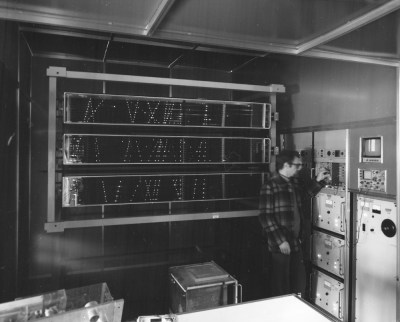
Scientists at CERN have come up with some amazing science advancements. They’ve also needed ways to display the data they collect. This image may depict some incredible new way to display data collected from a high power physics experiment – or it could be a scientist’s project for the CERN science fair. We may never know.
The album is titled CHAMBRE A ETINCELLES DANS EXPO TECHNOL, which roughly translates to “Sparks in the technology expo room”. The lines traveling between the three horizontal display devices definitely appear to be aligned. Are they sparks of electricity? You tell us!
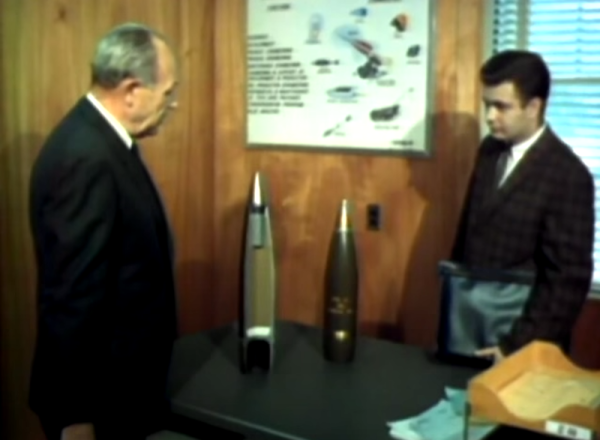
As the United States were settled, its leaders found that they needed firepower to preserve freedom. This became especially apparent during the military engagements of the era, so a number of specialized facilities were founded to manage the research, development, manufacture, and dissemination of different types of munitions.
Picatinny Arsenal in New Jersey was the place for both nuclear and conventional weapon development. The men and women working in this facility created anti-personnel devices, including a flexible, adhesive charge called Flex-X that could be affixed to almost anything. This demolition charge could be layered for increased power, and could even detonate underwater. Picatinny also developed new rocket engines, propellants, and liquid propulsion for projectiles.
In Pennsylvania, a small-arms ammunition plant called Frankford Arsenal developed a duplex rifle cartridge. That is, a lead projectile fires on target, and a second one sitting behind it in the cartridge shoots at an angle, landing an inch or so near the lead bullet. Frankford workers also ground precision optics for target sighting and centering, and developed a case-less cartridge. Propellants geared for a wide variety of uses also came out of Frankford. These propellants were employed to deliver nerve agent antidotes, inflate life rafts quickly, and eject pilots from sketchy situations.
The Edgewood Arsenal in Baltimore specializes in the research and development, manufacture, and supply of chemical weapons. They are particularly adept at fire suppression. Edgewood research has provided civilian benefits as well, such as an anthrax vaccine. In addition, Fort Detrick, Maryland contains a biological R&D wing where vital antidotes and vaccines are developed.
All of this R&D and manufacture was orchestrated by the Ammunition Procurement and Supply Agency (APSA) located near Joliet, IL. In addition to reviewing all contractor bids with equal consideration, APSA controlled distribution, maintaining inventory on large computers that could crunch numbers like nobody’s business.
Samsung has thrown its hat into the Internet of Things ring with its ARTIK platform. Consisting of three boards, each possesses a capability proportional to their size. The smallest comes in at just 12x12mm, but still packs a dual core processor running at 250MHz on top of 5 MB flash with bluetooth. The largest is 29x39mm and sports a 1.3GHz ARM, 18 gigs of memory and an array of connectivity. The ARTIK platform is advertised to be completely compatible with the Arduino platform.
Each of these little IoT boards is also equipped with Samsung’s Secure Element. Worthy of an article on its own, this crypto hardware appears to be built into the processor, and supports several standards. If you dig deep enough, you’ll find the preliminary datasheet (PDF) to each of these boards. It is this Secure Element thing that separates the ARTIK platform from the numerous other IoT devices that have crossed our memory banks, and brings forth an interesting question. With the age of the Internet of Things upon us, how do we manage all of that data while keeping it secure and private?
What is The Internet of Things?
These kind of terms get thrown around too much. It was just the other day I was watching television and heard someone talk about ‘hacking’ their dinner. Really? Wiki defines the IoT as –
“a network of physical objects or “things” embedded with electronics, software, sensors and connectivity to enable it to achieve greater value and service by exchanging data with the manufacturer, operator and/or other connected devices.”
Let’s paint a realistic picture of this. Imagine your toaster, shower head, car and TV were equipped with little IoT boards, each of which connects to your personal network. You walk downstairs, put the toast in the toaster, and turn on the TV to catch the morning traffic. A little window pops up and tells you the temperature outside, and asks if you want it to start your car and turn on the air conditioning. You select “yes”, but not before you get a text message saying your toast is ready. Meanwhile, your daughter is complaining the shower stopped working, making you remind her that you’ve programmed it to use only so much water per shower, and that there is a current clean water crisis in the country.
This is the future we all have to look forward to. A future that we will make. Why? Because we can. But this future with its technical advancements does not come without problems. We’ve already seen how malicious hackers can interfere with these IoT devices in not so friendly ways.
Is it possible for our neighbor’s teenage kid to hack into our shower head? Could she turn our toaster on when we’re not home? Or even start our car? Let’s take this even further – could the government monitor the amount of time you spend in the shower? The amount of energy your toaster uses? The amount of time you let your car idle?
Clearly, the coming age of the Internet of Things doesn’t look as nice when we lose the rose colored glasses. The question is how do we shape our future connected lives in a way that is secure and private? If closed source companies like Samsung get their IoT technology into our everyday household items, would you bet a pallet of Raspberry Pi’s that the government will mine them for data?
This, however, does not have to happen. This future is ours. We made it. We know how it works – down to the ones and zeros. There is no fate, except that which we make. Can we make the coming IoT revolution open source? Because if we can, our community will be able to help ensure safety and privacy and keep our personal data out of the government’s hands. If we cannot, and the closed source side of things wins, we’ll have no choice but to dig in and weed out the vulnerabilities the hard way. So keep your soldering irons sharp and your bus pirates calibrated. There’s a war brewing.
Here’s a worthwhile Kickstarter for once: the Prishtina Hackerspace. Yes, that’s a Kickstarter for a hackerspace in Kosovo. Unlike most hackerspace Kickstarters, they’re already mostly funded, with 20 days to go. If we ever get around to doing the Istanbul to Kaliningrad hackerspace tour, we’ll drop by.
Codebender is a web-based tool that allows you to code and program an Arduino. The Chromebook is a web-based laptop that is popular with a few schools. Now you can uses Codebender on a Chromebook. You might need to update your Chromebook to v42, and there’s a slight bug in the USB programmers, but that should be fixed in a month or so.
Here’s a great way to waste five minutes. It’s called agar.io. It’s a multiplayer online game where you’re a cell, you eat dots that are smaller than you, and bigger cells (other players) can eat you. [Morris] found the missing feature: being able to find the IP of a server so you can play with your friends. This feature is now implemented in a browser script. Here’s the repo.
The FAA currently deciding the fate of unmanned aerial vehicles and systems, and we’re going to live with any screwup they make for the next 50 years. It would be nice if all UAV operators, drone pilots, and everyone involved with flying robots could get together and hash out what the ideal rules would be. That’s happening in late July thanks to the Silicon Valley Chapter of AUVSI (Association for Unmanned Vehicle Systems International).
SOLAR ROADWAYS!!Al Jazeera is reporting a project in the Netherlands that puts solar cells in a road. It’s just a bike path, it’s only 70 meters long, and it can support at least 12 tonnes (in the form of a ‘fire brigade truck’). There’s no plans for the truly dumb solar roadways stuff – heating the roads, or having lanes with LEDs. We’re desperately seeking more information on this one.

 Hackaday Fail is a column which runs every now and again. Help keep the fun rolling by writing about your past failures and sending us a link to the story — or sending in links to fail write ups you find in your Internet travels.








 Last week’s prize was a