Production PCB And Pogo Pins Produce A Clever Test Jig

[Hans Summers] runs a site qrp-labs.com, selling self-assembly kits mostly for radio gear and GPS applications, and had some production problems with his QCX-mini QRP transceiver kit. They were using an assembly house that had some problems with a sub-contractor going under during the pandemic, and the replacement service was somewhat below the expected level of quality, resulting in a significant number of SMT populated boards coming out non-functional. Obviously, not wanting to pass these on to customers as a debug problem, they set to work on an in-house QA test jig, to give them the confidence to ship kits again. The resulting functional test jig, (video, embedded below) takes a fairly interesting approach. Skip the video to 9:00 for the description of the test jig and detailed test descriptions.

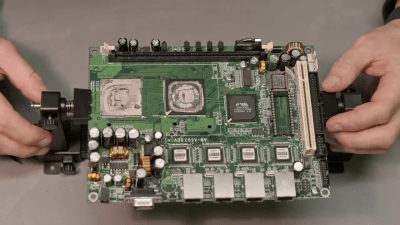
By taking an existing known-good PCB, stripping off all the SMT parts, and moving the through hole components to the rear PCB side, pogo pins could be soldered to strategic locations. Building the assembly into a rudimentary enclosure made from sawn-up raw copper clad board, with the pogos facing upwards, and a simple clamp on top, allowed the PCB-under-test (let’s call it the UUT from hereon) to be located and clamped in place. This compressed the pogos in order to make a firm electrical contact. A piece of MDF that had been attacked with a dremel did duty as a pressure plate, with cutouts around the SMT component areas to achieve the required uniform board pressure and keeping the force away from the delicate soldered parts. All this means that with an UUT connected via pogo pins to a through-hole only test PCB, the full circuit would be completed, if and only if the UUT was completely functional, and that means defect-free soldering and defect-free components.

Next the firmware was rewritten to do duty as the test controller, which when powered up would step through a sequence of test scenarios and measurements, logging the results to an OLED display and a serial interface. This rig survived 1,000 SMT tests without failing, giving [Hans] the confidence to ship out new kits and providing a database of datalog results as a backup should a customer have an issue during final assembly. All-in-all a smart idea to solve a difficult problem, with nary a custom test jig PCB in sight!

These pages have been graced with many a pogo-based test rig over the years. Here’s one to start, and if you’ve got a handy laser cutter and some scrap wood, making an accurate test rig is no bother either.

Continue reading “Production PCB And Pogo Pins Produce A Clever Test Jig”

8-bit counter made from 555s

555 Timer Contest Entry: A Digital Counter With Nothing But 555s

With a 555 on the BOM, you never know what you’re going to get. With 40 of the versatile timer chips in a build, you might just get something completely unexpected, like this 555-based eight-bit digital counter.

This one comes to us by way of [Astronomermike], who chose to make a digital circuit with nothing but 555s and a largish handful of passives as his entry in the current 555 Timer Contest. The ubiquitous timer chip is not exactly the first chip that comes to mind for digital applications, but it does contain an SR latch, which only requires a little persuasion to become a JK flip flop. His initial design for the flip flop that would form the core of the circuit had a pair of 555s surrounded with a bunch of OR gates and inverters — within the rules of the contest but hardly in its spirit. Luckily, the 555 makes a fine inverter too, and along with some diode-resistor OR gates, the basic counter module was born.

The video below shows the design and build, as well as the trip down the troubleshooting rabbit hole courtesy of a bad breadboard. Each half-nibble stage of the 8-bit counter occupies a full breadboard with ten 555s; the whole 40-chip string actually works and looks pretty cool doing it.

Truth be told, this is exactly the kind of thing we had in mind when dreaming up this year’s 555 contest, so good on [Astronomermike] for thinking outside the box for this one. To see what other uses people have found for the chip that keeps on giving, or to get your entry in before the deadline on January 10, head over to the contest page.

Continue reading “555 Timer Contest Entry: A Digital Counter With Nothing But 555s”

USB to Dupont adapter by [PROSCH]

USB Power Has Never Been Easier

USB cables inevitably fail and sometimes one end is reincarnated to power our solderless breadboards. Of course, if the cable broke once, it is waiting to crap out again. Too many have flimsy conductors that cannot withstand any torque and buckle when you push them into a socket. [PROSCH] has a superior answer that only takes a couple of minutes to print and up-cycles a pair of wires with DuPont connectors. The metal tips become the leads and the plastic sheathing aligns with the rim.

The model prints with a clear plus sign on the positive terminal, so you don’t have to worry about sending the wrong polarity, and it shouldn’t be difficult to add your own features, like a hoop for pulling it out, or an indicator LED and resistor. We’d like to see one with a tiny fuse holder.

If you want your breadboard to have old-school features, like a base and embedded power supply, we can point you in the right direction. If you are looking to up your prototyping game to make presentation-worthy pieces, we have a host of ideas.

The Benefits Of Critiquing Your Own PCB Designs

In a recent retrospective video, [Phil] from Phil’s Lab goes through a number of his early PCB designs, to critique and comment on what he likes and doesn’t like in these designs. Even though it’s only been a few a few years, he founds plenty that’s wrong. From poor and inconsistent formatting in the schematic, to sloppy and outright broken PCB layouts. It’s a fascinating look at years of lessons learned.

[Phil] comments on the importance of clear labeling and organization of sections and pages in the schematic to make it obvious what the function of a block is. Other lessons include the labeling of nets to make PCB routing a lot easier, making good use of PCB planes, getting all relevant information on components and layout in the schematic as a comment, and connecting decoupling capacitors to their relevant pins.

Although we tend to forget about older projects, it can be very interesting to take a look at them now and then, to see (hopefully) our progress over the years. In the case of [Phil] it’s fascinating to see the transition from a basic two-sided board with THT components to multi-layer boards with STM32 MCUs.

Continue reading “The Benefits Of Critiquing Your Own PCB Designs”

Teaching A DC Servo Motor To Act Like A Stepper

[Frank Herrmann] had an interesting idea to turn a geared DC motor into a servo motor assembly, but with a stepper motor-like interface. By stacking some small PCBs behind the motor body, it was possible to squeeze a DRV8837 DC motor driver and a pair of hall effect sensors on the first PCB layer, with the magnetic encoder nestled tightly behind it. Pin headers at the edge of the PCB connect to a second PCB bearing the microcontroller, which is based on the cheap STM32L432. The second PCB also holds an associated LDO and debug LED. Together, this handful of parts provide all that is needed to read the encoder, control the motor rotation and listen on the ‘stepper motor driver’ interface pins hooked up to the motion controller upstream. The Arduino source for this can be found on the project GitHub.

Whilst [Frank] mentions that this assembly has a weight and torque advantage over a NEMA 17 sized stepper motor, but we see no hard data on accuracy and repeatability which would be important for precise operations like 3D printing.

This project is part of a larger goal to make a complete 3D printer based around these ‘DC motor stepper motors’ which we will watch with interest.

While we’re on the subject of closed-loop control of DC motors, here’s another attempt to do the same, without the integration. If these are too small for you, then you always repurpose some windscreen washer motors.

Continue reading “Teaching A DC Servo Motor To Act Like A Stepper”

The No-MCU Fan Controller

The default for any control project here in 2019 was to reach for a microcontroller. Such are their low cost and ubiquity that they can be used to replicate what might once have needed some extra circuitry, with the minimum of parts. But here we are at the end of 2021, and of course microcontrollers are hard to come by in a semiconductor shortage. [Hesam Moshiri] has a project that takes us back to a simpler time, a temperature controlled fan the way they used to be made, without a microcontroller in sight.

Old hands will no doubt guess where this design is heading, there is an LM35 temperature sensor producing a voltage proportional to its temperature, and half of an LM358 which forms a comparator against a static voltage from a divider. The LM358’s output drives a MOSFET which in turn switches on or off the fan motor. This type of circuit used to be the daily fare of simple control electronics in the days when a microcontroller represented a significant expense, and it’s still a handy circuit to be reminded of.

Have you forgotten sensors such as the LM35 in a world of on-board sensors? Time to refresh your sensing memory.

A man welds on a chassis

Electric Wheelchair Dump Truck Hack Really Hauls

Have you ever looked at a derelict electric wheelchair and thought “I bet I could make something great with that!” Of course you have- this is Hackaday, after all! And so did [Made in Poland], who managed to get a hold of a broken down electric wheelchair and put the full utility of his well equipped metalworking shop to work. The results? Lets just say it hauls.

What we really enjoyed about the build was that there wasn’t much that couldn’t be done by an average garage hacker with a drill press, angle grinder, and a stick welder. While it’s definitely nicer to have a lathe and a high quality welding table, plasma cutter, and everything in between, nothing that [Made in Poland] did in the video is such high precision that it would require those extensive tools. There may be some parts that would beĀ a lot more difficult, or lower precision, but still functional.

Another aspect of the build is of course the control circuitry and user interface. Keeping the skid steer and castor approach meant that each motor would need to be controllable independently. To achieve this, [Made in Poland] put together a purely electromechanical drive controlled with momentary rocker switches and automotive relays to form a simple H-Bridge for each motor.

Of course you just have to watch until the end, because it really proves that a man will do anything to get out of hauling wood around! Old electric wheelchairs can also make a great base for big robots, as it turns out.

Continue reading “Electric Wheelchair Dump Truck Hack Really Hauls”