Introduction To FTDI Bitbang Mode

It was an interface that launched a thousand hacks. Near trivial to program, enough I/O lines for useful work, and sufficiently fast for a multitude of applications: homebrew logic analyzers, chip programmers, LCD interfaces and LED light shows, to name a few.

Today the parallel printer port is on the brink of extinction (and good riddance, some would say). Largely rendered obsolete by USB, few (if any) new peripherals even include a parallel connector, and today’s shrinking computers — nettops, netbooks, media center PCs — wouldn’t have space for it anyway. That’s great for tidy desks, but not so good if you enjoyed the dirt-cheap hacks that the legacy parallel port made possible.

Fear not, for there’s a viable USB alternative that can resurrect many of these classic hacks! And if you’ve done much work with Arduino, there’s a good chance it’s already lurking in your parts drawer.

Continue reading “Introduction To FTDI Bitbang Mode”

How-to: Bus Pirate Probe Cable

cover

Update, Saturday July 4th, 2009: All preorders are closed.

A probe cable makes it easy to connect the Bus Pirate to a circuit and get hacking. Good test clips make quick connections on cramped PCBs without causing short circuits. We made two cables for the Bus Pirate v2, keep reading for an overview of our designs and list of part suppliers.

Friday, July 3, 2009 is the last day to pre-order a Bus Pirate. There’s only two days left to get your own Bus Pirate, fully assembled and shipped worldwide, for only $30.

Continue reading “How-to: Bus Pirate Probe Cable”

How-to: The Bus Pirate V2 With USB

buspiratev2goii450

Update, Saturday July 4th, 2009: All preorders are closed.

The Bus Pirate is a universal serial interface tool, we use it to test new chips without writing any code. It currently supports most serial protocols, including 1-Wire, I2C, SPI, JTAG, asynchronous serial, MIDI, and more. We added some other features we frequently need, like pulse-width modulation, frequency measurement, voltage measurement, bus sniffers, pull-up resistors, and switchable 3.3volt and 5volt power supplies.

The new v2 family adds USB power and connectivity to the best Bus Pirate design yet. We also reduced the part count and cost wherever possible. If you want to get your hands on some Bus Pirate USB goodness, Seeed Studio has assembled hardware for $30 (including worldwide shipping).

Read about the new design after the break.

Continue reading “How-to: The Bus Pirate V2 With USB”

How-to: Build Your Own Spot Welder

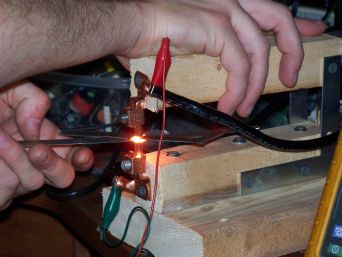
Spot welders are used in the fabrication of automobiles, PC cases, power supplies, microwave ovens, electrical junction boxes, Faraday cages, and various electronics. A spot welder is used because it produces a highly defined point of contact weld. The materials are welded without excessive heating, so working pieces are handled easily. The weld is also highly controlled and repeatable. In this how-to we cover the basics of a spot welder, and then show you how to build one from a microwave oven transformer.

Continue reading “How-to: Build Your Own Spot Welder”

How-to: Fix Your Stupid Internet

aprilfools-1

Dear Hack a Day,
Websites keep publishing poorly executed jokes today; how can I fix this?

We’ve been getting a lot of questions on the tip line like the one above, so we put together this one-step illustrated how-to. If you’re not the physical labor type, you can use [Steve Lambert]’s SelfControl.

[Related: Hack a Day goes autonomous, Craft a Day]

How-to: Bus Pirate V1, Improved Universal Serial Interface

front450a

We use the Bus Pirate to interface a new chip without writing code or designing a PCB. Based on your feedback, and our experience using the original Bus Pirate to demonstrate various parts, we updated the design with new features and cheaper components.

There’s also a firmware update for both Bus Pirate hardware versions, with bug fixes, and a PC AT keyboard decoder. Check out the new Hack a Day Bus Pirate page, and browse the Bus Pirate source code in our Google code SVN repository.

We cover the design updates and interface a digital to analog converter below.

Continue reading “How-to: Bus Pirate V1, Improved Universal Serial Interface”

How-to: Prepare Your Eagle Designs For Manufacture

back

Cadsoft Eagle is a multi-platform freeware circuit layout program. Lots of open source hardware is designed in Eagle, and it’s become a hobbyist favorite. We use it for all of our hardware designs.

There are several ways to turn an Eagle design into an actual printed circuit board (PCB). We’ll show you how to save Eagle designs as industry-standard gerber files that are accepted by any PCB manufacturer. You can use the gerbers to order a single prototype, or a full panel.

Continue reading “How-to: Prepare Your Eagle Designs For Manufacture”