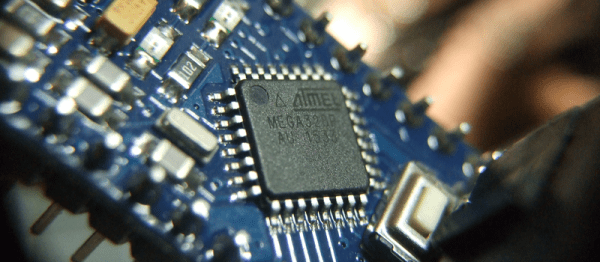
Bye-bye ATmega328P, Hello 328PB!

We never have enough peripherals on a microcontroller. Whether it’s hardware-driven PWM channels, ADCs, or serial communication peripherals, we always end up wanting just one more of these but don’t really need so many of those. Atmel’s new version of the popular ATmega328 series, the ATmega328PB, seems to have heard our pleas.

We don’t have a chip in hand, but the datasheet tantalizes. Here’s a quick rundown of the new features:

  • Two more 16-bit timer/counters. This is a big deal when you’re writing code that’s not backed up by an operating system and relies on the hardware for jitter-free timing.
  • Two of each USART, SPI, and I2C serial instead of one of each. Good when you use I2C devices that have limited address spaces, or when you need to push the bits out really fast over SPI.
  • Ten PWM channels instead of six. This (along with the extra 16-bit timers) is good news for anyone who uses PWM — from driving servos to making music.
  • Onboard capacitive sensing hardware: Peripheral Touch Controller. This is entirely new to the ATmega328PB chip, and looks like it’ll be interesting for running capacitive sense buttons without additional ICs. It relies on Atmel’s QTouch software library, though, so it looks like it’s not a free-standing peripheral as much as an internal multiplexer with maybe some hardware-level filtering. We’ll have to look into this in detail when we get our hands on one of the chips.

So what does this mean for you? A quick search of the usual suspects shows the chips in stock and shipping right now, and there’s an inexpensive dev kit available as well. If you write your own code in C, taking advantage of the new features should be a snap. Arduino folks will have to wait until the chips (and code support) work their way into the ecosystem.

Thanks [Peter van der Walt] for the tip!
Microchip To Acquire Atmel For $3.56 Billion

Just last week, there was considerable speculation that Microchip would buy Atmel. The deal wasn’t done, and there was precedent that this deal wouldn’t happen – earlier this year, Dialog made an approach at Atmel. Now, though, the deal is done: Microchip will acquire Atmel for $3.56 Billion.

There are three main companies out there making microcontrollers that are neither ancient 8051 clones or ARM devices: TI’s MSP430 series, Microchip and Atmel. Microchip has the very, very popular PIC series microcontrollers, which can be found in everything. Atmel’s portfolio includes the AVR line of microcontrollers, which are also found in everything. From phones to computers to toasters, there’s a very high probablitiy you’re going to find something produced by either Atmel or Microchip somewhere within 15 feet of your person right now.

For the hobbyist electronic enthusiast, this has led to the closest thing we have to a holy war. Atmel chips were a little easier (and cheaper) to program, but were a little more expensive. Microchip’s chips have a very long history and proportionally more proper engineers who are advocates. PIC isn’t Arduino, though, a community that has built a large and widely used code base around the AVR family.

Microchip’s acquisition of Atmel follows several mergers and acquisitions in recent months: NXP and Freescale, Intel and Altera, Avago and Broadcom, and On Semiconductor and Fairchild. The semiconductor industry has cash and wants to spend it. What this means for the Atmel product line is left to be seen. The most popular micros probably won’t be discontinued, but if you’re using unpopular Atmel micros such as the ATtiny10 you might want to grab a reel or two before they’re EOL’d.


A Shareable Wireless Biometric Flash Drive

Wireless storage and biometric authentication are both solved problems. But as [Nathan] and [Zhi] have noticed, there is no single storage solution that incorporates both. For their final project in [Bruce Land]’s ECE 4760, they sought to combine the two ideas under a tight budget while adding as many extras as they could afford, like an OLED and induction coil charging.

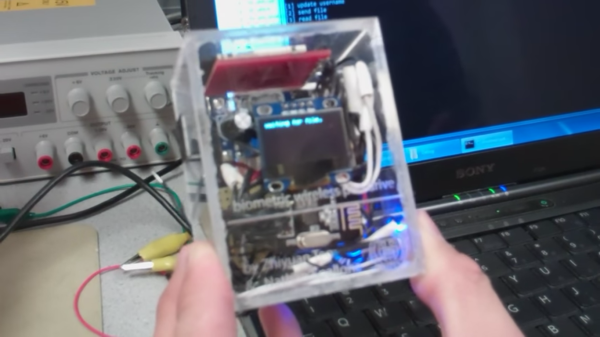
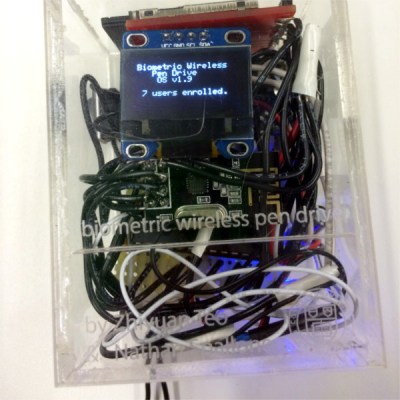
final_product_600Their solution can be used by up to 20 different people who each get a slice of an SD card in the storage unit There are two physical pieces, a base station and the wireless storage unit itself. The base station connects to the host PC over USB and contains an Arduino for serial pass-through and an nRF24L01+ module for communicating with the storage side. The storage drive’s components are crammed inside a clear plastic box. This not only looks cool, it negates the need for cutting out ports to mount the fingerprint sensor and the OLED. The sensor reads the user’s credentials through the box, and the authentication status is displayed on an OLED. Files are transferred to and from the SD card over a second nRF24L01+ through the requisite PIC32.
Fingerprint authorization gives the unit some physical security, but [Nathan] and [Zhi] would like to add an encryption scheme. Due to budget limitations and time constraints, the data transfer isn’t very fast (840 bytes/sec), but this isn’t really the nRF modules’ fault—most of the transmission protocol was implemented in software and they simply ran out of debugging time. There is also no filesystem architecture. In spite of these drawbacks, [Nathan] and [Zhi] created a working proof of concept for wireless biometric storage that they are happy with. Take a tour after the break.
Continue reading “A Shareable Wireless Biometric Flash Drive”

Microchip’s Proposal To Acquire Atmel

A proposal from Microchip to acquire Atmel has been deemed a ‘superior proposal’ by Atmel’s board of directors (PDF). This is the first step in the acquisition of a merger between Microchip and Atmel, both leading semiconductor companies that have had a tremendous impact in the electronics industry.

Microchip is a leading manufacturer of microcontrollers, most famously the PIC series of micros that can be found in any and every type of electronic device. Atmel, likewise, also has a large portfolio of microcontrollers and memory devices that are found in every type of electronic device. Engineers, hackers, and electronic hobbyists are frequently sided with Microchip’s PIC line or Atmel’s AVR line of microcontrollers. It’s the closest thing we have to a holy war in electronics.

Last September, Dialog acquired announced plans to acquire Atmel for $4.6 Billion. Today’s news of a possible acquisition of Atmel by Microchip follows even larger mergers such as NXP and Freescale, Intel and Altera, Avago and Broadcom, On Semiconductor and Fairchild, and TI and Maxim. The semiconductor industry has cash on hand and costs to cut, these mergers and acquisitions are the natural order of things.

While the deal is not done, the money is on the table, and Atmel’s board is apparently interested.

Introducing The BeagleBone Blue

The BeagleBone is a board that doesn’t get a lot of attention in a world of $5 Raspberry Pis, $8 single board computers based on router chipsets, and a dizzying array of Kickstarter projects promising Android and Linux on tiny credit card-sized single board computers. That doesn’t mean the BeagleBone still isn’t evolving, as evidenced by the recent announcement of the BeagleBone Blue.

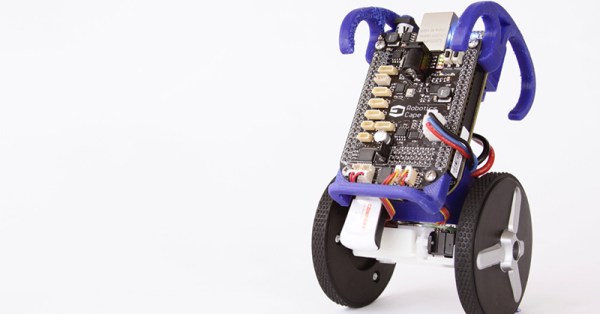
The BeagleBone Blue is the latest board in the BeagleBone family, introduced last week at CES. The Blue is the result of a collaboration between UCSD Engineering and TI, and with that comes a BeagleBone built for one specific purpose: robotics and autonomous vehicles. With a suite of sensors very useful for robotics and a supported software stack ideal for robots and drones, the BeagleBone Blue is the perfect board for all kinds of robots.

On board the BeagleBone Blue is a 2 cell LiPo charger with cell balancing and a 6-16 V charger input. The board also comes with eight 6V servo outputs, four DC motor outputs and inputs for four quadrature encoders. Sensors include a nine axis IMU and barometer. Unlike all previous BeagleBones, the BeagleBone Blue also comes with wireless networking: 802.11bgn, Bluetooth 4.0 and BLE. USB 2.0 client and host ports are also included.

Like all of the recent BeagleBoards, including the recently released BeagleBone Green, the Blue uses the same AM3358 1 GHz ARM Cortex 8 CPU, features 512 MB of DDR3 RAM, 4GB of on board Flash, and features the main selling point of the BeagleBoard, two 32-bit programmable real-time units (PRUs) running at 200 MHz. The PRUs are what give the BeagleBone the ability to blink pins and control peripherals faster than any other single board Linux computer, and are extremely useful in robotics, the Blue’s target use.

Right now, the BeagleBone Blue isn’t available, although we do know you’ll be able to buy one this summer. Information on pricing and availability – as well as a few demos – will come in February.

PIC32 Smart Watch For Less Than A Benjamin

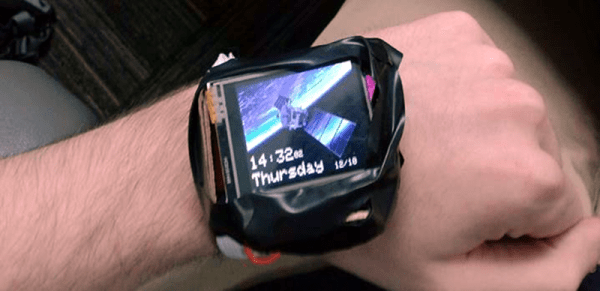
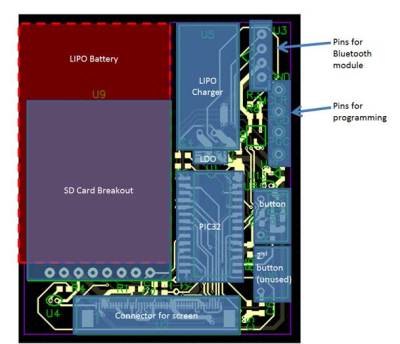
[Matthew Filipek] likes smart watches, but wanted to build one for under $100, so he did. The watch has a 1.7 inch LCD touchscreen, a rechargeable LiPo battery, an SD card, and Bluetooth. The watch is a little large since [Matthew] had only a month to complete the project that drove him to use some pre-made modules image004and meant one shot at getting his custom PCB right.

The watch sports three applications: a settings app, a simple game, and a sketch program (you can see a demo in the video below). Power management is a primary goal, of course, although the clock rate is held high enough to make the game playable. To simplify the software, [Matthew] uses protothreads–a lightweight thread abstraction for embedded systems.

We’ve seen several DIY smartwatches in the past including one entry for the Hackaday Prize. It is hard to roll your own watch that has the same small size and style as a commercial offering. However, there is something to be said for having a homebrew watch for boosting your hacker cred.

Continue reading “PIC32 Smart Watch For Less Than A Benjamin”

LiteBSD Brings 4.4BSD To PIC32

A few years ago [Serge Vakulenko] started the RetroBSD project–a 16-bit port of the old 2.11BSD operating system to the Microchip PIC32 microcontroller. This was impressive, but version 2 of BSD is, to most people, old news and somewhat difficult to use compared to modern BSD and Linux operating systems.

[Serge] has been at it again, however, and now has a port of 4.4BSD–LiteBSD–running on the PIC32MZ. According to [Alexandru Voica] there is about 200K of user space memory in the basic build, and by removing some OS features, you could double or triple that figure.

Continue reading “LiteBSD Brings 4.4BSD To PIC32”