4-Bit Audio Output Via Voltage Reference

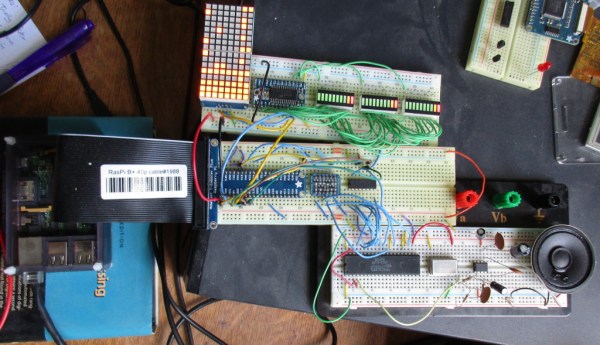
[Bruce Land] switched his microprocessor programming class over from Atmel parts to Microchip’s PIC32 series, and that means that he’s got a slightly different set of peripherals to play with. One thing that both chips lack, however is a digital-to-analog converter (DAC). Or do they? (Dun-dun-dun-duuuuhnnnn!)

The PIC part has a programmable, sixteen-level voltage reference. And what is a Vref if not a calibrated DAC? With that in mind, [Bruce] took to documenting its performance and starting to push it far beyond the manufacturer’s intentions. Turns out that the Vref has around 200 kHz of bandwidth. (Who would update a voltage reference 200,000 times per second?)

Anyway, [Bruce] being [Bruce], he noticed that the bits weren’t changing very often in anything more than the least significant bit: audio waveforms, sampled fast enough, are fairly continuous. This suggests using a differential PCM encoding, which knocks the bitrate down by 50% and saves a lot on storage. (Links to all the code for this experiment is inline with his writeup.)

The audio hacks that come out of [Bruce]’s Cornell ECE classes are always a treat. From the lock that you have to sing to open, to chiptunes programmed into an FPGA, there’s something for music fans of all inclinations.

Onde Magnetique Will Wow And Flutter Your Ears

[Scott Campbell] built a cassette-based synthesizer that sounds exactly like everything you’ve heard before. The sound generation comes straight off cassettes, but the brainbox of this synth varies the volume and pitch. It’s called the Onde Magnetique, and it is what you would get if you combined a Mellotron and Ondes Martenot.

The key component for the Onde Magnetique is a Sony cassette recorder that conveniently and inexplicably comes with a ‘tape speed input’ mini jack. By varying the voltage sent to this input jack, the speed of the tape, and thus the pitch of the sound being played, is changed. Build a box with a touch-sensitive button for volume, and a few tact switches for different speeds, and you have an electromechanical bastard child of a Mellotron and an Ondes Martenot.

By itself, the Onde Magnetique produces no sound – it only controls the pitch and volume of whatever is on the cassette. [Scott] produced a few single-note cassettes for his instrument, with ‘voice patches’ including a flute, choir, and a synth. With the CV and Gate input, these sounds can be sequenced with outboard gear, producing the wonderful sounds heard in the video after the break.

Continue reading “Onde Magnetique Will Wow And Flutter Your Ears”

The Music Of A Sunset

What would you do if you suddenly went blind and could never again see the sun set? How would you again experience this often breathtaking phenomenon? One answer is music, orchestrated by the sun and the Weather Warlock.

Built by the musician [Quintron] (builder and inventor of insane electronic instruments), the Weather Warlock is an analog synthesizer controlled by — you guessed it — the weather. It translates temperature, moisture, wind and sunlight into tones and harmonics with an E major root chord. UV, light, moisture, and temperature sensors combined with an anemometer set up outside feed the weather data to a synthesizer that has [Quintron] dialing knobs and toggling switches. The Weather Warlock steams 24/7 to the website weatherfortheblind.org so that the visually impaired are able to tune in and experience the joy of sunrise and sunset through music. Continue reading “The Music Of A Sunset”

Ever Buy Music From Apple? Use Linux? You Need This Tool

Sure, you’re a hardcore superuser, but that doesn’t mean you don’t enjoy the finer things in life — like shiny squircles and getting every new app first. But, what’s an OS-indiscriminate person like yourself going to do when it comes time to purchase music? That’s where the recover_itunes tool shines, and if you’re a Linux user with an iPhone, it might just be your new best friend.

Continue reading “Ever Buy Music From Apple? Use Linux? You Need This Tool”

Nirvana Like You’ve Never Heard Them Before

If you were an early 1990s youth, the chances are [Nirvana]’s Smells Like Teen Spirit is one of those pieces of music that transports you straight back to those times. As your writer it evokes a student radio studio and the shelves of its record library, and deafening badly-lit discos with poorly adjusted PA systems and unpleasantly sticky dance floors.

One of our finds this morning therefore comes as an evocative diversion, Smells Like Teen Spirit on [SileNT]’s Floppotron. The Floppotron is a music player composed of a huge array of floppy drives, hard drives, and a couple of flatbed scanners. The scanners are controlled by off-the-shelf Arduino boards and the hard drives have ATMega16s with H-bridge drivers.

This build is the most refined floppy drive organ we’ve seen yet. The floppies are divided into single-voice blocks of eight controlled by an ATMega16, with dynamic volume envelopes mad possible by the number of simultaneously running drives, so the sounds can fade in and out like “natural” musical instruments. The hard drives and scanners are run against their mechanical stops, providing percussion. All the boards are daisychained via SPI to an Arduino that acts as a PC interface, and the PC schedules the performance with a Python script.

He’s provided a couple of pieces as YouTube videos, the floppy motors work particularly well for [Nirvana]’s grunge, but perhaps a bit more mechanical for Hawaii Five-O. This last track will be more evocative than the first if you attended a particular university in the North of England where it was the end-of night record played as the lights came up in one of the discos that had a much better-adjusted PA because the technician knew what she was doing. For those of you with different childhoods, there’s also the Imperial March.

Continue reading “Nirvana Like You’ve Never Heard Them Before”

Orbs Light To Billie Jean On This Huge Sequencer

Sequencers allow you to compose a melody just by drawing the notes onto a 2D grid, virtually turning anyone with a moderate feel for pitch and rhythm into an electronic music producer. For  [Yuvi Gerstein’s] large-scale grid MIDI sequencer GRIDI makes music making even more accessible.

Instead of buttons, GRIDI uses balls to set the notes. Once they’re placed in one of the dents in the large board, they will play a note the next time the cursor bar passes by. 256 RGB LEDs in the 16 x 16 ball grid array illuminate the balls in a certain color depending on the instrument assigned to them: Drum sounds are blue, bass is orange and melodies are purple.

Underneath the 2.80 x 1.65 meters (9.2 x 4.5 foot) CNC machined, sanded and color coated surface of the GRIDI, an Arduino Uno controls all the WS2812 LEDs and reads back the switches that are used to detect the balls. A host computer running Max/MSP synthesizes the ensemble. The result is the impressive, interactive, musical art installation you’re about to see in the following video. What better tune to try out first than that of Billie Jean whose lighted sidewalk made such an impression on the original music video.

Continue reading “Orbs Light To Billie Jean On This Huge Sequencer”

Modular Drum Machine Creates Random Rhythms

Don’t worry, the rhythms themselves aren’t random! That would hardly make for a useful drum machine. [kbob]’s creation does have the ability to randomly generate functional rhythms, though, and it’s all done on a breadboard.

The core of this tiny drum machine is two Teensy dev boards. One is an FM synth tuned to sound like drums, and the other is a random rhythm generator with several controls. The algorithms are from Mutable Instruments’ open source Eurorack modules. The entire thing fits on a breadboard with JIGMOD modules for the user interface. The machine runs on lithium batteries in the form of USB cell phone chargers. The battery holders were designed in Fusion 360 and 3D printed.

The function of the drum machine is pretty interesting as well. There are a set of triggers tied to the buttons on the machine. When a button is pressed, the drum machine plays that sound at the appropriate time, ensuring there are no offbeat beats. The potentiometers are polled once every millisecond and the program updates the output as required. There’s also a “grid” of rhythms that are controlled with two other knobs (one to map the X coordinate and the other for the Y) and a “chaos” button which adds an element of randomness to this mapping.

The modular nature of this project would make this a great instrument to add to one’s musical repertoire.It’s easily customizable, and could fit in with any of a number of other synthesizer instruments.

Continue reading “Modular Drum Machine Creates Random Rhythms”