Guitar Made From Noodles Glows In The Dark

Wood.  Specifically, certain types of tone woods; woods that impart a certain tone. That’s what guitars are made of. And occasionally, plastic, or metal, or fibreglass or, well, anything. [_forwardaudio_] built his out of noodles, because, why not?

Well, not completely out of noodles. Epoxy is used to give some strength to the noodles, because, despite the fantastic tone that noodles impart to the guitar, they’re not known for their strength. The epoxy helps keep the noodles in place, focusing their noodly tone.

To add a bit of punch to the look of the guitar, the back and front of the body have UV powder blended in, blue on the front and green on the back. Once the guitar was assembled, a set of UV strings were added as well, to add even more glowy goodness.

In the video (after the break) the build process is shown along with the simplified, volume only, wiring. At the end, [_forwardaudio_] noodles around on the guitar a bit.

I’ll show myself out.

If noodles aren’t your thing, maybe you’d prefer 3D printing an extended fretboard for your guitar, or to build yourself a 12 foot long guitar.

Continue reading “Guitar Made From Noodles Glows In The Dark”

This Chiptune Player’s Got What Nintendon’t

When it comes to chiptunes, the original Nintendo Entertainment System and the Game Boy get all the accolades. The OPL synths have all the fun. But there’s another chip out there in dusty old machines that is at least as interesting with a repertoire at least as influential as the Mega Man 2 OST. It’s the YM2612, the chip in the Sega Mega Drive/Genesis.

[natalie] created a portable device capable of playing back the files targeting the sound chips in this venerable machine. It’s the MegaGRRL, and it’s the iPod for the original Genesis sound tracks.

Inside the MegaGRRL is an ESP32 in the form of an ESP-WROOM-32 module. There is, of course a YM2612 chip in there, along with a headphone amplifier and a battery charger. The display is a fairly standard and cheap affair that’s 240 x 320 pixels in full color, and there are seven buttons on this device, because of course you need an A, B, and C button.

Combined with a 3D printed enclosure, the GameGRRL does exactly what it says it will: it plays all the music from old Sega games. Now, when you’re in the inevitable argument with someone over the fact that Michael Jackson wrote the Sonic 3 soundtrack, the proof is right in your pocket. Of if you want to jam out on the Toe Jam And Earl soundtrack, that’s right there too. You can check out the video demos below.

Continue reading “This Chiptune Player’s Got What Nintendon’t”

MIDI-Gurdy, MIDI-Gurdy, MIDI-Gurdy Man

The hurdy gurdy is the perfect musical instrument. It’s an instrument with a crank, and a mechanical wonderment of drone strings and weird chromatic keyboards. No other musical instrument combines the sweet drone of bagpipes with the aural experience of an eight-year-old attempting to play Hot Cross Buns on a poorly tuned violin.

Now, the hurdy gurdy is going digital. The Digi-Gurdy is [XenonJohn]’s entry into this year’s Hackaday Prize, and it’s exactly what it says on the tin: it’s a musical instrument that drones on and on, with keys plunking out a melody.

If you’re not familiar with a hurdy gurdy, this video is a varily good introduction. It’s a box with somewhere between four and six strings mounted on the outside. The strings vibrate by means of a wooden wheel powered by a crank. There’s a keyboard of sorts along the body of the instrument that ‘fret’ a single string providing the melody; all the other strings are drone strings that sound continuously. I think it was in, like, a Led Zeppelin video, man.

While it’s a slightly complicated build to make an analog hurdy gurdy, delving into the digital domain is easy: [XenonJohn] is building a hurdy gurdy that simply outputs MIDI commands with some buttons and a Teensy 3.6 microcontroller. The parts are 3D printed, and since this hurdy gurdy is completely digital, you can change the tuning of the drone strings without actually tuning them. Awesome.

This MDF Sound Bar Sounds Great

Everyone should build a speaker cabinet at least once in their life, if only so they can realize how much thought goes into building a simple box. [John] of ibuildit.ca wanted a sound bar for his home theater setup, and that means building a sound bar. The result is beautiful, and a demonstration of how much you can do with just a router and a table saw.

[John] built this sound bar almost entirely out of MDF, which isn’t the best material but it works well enough for a speaker cab that’s meant to be mounted to a wall. The sides were constructed first, with a rabbet holding the front and back on. Both the woofer and tweeter are inset into the front, and a standard piece of plumbing pipe serves as the bass port. Slap a round over bit into the router and do some light sanding, and everything looks great with a coat of black paint.

As with any speaker enclosure, the design is effectively parametric, designed entirely around the drivers being used. In this case, [John] is using a spreadsheet named ‘Unibox’ that gives you all the formulas and graphs for designing a speaker enclosure.

With the box built and the speakers installed, the only matter left were a few aesthetic choices. [John] went with a standard black finish with a very nice wooden grille held onto the front with magnets. It’s a design that pops, but the true test of a speaker is how it sounds. That’s a bit hard to convey over the Internet, but [John] included a few sound samples at the end of the build video, available below.

Continue reading “This MDF Sound Bar Sounds Great”

A Baby Named DJ

Some of us are guilty of picking up questionable hardware from garage sales, fleamarkets, and well-meaning relatives. There is a balance between turning down a good investment and hoarding, and if we figure out how to tell the difference you will be the first to know. [Clem Mayer] may start on the side of unwise acquisition, but he pushes a broken fetal detector into the realm of awesome by converting it to an analog synthesizer, born to headline at an Eastern European dance party.

He starts with a basic teardown, and we get to see how old hardware was serviceable with only two standard screws. It is a good thing too, because the nickel-cadmium batteries are older than some of you and they are in need of replacement. New nickel-metal hydride batteries got it up and running but [Clem] does not have a baby bump so its functionality turned to Pink Floyd era synthesizer circuit bending. Circuit bending involves modifying a circuit for sound it was not intended to make.

Continue reading “A Baby Named DJ”

DIY Raspberry Pi Multi FX Stomp Box

From building your own analog effects pedal to processing audio through micro controllers, a lot of musicians love building their own boxes of sound modification. In his entry for the 2019 Hackaday Prize, [Craig Hissett] has a project to build an all-in-one multi-effects stomp box.

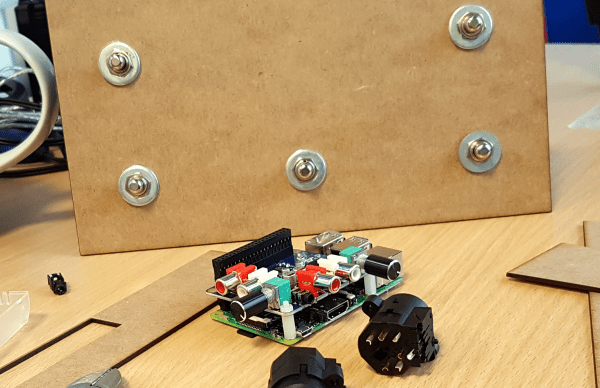
At the center of the box is a Raspberry Pi with an AudioInjector stereo sound card.  The card takes care of stereo in and out, and passing the signal to the Pi. The software is Modep, an open source audio processor that allows the setup of a chain of digital effects plugins to be run on the Pi. After finding some foot switches, [Craig] connected them to an Arduino Pro Micro which he set up as a MIDI device that sends MIDI messages to the Modep software running on the Pi.

There are still a few steps to go, but [Craig] has the basic layout covered. Next up is wiring it up and building a proper case for it, as well as working on latency. A few years ago, another multi-effects stomp box was featured in the Hackaday Prize, and last year, this multi-effects controller was featured.


Exquisite Craftsmanship Elevate Vic’s Creations Above The Rest

This booth was easy to miss at Maker Faire Bay Area 2019 amidst tall professional conference signage erected by adjacent exhibitors. It showcased the work of [Dr. Victor Chaney] who enjoys his day job as a dentist and thus feels no desire to commercialize his inventions — he’s building fun projects for the sake of personal enjoyment which he simply calls Vic’s Creations. Each project is built to his own standards, which are evidently quite high judging by the perfect glossy finish on every custom wood enclosure.

Some of these creations were aligned with his musical interests. The Backpacking Banjo was built around a (well cleaned) cat food can to satisfy the desire for a lightweight instrument he can take camping. His Musical Laser Rainbow Machine (fully documented in Nuts & Volts) was created so little bands formed by independent artists like himself can have a visual light show to go with their live performances. The Music Kaleidoscope is another execution along similar lines, with an LED array whose colors are dictated by music. Venturing outside the world of music, we see a magnetically levitated Castle In The Clouds which also receives power wirelessly to illuminate LEDs

The largest and most complex work on display is an epic electromechanical masterpiece. Par One is a rolling ball sculpture featuring the most convoluted golf course ever. Several more rolling ball sculptures (also called marble machines or marble runs) are on display at Dr. Chaney’s office which must make it the coolest dentist’s lobby ever. The lifelike motions he was able to get from the automatons he built into the sculpture are breathtaking, as you can see below.

Continue reading “Exquisite Craftsmanship Elevate Vic’s Creations Above The Rest”