A Tiny USB Hub For All Your Hardware Modding Needs

Going all the way hack to the heady days of Eee PC modding, hardware hackers have been on the hunt for small USB hubs that can easily be liberated from their enclosures and integrated into whatever project they happen to be working on. From time to time you see recommendations out there for makes and models which lend themselves to this sort of repurposing, but it’s seemed more difficult than necessary to source such a basic component.

Which is why [RETROCUTION] has developed a USB hub that’s not only extremely small, but relatively easy to assemble with only six components. Plus best of all, they are dirt cheap.

When you add up the cost of getting the PCBs made and buying all the SMD components, the per-unit price of these hubs is only going to be a few dollars. If you’ve got what it takes to make the PCBs in-house, even better. Considering how much easier these things could make other projects, it seems more than worth the upfront cost.

The star of the show is the FE1.1s, a four port USB 2.0 controller in a SSOP-28 package. As of this writing, it goes for about 25 cents from the usual overseas sources (even less, for larger orders). Add to the mix a few 10 μF ceramic capacitors, a 2.7 kΩ resistor, and a 12 MHz crystal.

There’s no provision for actual USB ports in the design, but they would just take up space anyway; this hub is intended to be directly soldered to the other devices. Incidentally, to reduce the number of traces and pads on the PCB, there aren’t power lines for the downstream devices either. So you’ll need to power them separately.

The passives are 0603, but the crystal is a good old fashioned through-hole component. [RETROCUTION] assembles the boards with a solder paste stencil and a hot air station, but if you’ve got a little practice, it’s certainly something you could do with an iron. With such a straightforward design, you could build a lifetime supply of these itty-bitty hubs in an afternoon. That’s certainly our plan, anyway.

Continue reading “A Tiny USB Hub For All Your Hardware Modding Needs”

Light The Way To Every Component

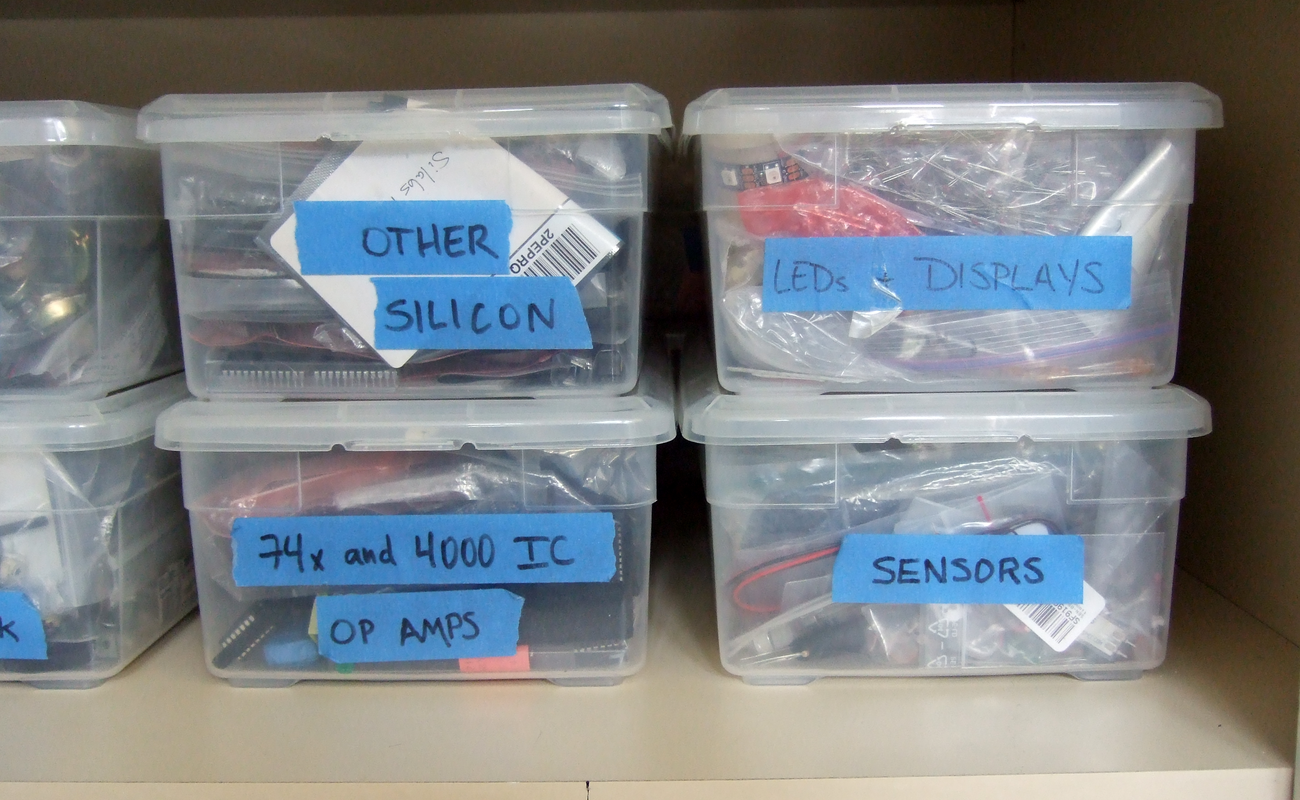
How do you organize your stock of components and modules? If an unruly pile of anti-static bags and envelopes from China stuffed into a cardboard box sounds familiar, then you need help from [Dimitris Tassopoulos]. He’s organized his parts into drawers and created a database, then linked it via an ESP8266 and a string of addressable LEDs to light up the individual drawer in which any given component resides. It’s a genius idea, as you can see in action in the video below the break.

Behind the scenes is a web server sitting atop an SQL database, with a PHP front end. It’s running on a Banana Pi board, but it could just as easily be running on any other similar SBC. The ESP8266 has a REST API to which the webserver connects when a component is sought, and from that it knows which LED to light.

The LED strip is not the tape with which most readers will be familiar, but a string of the type we might be more used to as Christmas lights. These have a 100mm spacing between LEDs, allowing them to be easily positioned behind each drawer. The result is a very effective parts inventory system. We’re not entirely sure that it would entirely banish the tide of anti-static bags here, but we’re impressed nevertheless.

Continue reading “Light The Way To Every Component”

New Part Day: LED Driver Is FPGA Dev Board In Disguise

Our new part of the day is the ColorLight 5A-75B, a board that’s meant to drive eight of those ubiquitous high-density color LED panels over gigabit Ethernet. If you were building a commercial LED wall, you’d screw a bunch of the LED panels together, daisy-chain a bunch of these boards to drive them, supply power, and you’d be done. Because of that high-volume application, these boards are inexpensive, around $15 each, and available as quickly as you can get stuff shipped from China.

But we’re not here to talk commercial applications. Managing fast Ethernet and pushing so many pixels in real time is a task best handled by an FPGA, and [Tom Verbeure] noticed that these things were essentially amazing FPGA development boards and started hacking on them. [q3k] put it up on GitHub, and you can follow along with the chubby75 reverse engineering project to dig into their secrets.

While the first generations of these boards used the old-standby Spartan 6, things got interesting for fans of open FPGA tools when newer versions were found using the Lattice ECP5-25 chips, the little brother of the stonking big chip [Sprite_TM] used on the 2019 Hackaday Supercon badge. If you want to grab one you’re looking for ColorLight boards marked with revision 6 or 7 as of this writing.

What does this mean? For the price of a gourmet hamburger, you get an FPGA that’s big enough to run a RISC-V softcore, two 166 MHz, 2 MB SDRAMS, flash for the FPGA bitstream, a bazillion digital outputs on 5 V level shifters, and two gigabit Ethernet ports. The JTAG port is broken out in 0.1″ headers, and it works with OpenOCD, which is ridiculously convenient. How’s that for a well-stocked budget FPGA dev board that’s served by a completely open toolchain? Continue reading “New Part Day: LED Driver Is FPGA Dev Board In Disguise”

What To Know When Buying Chips That Haven’t Been Made For Three Decades

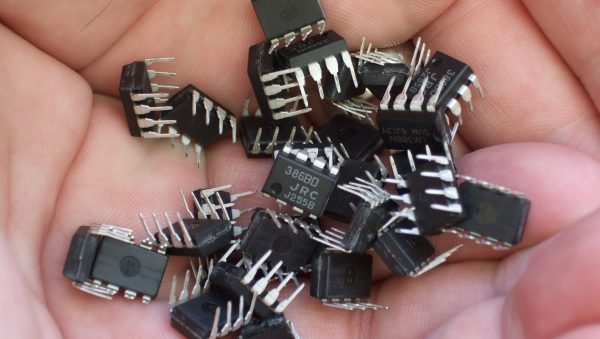
Those of us who have worked with vintage sound generator chips such as the Yamaha FM synthesizers in recent years have likely run into our own fair share of “fake” or “remarked” chips, sometimes relabeled to appear as a chip different than the die inside the packaging entirely. [David Viens] from Plogue has finally released his findings on the matter after 3 years of research. (Video, embedded below.)

The first thing to determine is in what way are these chips “fake”? Clearly no new YM2612’s were manufactured by Yamaha in 2015, but that doesn’t mean that these are simply unlicensed clones put out by another die factory. [David] explains how these chips are often original specimens sourced from recycled electronic waste from mostly environmentally unsafe operations in China, which are then reconditioned and remarked to be passed as “new” by resellers. Thankfully, as of 2017, he explains that most of these operations are now being shut down and moved into an industrial park where the work can be done in a less polluting manner.

The next thing that [David] dives into is how these remarked chips can be spotted. He explains how to use telltale signs in the IC packaging to identify which chip plant produced them, and visible indications of a chip that has been de-soldered from a board and reconditioned. There are different ways in which the remarking can be done, and sometimes it’s possible to undo the black-top, as it’s called, and reveal the original markings underneath with the simple application of acetone with a cotton swab.

We’ve talked about fake chips and how they can lead to hardware failure here before, but in the case of chips like these which aren’t manufactured anymore, we’re not left with much choice other than FPGA or software reimplementations. Check out [David]’s 40-minute look into these chips after the break.

Continue reading “What To Know When Buying Chips That Haven’t Been Made For Three Decades”

A Supercapacitor Might Just Light Your Way One Day

Sometimes the simplest hacks are the most useful ones, and they don’t come much simpler than the little supercapacitor LED flashlight from serial maker of cool stuff [Jeremy S. Cook]. Little more than an LED, a supercapacitor, USB plug, and couple of resistors, it makes a neat little flashlight that charges from any USB A power socket and delivers usable light for over half an hour.

It’s neat, but on its own there’s not much to detain the reader until it is revealed as a “Hello World” supercapacitor project from an article in which he delves into the possibilities of these still rather exotic components. Its point is to explore their different properties when compared to a battery, for example a linear voltage drop in contrast to the sharp drop-off of a chemical cell. In the video below the break we see him try a little boost regulator to deliver a constant voltage, with consequent severe loss of lighting time for the LED. It’s by this type of experimentation that we learn our way around a component unfamiliar to us, and the article and video are certainly worth a look if you’ve never used a supercapacitor before.

Continue reading “A Supercapacitor Might Just Light Your Way One Day”

Making Custom 3D Printed Slide Switches

For a little over a year now we’ve been covering the incredible replicas [Mike Gardi] has been building of educational “computers” from the very dawn of the digital age. These fascinating toys, many of which are now extremely rare, are recreated using 3D printing and other modern techniques for a whole new generation to enjoy and learn from.

He’s picked up a trick or two building these replicas, such as this method for creating bespoke slide switches with a 3D printer. Not only does this idea allow you to control a custom number of devices, but as evidenced in the video after the break, the printed slider sounds absolutely phenomenal in action. Precisely the sort of “clunk” you want on your front panel.

Of course, [Mike] doesn’t expect anyone to create this exact switch. He’s designed it as part of his Working Digital Computer (WDC-1) project that he’s documenting on Hackaday.io, so it has a rather specific set of design parameters. But with the steps he outlines in the write-up, you should have no problem adapting the concept to fit your specific needs.

So how does it work? One half of the switch is a track is printed with indents for both reed switches and 6 x 3 mm disc magnets. The other is a small shuttle that itself has spaces for two of the same magnets. When it slides over the reed switches they’re activated by the magnet on one side, while the magnet on the other side will be attracted to the one embedded into the track. This not only gives the switch detents that you can feel and hear while moving it, but keeps the shuttle from sliding off the intended reed switch.

If you like this, you’ll absolutely love his mostly 3D printed binary encoder that we featured recently. With his track record, we’re excited to follow the WDC-1 project as it develops, and thrilled that [Mike] has brought it to Hackaday.io.

Continue reading “Making Custom 3D Printed Slide Switches”

New Part Day: Sonoff USB Smart Adaptor Taps A New WiFi Chip

For decades, we dreamt of a future where all of our electronics used a standardized power connector. Most of us probably didn’t expect that USB would ultimately fill that role, but we’ll take what we can get if it means a future without getting a new wall wart for every piece of tech we buy. From soldering irons to laptops, the number of things you can power with a lowly USB cable these days is pretty incredible.

Which makes it all the more surprising it took so long for somebody to come up with a way to toggle USB devices off and on over the network. The Sonoff “USB Smart Adaptor”, which the company says will start shipping before the end of the year, is the logical evolution of their exceptionally popular mains voltage smart switches. The Smart Adapter is designed to go between the device and its existing power supply, allowing the user to drag any USB powered device kicking and screaming into their existing smart home setup. All for the princely sum of $6.50 USD.

In the video after the break, Sonoff gives a few potential uses of the Smart Adapter: from controlling a string of LEDs to limiting how long a smartphone is allowed to charge for. But really, there’s a nearly limitless number of devices which could be easily and cheaply integrated into your home automation routines thanks to this gadget.

On the other end of the spectrum, those who are looking to keep a tighter control on the ears and eyes that are active in their home could use the Smart Adapter to make sure their Google and Amazon listening devices assistants are only powered up during certain hours of the day.

Unfortunately, there’s a catch. Sonoff smart switches are best known, at least among the type of folks who read Hackaday, for the fact that they’re based on the eminently hackable ESP8266 microcontroller. Given the size of this product and its intended use, it would seem logical enough to assume this device also utilizes the insanely popular chip. But according to a Sonoff representative, the USB Smart Adapter won’t be using an ESP at all; leaving its hackability an open question until people can actually get their hands on them and start poking around.

Continue reading “New Part Day: Sonoff USB Smart Adaptor Taps A New WiFi Chip”