Converting An Atari 2600 Into A Home Computer; Did That Ever Work?

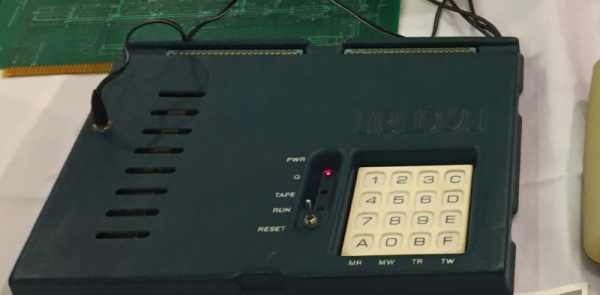
[Tony] posted an interesting video where he looks at the Atari 2600 and the way many companies tried to convert it into a real home computer. This reminded us of the ColecoVision, which started out as a video game but could expand to a pretty reasonable computer.

It might seem silly to convert a relatively anemic Atari video game into a computer, but keep in mind that computers were pretty expensive in those days. Not to mention, the Atari itself was a fair investment back then, too.

Continue reading “Converting An Atari 2600 Into A Home Computer; Did That Ever Work?”

A Tetris To Be Proud Of, With Only A Nano

Tetris may have first arrived in the West on machines such as the PC and Amiga, but its genesis at the hands of [Alexey Pajitnov] was on an Electronika 60, a Soviet clone of an early-1970s DEC PDP-11. Thus those tumbling blocks are hardly demanding in terms of processor power, and a game can be implemented on the humblest of hardware. Relatively modern silicon such as the Atmega328 in [c0pperdragon]’s Arduino Nano Tetris console should then have no problems, but to make that assumption is to miss the quality of the achievement.

In a typical home or desktop computer of the 1980s the processor would have been assisted by plenty of dedicated hardware, but since the Arduino has none of that the feat of creating the game with a 288p video signal having four gray scales and with four-channel music is an extremely impressive one. Beside the Nano there are only a few passive components, there are no CRT controllers or sound chips to be seen.

The entire device is packaged within a clone of a NES controller, with the passives on a piece of stripboard beside the Nano. There is a rudimentary resistor DAC to produce the grey scales, and the audio is not the direct PWM you might expect but a very simple DAC created by charging and discharging a capacitor at the video line frequency. The results can be seen and heard in the video below the break, and though we’re sure we’ve heard something like that tune before, it looks to be a very playable little game.

Continue reading “A Tetris To Be Proud Of, With Only A Nano”

The ZX Spectrum Next Arrives

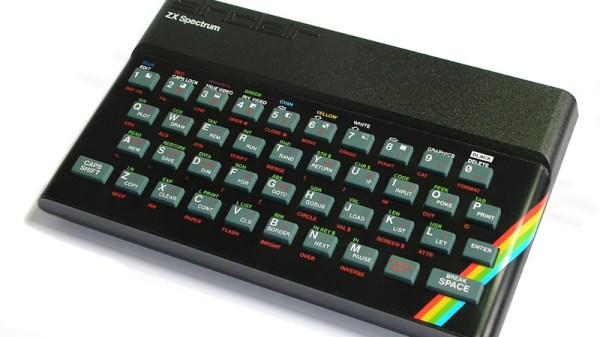
Sinclair Research was best known in the United States for the tiny ZX80, and the ZX81, under its Timex branding. However, they also made the ZX Spectrum which had many features that were — at the time — unusual. A few years ago there was a Kickstarter to recreate a modern version of the Spectrum, and [Nostalgia Nerd’s] new ZX Spectrum Next has finally arrived. As you can see in the first part of the hour-long video he was very excited about it. Almost too excited for YouTube.

The new incarnation of the Spectrum claims to be fully compatible with the original but also offers improved graphics modes, SD cards instead of tape, and an optional 7 MHz clock speed. The 512K of RAM would have been sinfully luxurious back in the day when the original model came with 16K, although the most iconic Spectrums would be the 48K models. The new version even has the option of taking a Raspberry Pi Zero to act as an accelerator.

Continue reading “The ZX Spectrum Next Arrives”

Hands-On: Smarty Cat Is Junior’s First Slide Rule

You may remember that I collect slide rules. If you don’t, it probably doesn’t surprise you. I have a large number of what I think of as normal slide rules. I also have the less common circular and cylindrical slide rules. But I recently picked up a real oddity that I had to share: the Smarty Cat. It isn’t exactly a slide rule but it sort of is if you stretch the definition a bit.

Real Slide Rules

A regular slide rule takes advantage of the fact that you can multiply and divide by adding logarithms. Imagine having two rulers marked in inches or centimeters — it doesn’t matter (see the adjoining image). Suppose you want to add 5 and 3. You count off 5 marks on one ruler and line it with up the zero inch mark on the other ruler. Now you count off 3 marks on the second ruler and that position on the first ruler will indicate the result. Here it lines up with the 8 mark, which is, of course, the correct answer.

That’s a simple addition. But if you can convert your numbers into logarithms, add the logarithms, and then back out to a regular number, you can multiply.

Continue reading “Hands-On: Smarty Cat Is Junior’s First Slide Rule”

A Z80 Computer At The Next Level

At the close of the 8-bit home computer era there were some machines produced that attempted to bridge the gap between the 8- and 16-bit worlds, either by providing a 16-bit device with a backwards compatibility mode, or an 8-bit one with enhanced capabilities to compete with its newer rivals. These products largely fell by the wayside in the face of new 16-bit only platforms, but they and the various enhanced versions of 8-bit processors that appeared over subsequent decades present a fascinating glimpse of what might have been. It’s a theme [Konstantin Dimitrov] explores with his Z20X computer project, a machine using the Zilog eZ80 processor running at 20 MHz, with 512 kB of external memory, and an interface for a 7″ TFT screen module.

The eZ80 is a more recent development, a pipelined processor capable of much higher clock speeds and addressing up to 16 MB of memory while maintaining software compatibility with the Z80. Had it come to market in the late 1980s it would have been a sensation, but instead it has appeared in embedded computers and perhaps of most interest to Hackaday readers, in TI’s line of programmable calculators.

The Z20X is designed to be a through-hole board, with the only SMD component the eZ80 itself. We can understand the motivation behind this, but at the same time wonder whether its likely builders in 2020 will be people unfazed by SMD assembly. It has a system of processor modules in case of future upgrades, and an expansion backplane with an option of an RC2014-compatible bus. There are also PS/2 keyboard and mouse connectors, a serial bus, and an on-board sound chip. The website is short on details of any software, but we’d expect it to work with the typical Z80 retrocomputer offerings such as a BASIC interpreter and the CP/M operating system.

This machine is likely to appeal to retrocomputing enthusiasts, but had it appeared even without the display in a previous decade it would no doubt have become an object of desire. It does however serve as a reminder that the Z80 line has been updated, and though most of us will have moved on it still offers a few chips that could be of interest. Meanwhile for a comparison, take a look at last year’s review of the latest in the range of RC2014 retrocomputer boards.

Thanks [yNos] for the tip.

Restoring The Coolest Laptop Ever

Well-seasoned readers will no doubt remember GRiD laptops, the once and always tacti-cool computers that dominated the military market for decades. GRiDs were the first laptops to go to space, and they were coveted for their sleek (for the time) good looks and reputation as indestructible machines.

The GRiDs went through many iterations, and even though their military roots make them nearly unobtanium, [Simon] scored a GRiD laptop and set about restoring it. His theme was the 1986 movie Aliens, which featured a few GRiD Compass computers as props. [Simon]’s 1550SX came a little later than the Compass 2, but documents with the machine reveal it was a Royal Air Force machine that had been deemed unserviceable for reasons unknown.

[Simon] carefully tore it down – pay close attention to the video below and you’ll hear the telltale plink of the magnesium case parts rather than the dull thud of plastic; they don’t make them like that anymore – and cleaned it up. He replaced the original display with a PiMoroni 10″ retro game display to keep the original 4:3 aspect ratio. A Raspberry Pi 4 went inside, along with a Teensy to take care of adapting the GRiD keyboard to USB and lighting up some front-panel LEDs. A second Teeny allows the original IsoPoint mouse to be used, which is a real gem. With the addition of appropriate graphics, the machine looks like it would be at home on a Colonial Marines dropship.

We love the retro feel of [Simon]’s build, and the movie nostalgia. We’re just glad he didn’t include a LiPo battery, which might not get along with the magnesium case. Game over, man!

Continue reading “Restoring The Coolest Laptop Ever”

C#, The Language For All Platforms – Now Including Windows 3.11 And DOS

The Microsoft .NET framework has been with us in one form or another since the millennium, and though it has remained largely the preserve of the Microsoft universe, it has found its way since then through a variety of implementations to other platforms including MacOS and GNU/Linux. In Microsoft terms though its history goes back only as far as Windows 98, earlier MS operating systems remain off-limits.

Just a glimmer of .NET in DOS and Windows 3.11 comes courtesy of [Michal Strehovský], who has successfully compiled .net C# code for both Windows 3.11 and DOS. An in-depth explanation comes courtesy of [Scott Hanselman], and it involves some tricks spanning the decades since the early 1990s. The .NET Core compiler’s object files can be fed into the linker that shipped with an ancient version of Microsoft’s C++ compiler, which when used with Microsoft’s Win32s compatibility layer that brought some of Windos NT’s APIs to the 16-bit OS, allows C# from 2020 to run as though it were 1992 again. Meanwhile the DOS version uses .NET Core’s ability to produce self-contained executables along with some very significant tricks to pare down the size of the finished program from many megabytes to an eventual DOS-suitable 27k. Remember the apocryphal Bill Gates quote, that “640k should be enough for anyone“, that refers to the maximum memory available to DOS without extra memory-extending tricks.

Neither piece of software is especially useful, and we can’t see a rush of C# coders to these new platforms. But we applaud him for his ingenuity, and getting old hardware to do new tricks is right up our alley. It’s certainly dredged up a few memories from back in the day for us. Meanwhile we’ve featured .NET in a few projects over the years, most recently on an FPGA.